Selling a house with solar panels is easy if you own the system outright and harder if it's financed or leased. Owned panels usually add value. A solar loan has to be paid off (or its UCC filing released) at closing. A lease or power purchase agreement (PPA) has to be transferred to the buyer, with the solar company's approval, or bought out. Start on the paperwork the week you decide to sell, not the week before closing.
I'm Christian Castro, a licensed California realtor (DRE #02195959) and the owner of Cash For Houses Fresno. Rooftop solar is everywhere in Fresno, and on the houses we buy, the solar contract is one of the first things we ask about because it decides how fast escrow can close. This guide covers each setup, what PG&E's net metering rules mean for your buyer and what the research says solar is worth.
The short answer
- Owned and paid off: the panels are part of the house and can add value. See owned systems.
- Financed with a solar loan: pay it off from your sale proceeds and make sure the lender's UCC-1 filing is terminated. See solar loans.
- Leased or PPA: the buyer takes over the contract after a credit check, or you buy it out. Buyouts often run $8,000 to $35,000. See leases and PPAs.
- PACE: usually has to be paid off at closing for a financed buyer. See PACE.
- Net metering: with PG&E, the 20-year NEM legacy period stays with the system, so the buyer gets whatever years are left. See net metering.
Step one: find out which kind of solar you have
A lot of owners, and almost every heir, aren't sure. Look at your paperwork and your bills:
| Setup | Who owns the panels | How you can tell | What happens at sale |
|---|---|---|---|
| Owned (cash) | You | Paid in full, no monthly solar bill | Panels go with the house |
| Solar loan | You, with a lender's security interest | Monthly loan payment; UCC-1 on title | Pay off or have the buyer assume; UCC terminated |
| Lease or PPA | The solar company | Monthly lease or per-kWh bill from Sunrun, Tesla, etc. | Transfer to the buyer or buy out |
| PACE | You, with a lien | Special assessment on the property tax bill | Usually paid off at closing |
If you can't find the contract, call the company on the inverter label or the monthly bill. Your property tax bill will show a PACE assessment, and a preliminary title report will show any UCC filing.
Selling with owned solar panels
This is the simple case. Owned, paid-off panels are a fixture of the house like the roof or the HVAC, and Fannie Mae says its standard appraisal, insurance and title rules apply. Gather the install date, system size in kilowatts, warranty papers and a year of PG&E bills, and give them to your agent or buyer. Those bills are your best marketing: a buyer can see what the house really costs to run in a Fresno summer.
Selling with a solar loan and a UCC-1 filing
When a solar loan is made, the lender usually records a UCC-1 fixture filing that gives it a security interest in the panels. It's not a mortgage, but it shows up on the preliminary title report, and title companies and the buyer's lender typically want it cleared before closing.
- Get a payoff quote early from the solar lender.
- Pay it off through escrow from your sale proceeds, like your mortgage. Our guide to selling a house with a mortgage explains how payoffs work.
- Confirm the UCC-3 termination. The lender should file a termination of the UCC-1. Get it in writing; a forgotten filing can hold up the next sale or refinance.
Some solar lenders allow a qualified buyer to assume the loan, but most buyers and their lenders prefer a clean payoff. Under Fannie Mae rules, a financed system that stays recorded counts in the buyer's debt and loan-to-value ratios, and any fixture filing ahead of the mortgage has to be subordinated. Old solar UCCs are one of the "liens" we see most; our guide to selling a house with a lien covers the rest.
Selling with leased solar panels or a PPA
With a lease or PPA, the solar company owns the equipment and you pay to use it or for the power it makes. Contracts usually run 20 to 25 years. When you sell, there are three paths:
- Transfer to the buyer. The buyer applies with the solar company, passes a credit review, and signs on for the rest of the term. Approval generally takes one to four weeks, and some providers look for a credit score in the mid-600s or higher, according to industry guides. Tell the solar company as soon as you accept an offer.
- Buy it out. You pay the remaining value and the panels become part of the house. Reported buyouts often run $8,000 to $35,000, depending on the company, system size and years left.
- Remove or relocate it. Some contracts allow this for a fee. It's rarely the best option.
Leases affect financed buyers in two ways. Fannie Mae requires the monthly lease payment to be counted in the buyer's debt-to-income ratio (a PPA paid only per kWh of power produced can be excluded), and it says the value of leased panels can't be included in the appraised value. So a lease doesn't raise your price, and it can shrink how much a buyer qualifies for. Plan for a slightly longer escrow, and put who handles the transfer, and who pays any fees, in the purchase contract.
Selling with a PACE solar loan
PACE (Property Assessed Clean Energy) loans, from programs like HERO and Ygrene, are repaid as a special assessment on your property tax bill and technically stay with the property. In practice, Fannie Mae won't buy a loan on a property with an outstanding PACE balance unless it's paid in full at or before closing, so most sellers with a financed buyer pay it off from escrow. Look for the assessment on your Fresno County property tax bill and order a payoff early.
What happens to net metering when you sell
Most Fresno homes are on PG&E, so the CPUC's net metering rules apply:
- Systems that applied before April 15, 2023 are on NEM 1.0 or NEM 2.0. NEM 2.0 customers can stay on it for 20 years from the date they interconnected.
- PG&E says the 20-year legacy period is "tied to the system, not the owner." If you've used 12 of the 20 years, the buyer gets the remaining 8.
- Systems that applied on or after April 15, 2023 are on the Net Billing Tariff (often called NEM 3.0), which pays less for exported power.
- AB 942 didn't change this for home sales. An early version would have moved buyers of NEM homes onto the newer tariff, but that provision was removed in committee in July 2025.
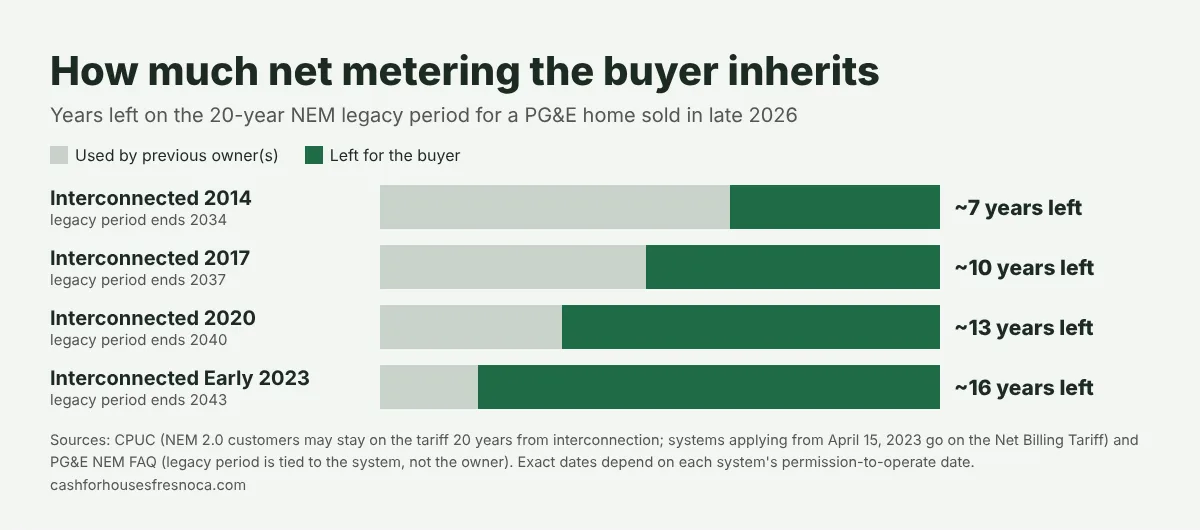
Tell buyers the interconnection date and give them the interconnection agreement. Adding panels later can cost the legacy status: PG&E says systems that grow by more than 1 kW or 10% move to the newer billing plan.
Do solar panels increase home value?
Owned solar usually does. The best-known study, Lawrence Berkeley National Laboratory's "Selling Into the Sun" (opens in a new tab), looked at 22,822 home sales in eight states, including 3,951 homes with solar, and found buyers paid about $4 per watt of installed solar, around $15,000 for an average 3.6 kW system.
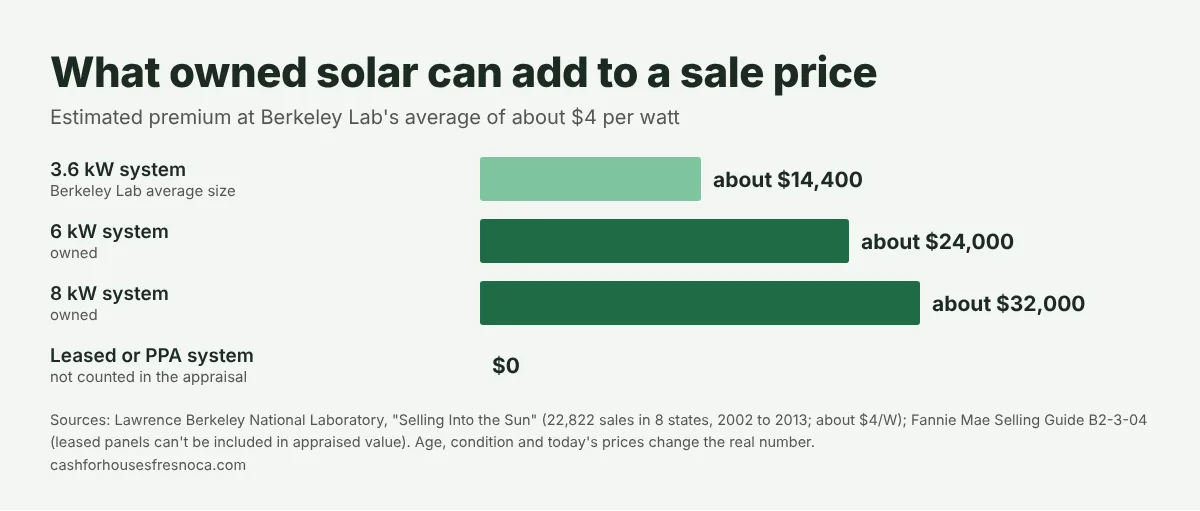
Treat that as a ceiling, not a promise. The study used sales through 2013, and panels lose value as they age. A 12-year-old system with a few years of warranty left isn't worth what a new one is, and a roof that needs replacing under the panels can wipe out the premium, since removing and reinstalling panels adds to the roofing bill. Many appraisers also aren't trained to value solar, so give yours the system specs and utility bills, and ask for one familiar with green features.
Selling a Fresno house with leased or financed solar?
We buy houses with solar leases, solar loans and PACE assessments as-is for cash, and we work the payoff or transfer through escrow with you. Close in as little as 7 days or on the date you choose. Call or text (559) 512-6998.
Call (559) 512-6998Get My All-Cash OfferDisclosures and documents to gather
California sellers must disclose known material facts, and a solar loan, lease, PPA or PACE assessment is one of them. Put it on the Transfer Disclosure Statement and the Seller Property Questionnaire. For a lease, buyers will want the company name, monthly payment, escalator, years left and transfer rules. Pull these together before you list:
- The solar contract (purchase, loan, lease or PPA) and any amendments
- Payoff quote or buyout quote, and the transfer application if leased
- System size, install date, panel and inverter warranties, and any roof penetration warranty
- PG&E permission-to-operate letter or interconnection agreement
- Twelve months of PG&E bills and the annual true-up statement
- Monitoring app login or production history
If you inherited the house, you may not know any of this. The estate or trust still has to sort it out before closing; our guides to selling an inherited house in Fresno and selling a house with a reverse mortgage cover the rest of that paperwork.
Selling a solar house for cash
A cash sale doesn't make a solar contract disappear. We still have to pay off a loan, terminate the UCC, clear a PACE assessment, or take over or buy out a lease. What changes is that no lender is counting the lease against our income or refusing to value the panels, so a contract that would slow down a traditional sale is just another line on the settlement statement.
If your house is in great shape and the panels are owned, listing will probably get you the most money; see our comparison of a cash offer vs. listing. If the house needs work, the lease is hard to transfer or you need to close fast, an as-is cash sale may be simpler. Our breakdown of how much it costs to sell a house helps you compare the two.
Get a cash offer on your Fresno solar home
Tell us about the house and the solar setup (owned, loan, lease, PPA or PACE). We'll send a no-obligation all-cash offer, handle the solar paperwork through escrow and pay the closing costs. Close in as little as 7 days or on the date you choose.
FAQ: selling a house with solar panels
Is it harder to sell a house with solar panels?
Not if the panels are owned and paid off; they usually help. It's harder with a lease or PPA, because the buyer has to qualify with the solar company and lenders count the payment as debt without adding the panels to the appraised value. Solar loans and PACE assessments usually just get paid off at closing.
What happens to leased solar panels when you sell your house?
The buyer usually takes over the lease after the solar company approves their credit, or the seller buys out the lease so the panels come with the house. Some contracts allow removal for a fee. Start the transfer as soon as you accept an offer.
How much does it cost to buy out a solar lease?
It depends on the company, the system and the years left. Industry guides report buyouts commonly ranging from about $8,000 to $35,000. Ask the solar company for a written buyout quote.
Do I have to pay off my solar loan when I sell?
Usually, yes. Most sellers pay it off from the sale proceeds through escrow, and the lender files a UCC-3 to terminate its UCC-1 filing. Some lenders allow a qualified buyer to assume the loan.
Does NEM 2.0 transfer to the new owner?
For PG&E customers, yes. PG&E says the 20-year net metering legacy period is tied to the system, not the owner, so the buyer gets the years remaining from the original interconnection date.
How much value do solar panels add to a house?
Berkeley Lab found buyers paid about $4 per watt, roughly $15,000 for an average 3.6 kW owned system, in sales through 2013. Leased panels add nothing to the appraised value under Fannie Mae rules. Age, condition and the roof all affect the real number.
Can I sell a house with leased solar panels for cash?
Yes. A cash buyer still has to take over or buy out the lease, but there's no lender to count the payment or exclude the panels. We buy Fresno-area houses with solar leases. Call or text (559) 512-6998.
Sources
- Lender treatment of owned, financed, leased, PPA and PACE solar: Fannie Mae Selling Guide B2-3-04, Special Property Eligibility Considerations (opens in a new tab).
- Net metering rules and the April 15, 2023 cutoff: California Public Utilities Commission (opens in a new tab); legacy period tied to the system and 1 kW / 10% expansion rule: PG&E NEM FAQ (opens in a new tab).
- Home value premium: Lawrence Berkeley National Laboratory, "Selling Into the Sun" (opens in a new tab).
- Lease transfer timing, credit review, buyout ranges, UCC-3 termination and AB 942 history: Grey Square (August 2026) (opens in a new tab), Helios Energy (opens in a new tab) and Helios Energy on AB 942 (opens in a new tab).
- Cover photo: modern building overhang (rawpixel, CC0, via the Jenn WordPress theme). It doesn't show a client's property. Charts by Cash For Houses Fresno.
Sharing this data? You're welcome to use the charts on this page. Please credit "Cash For Houses Fresno" and link back to this page.