Squatters rights in California are much weaker than the internet makes them sound. A squatter can only gain ownership through adverse possession, which takes five straight years of open, exclusive occupation plus paying all the property taxes for those five years. That almost never happens. But a squatter does have one real right: you can't throw them out yourself. Once someone is living in the house, you usually have to go through a court eviction, and that takes weeks or months.
I'm Christian Castro, a licensed California realtor (DRE #02195959) and the owner of Cash For Houses Fresno. We buy a lot of vacant, inherited and out-of-town-owner houses in the Central Valley, so we see occupied houses that the owner didn't know were occupied. This guide explains what the law says, what to do in the first 48 hours and what it really takes to get a squatter out. It's general information, not legal advice; for a live case, talk to a landlord-tenant attorney.
The short answer
- Ownership: a squatter needs 5 years of continuous, open, hostile, exclusive possession and must pay every property tax bill in that time. See adverse possession.
- Removal: if they just broke in, police may treat it as trespassing. If they've settled in or claim a lease, you'll likely need an unlawful detainer (eviction) case. See how to remove a squatter.
- Time: about 30 to 60 days if they don't fight it, 90 to 180 days if they do. See timeline.
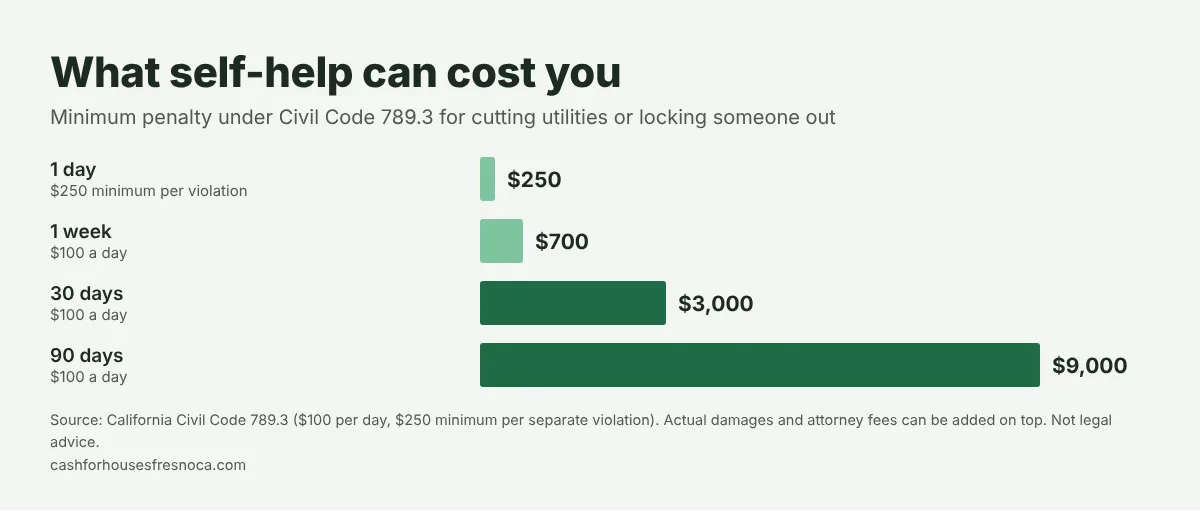
- Never self-help: changing the locks or cutting utilities can cost you $100 a day under Civil Code 789.3. See what not to do.
- No fast track yet: SB 448, a bill to let police remove squatters without an eviction case, died in February 2026. See 2026 law changes.
What counts as a squatter in California
A squatter is someone living in a property without the owner's permission and without paying rent under an agreement. The word isn't in the statutes. Legally, the person is either a trespasser or an occupant you have to evict, and which one depends on how they got in and how long they've been there.
| Situation | How the law usually treats it | Usual path out |
|---|---|---|
| Someone broke in recently and is clearly not living there | Trespass under Penal Code 602 | Police, if they agree to act |
| Someone moved in, set up a household, maybe has a fake or verbal "lease" | Civil dispute over possession | Unlawful detainer (eviction) case |
| A guest, relative or ex-partner you let in who won't leave | Usually a tenant or lodger, not a trespasser | Written notice, then eviction if needed |
| A former tenant who stopped paying | Tenant, with full tenant protections | Normal eviction (see our eviction guide) |
The hard part is that police can't decide who's telling the truth about a lease. If the person shows any paperwork, officers will usually call it a civil matter and leave. That's why so many owners end up in court even when the "lease" is obviously fake.
Adverse possession: can a squatter take your house?
This is the fear behind most searches for squatters rights in California, and it's mostly unfounded. Under California's adverse possession rules (Code of Civil Procedure sections 318 to 325 and Civil Code section 1007), a squatter can only gain title if all of these are true:
- Five years: they've possessed the property continuously for at least five years.
- Open and notorious: they live there openly, not in hiding.
- Hostile: they're there without your permission. A tenant or invited guest doesn't qualify.
- Exclusive: they occupy it as an owner would, not shared with you.
- Claim of right or color of title: they act as if it's theirs.
- Taxes paid: under CCP 325, they've paid all state, county and municipal taxes levied on the property during those five years.
The tax rule is where nearly every claim fails. If you, a lender's impound account or anyone else on your side has been paying the Fresno County tax bill, a squatter can't meet it. Practical tip: keep your own tax bills current and check them online. Our Fresno County property tax guide shows where to look and what happens when taxes go unpaid. A house with years of unpaid taxes and no one checking on it is the rare case where a claim gets anywhere.
A related and more common risk is deed fraud: someone records a forged deed to "own" a vacant house on paper. Sign up for the free alert described in our Fresno County Recorder guide so you're notified if anything is recorded on your parcel.
What to do in the first 48 hours
- Don't confront anyone alone. Don't go in, and don't argue at the door.
- Call the police right away. In Fresno, call Fresno PD (or the Sheriff in unincorporated areas). Say the house is vacant, you're the owner and nobody has permission to be there. Speed matters: officers are much more willing to treat a fresh break-in as trespassing than an occupant who has been there for weeks.
- Bring proof of ownership: a copy of the recorded deed, the latest tax bill and your ID. A utility bill in your name helps.
- Document everything: photos and video from outside, dates, names, vehicle plates and any "lease" they show.
- Get a report number even if police won't remove anyone. You'll want it in court.
- Call a landlord-tenant attorney if the person is still there after the police visit. Every day matters for the timeline below.

How to remove a squatter legally
If police won't act, the legal tool is an unlawful detainer lawsuit, the same fast-track case used to evict tenants. The usual steps:
- Serve a written notice to quit. For someone with no rental agreement, this is usually a 3-day notice (CCP 1161). Service has to be done correctly; bad service is the most common reason these cases get thrown out.
- File the unlawful detainer complaint in Fresno County Superior Court after the notice period runs out.
- Serve the summons and complaint with a Prejudgment Claim of Right to Possession (CCP 415.46). This covers anyone living there whose name you don't know. Occupants who don't file a claim within 10 days can be removed under the judgment.
- Wait for a response. Since AB 2347 took effect on January 1, 2025, defendants get 10 court days (not counting weekends and court holidays) to respond, up from 5.
- Get a judgment. If they don't respond, ask for a default judgment. If they do, the case goes to trial, normally within about 20 days of a request.
- Get a writ of possession and give it to the Sheriff (CCP 715.010).
- Lockout. The Sheriff posts a 5-day notice to vacate, then removes the occupants and hands you the house (CCP 715.020).
- Handle belongings left behind with a written notice of belief of abandonment under Civil Code 1980 and following. Don't just haul them to the dump.
Squatters in a house you want to sell?
We buy occupied Fresno-area houses as-is for cash, squatters and all. After closing, the problem is ours, not yours. Close in as little as 7 days or on the date you choose. Call or text (559) 512-6998.
Call (559) 512-6998Get My All-Cash OfferHow long it takes and what it costs
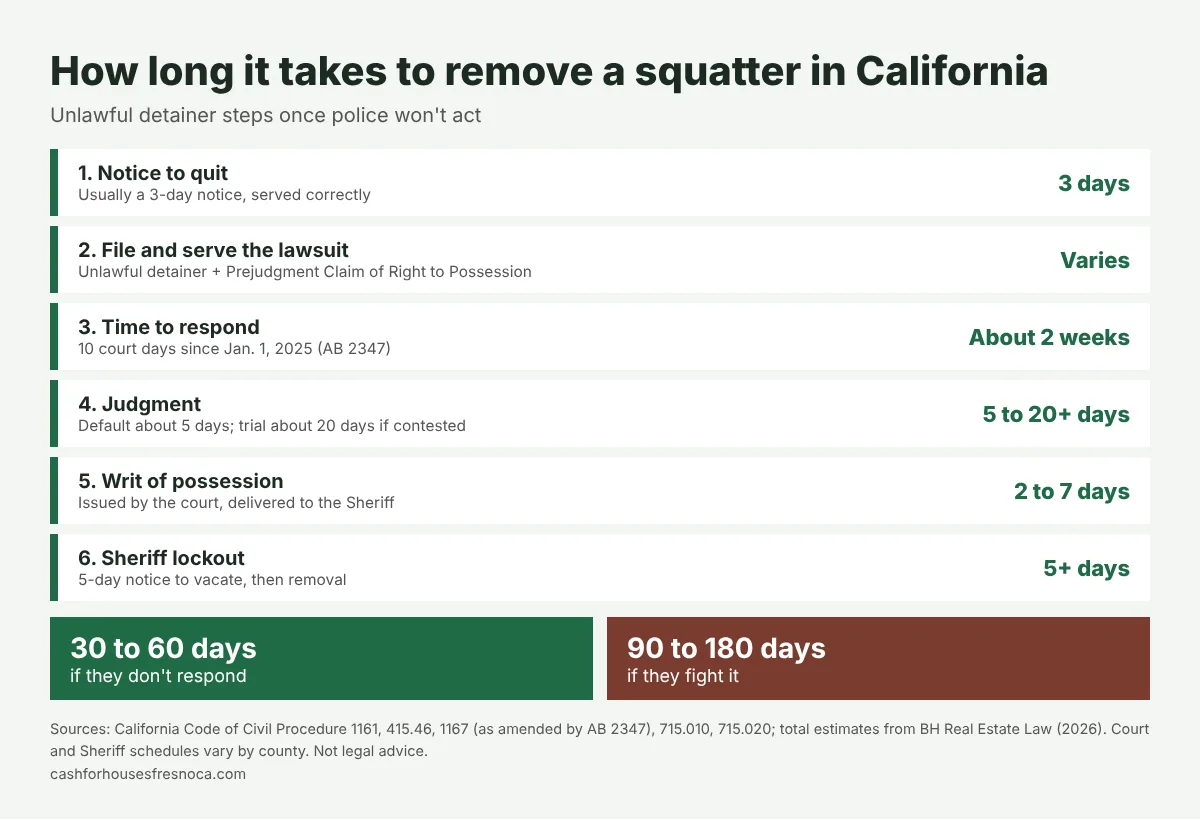
An uncontested case typically takes about 30 to 60 days from notice to lockout; a contested case can take 90 to 180 days, according to estimates from a Southern California real estate law firm. Fresno County court and Sheriff schedules vary, so treat those as ballparks.
Court filing fees come from the statewide civil fee schedule (effective January 1, 2026): $240 to file an unlawful detainer when the amount claimed is $10,000 or less, and $385 when it's over $10,000 up to $35,000. Add process servers, Sheriff fees and, in most cases, an attorney. Then add what the house is costing you while you wait: mortgage, taxes, insurance, utilities and damage.
What not to do
California bans "self-help" evictions, even against someone who has no right to be there. Under Civil Code 789.3, you can't shut off utilities, change the locks, take off doors or windows, or remove someone's belongings to force them out. Penalties include actual damages plus $100 for each day of the violation, with a minimum of $250 per violation. The occupant can also sue for forcible entry or detainer under CCP 1159 and 1160.
Also don't threaten anyone, don't let a friend "handle it," and don't sign anything that looks like a lease or accept money from the occupant. Taking rent can turn a squatter into a tenant.
Squatter laws in 2026: what changed and what didn't
- AB 2347 (in effect since January 1, 2025): doubled the response time in unlawful detainer cases from 5 to 10 court days. Good for tenants, slower for owners.
- SB 448 (Umberg), failed: would have let owners of residential property ask law enforcement to remove people with no lease or legal claim, without a full eviction case. It was held in the Senate Appropriations Committee in May 2025 and returned to the Secretary of the Senate on February 2, 2026 (opens in a new tab), which ended it.
- AB 897 (DeMaio), failed: would have required occupants without a lease to show proof of legal entry within three days. Legislators rejected it in committee.
So unlike Florida, which passed a fast affidavit-based removal law in 2024, California still has no shortcut. Plan on the eviction process.
How to keep squatters out of a vacant Fresno house
- Register the vacancy. The City of Fresno requires owners to register buildings expected to be vacant for more than 30 days. Registration is free; skipping it can bring a $250-a-month citation. See the city's Code Enforcement page (opens in a new tab).
- Secure it the city's way. Keep doors and windows locked and repaired. Fresno's vacant building rules don't allow plywood where it's visible from the street; use clear rigid material instead. Confirm with Code Enforcement for your property.
- Visit or have someone visit weekly. Most squatter cases start in houses nobody checks for months.
- Make it look lived in: mow the lawn, collect mail, keep a light on a timer.
- Add a camera and a monitored alarm so you know within hours, not weeks.
- Ask your police department about a trespass authorization letter. Many California departments accept a letter that lets officers act on trespassers when you're not there; under SB 602 (2023), one request for a vacant property can stay valid for up to 12 months.
- Tell the neighbors who to call if they see anyone.
Vacant houses also rack up code violations fast. If the city has already sent you a notice, our guide to selling a house with code violations explains your options.
Selling a house with squatters in it
You can sell a house that has squatters in it. It just limits who will buy. A buyer using a mortgage generally can't close on an occupied house they can't inspect or move into, and most agents won't list one. Your options:
- Remove them first, then sell. Best price, but you carry the costs and the time above, plus repairs for whatever damage they leave.
- Sell to a cash buyer as-is. An investor buys the house occupied, takes over the eviction and the cleanup, and you're done at closing. You'll get less than a fully repaired, vacant house would bring, so compare the numbers.
This comes up most with inherited houses that sat empty during probate, and with rentals where the "tenant" moved someone else in. If it's a former tenant, read our guide to selling a house with tenants instead, because the rules are different. And if you're a landlord who's just done, see our tired landlord page.
Have a Fresno house with squatters or unwanted occupants?
Tell us about the property. We'll send a no-obligation all-cash offer for the house as-is, occupied or not, and pay the closing costs. Close in as little as 7 days or on the date you choose.
FAQ: squatters rights in California
How long does a squatter have to live in a house to claim it in California?
At least five continuous years, and they must also have paid all the property taxes on it during those five years, along with meeting the other adverse possession requirements. In practice, if the owner keeps paying the tax bill, a squatter can't gain title.
Can police remove squatters in California?
Sometimes. If someone has just broken in, police may arrest or remove them for trespassing under Penal Code 602. If the person has moved in, claims a lease or the situation is unclear, officers usually call it a civil matter, and the owner has to file an unlawful detainer case.
How long does it take to evict a squatter in California?
Roughly 30 to 60 days if the squatter doesn't respond to the lawsuit, and 90 to 180 days if they fight it. Defendants have had 10 court days to respond since January 1, 2025, which added time compared with the old 5-day rule.
Can I turn off the utilities to get a squatter out?
No. California Civil Code 789.3 bars shutting off utilities, changing locks or removing doors and windows to force someone out. Penalties include actual damages plus $100 per day, with a $250 minimum per violation.
Is there a new squatter law in California in 2026?
No new fast-track law passed. SB 448, which would have let law enforcement remove people with no lease from residential property, failed on February 2, 2026. AB 897 also failed. The 10-court-day response time from AB 2347 has applied since 2025.
What if the squatter shows me a lease?
Don't argue about it at the door. Take a photo of it, report it to police and let a court decide whether it's real. A forged lease can be a crime, but you still usually need an unlawful detainer case to get possession.
Can I sell a house with squatters in it?
Yes. Most buyers with mortgages can't, but cash buyers can buy an occupied house as-is and handle the removal themselves. We buy Fresno-area houses with squatters. Call or text (559) 512-6998.
Sources
- Adverse possession: California Code of Civil Procedure sections 318 to 325 and Civil Code section 1007, as summarized by BH Real Estate Law (August 2026) (opens in a new tab) and CA Landlord Laws (opens in a new tab).
- Unlawful detainer steps, Prejudgment Claim of Right to Possession, writ and lockout timing, Civil Code 789.3 penalties and timeline estimates: BH Real Estate Law (opens in a new tab).
- Court filing fees: Judicial Council of California, Statewide Civil Fee Schedule effective January 1, 2026 (opens in a new tab).
- SB 448 history: CalMatters Digital Democracy (opens in a new tab); Senate Judiciary Committee analysis (opens in a new tab) (also the source for SB 602's 12-month request). AB 897: The Center Square (opens in a new tab).
- Fresno vacant building registration, $250 monthly citation and board-up rules: City of Fresno Code Enforcement (opens in a new tab) (checked November 2026).
- Photos: cover, chain-link fence (pxhere, CC0, via the Alleyoop WordPress theme); papers on a desk (rawpixel, CC0, via the Awburn WordPress theme). Neither shows a client's property.
Sharing this data? You're welcome to use the charts on this page. Please credit "Cash For Houses Fresno" and link back to this page.