Yes, you can sell a fire-damaged house in California without fixing it first, and in most cases you keep your insurance claim. California law even protects your replacement cost benefits when a home is a total loss and you buy a different house instead of rebuilding. What changes is who will buy it: most buyers using a mortgage can't finance a burned house, so your real choices are repairing and listing, listing as-is to investors, selling to a cash buyer, or selling the lot.
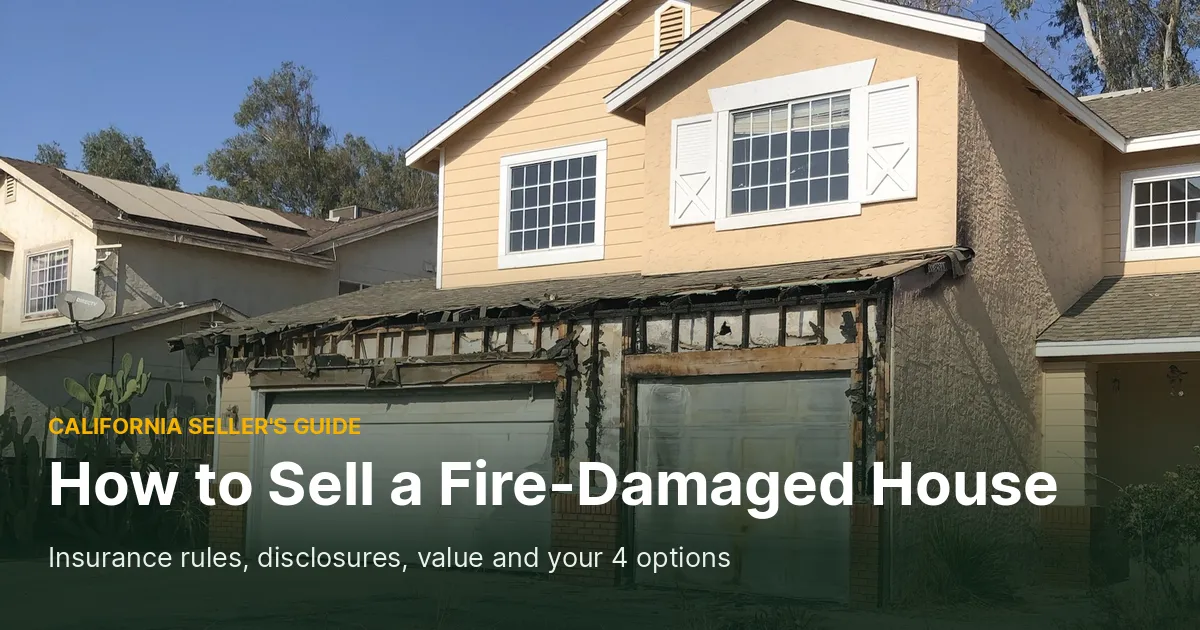
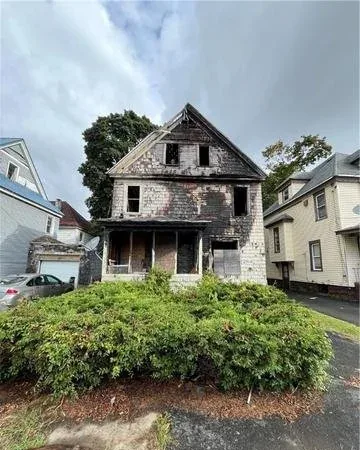
I'm Christian Castro, a licensed California realtor (DRE #02195959) and the owner of Cash For Houses Fresno. The house on the cover of this guide is one we bought ourselves: the garage had burned, the roof framing over it was charred, and the owner didn't want to spend a year managing contractors. This guide walks through what I tell every owner in that spot, with links to the state laws behind it. It's general information, not legal, tax or insurance advice, so check your own policy with your insurer or a licensed professional.
The short answer
- You can sell before repairs and usually before the claim is settled. Selling the house and settling the claim are two separate things.
- Your claim normally stays with you. The insurer pays the policyholder (and your mortgage lender, if you have one), not the buyer, unless you agree otherwise in writing.
- Replacement cost after a total loss: under Insurance Code 2051.5 (opens in a new tab), you can buy a home somewhere else and still collect, up to what it would cost to rebuild on your old lot.
- You must disclose the fire. California's Transfer Disclosure Statement asks directly about major fire damage, even if it was repaired.
- Value: a cash buyer works backward from the after-repair value. On a typical Fresno house with heavy fire damage, that often lands around half to two-thirds of the repaired value.
- Secure the house now. In Fresno, empty burned houses attract trespassers and repeat fires, and the city can fine owners of unsecured vacant buildings up to $10,000.
First steps after a house fire
House fires are more common than most people think. According to the National Fire Protection Association's 2024 numbers, reported by the National Safety Council (opens in a new tab), a home structure fire was reported somewhere in the U.S. every 96 seconds. In the days after one, a few things matter more than the sale:
- Get the fire report. Ask the fire department for the incident report number. Your insurer, any buyer and any lender will ask for it.
- Call your insurance company and open a claim. In California, the insurer has to acknowledge your claim within 15 days and start its investigation, under the state's fair claims rules (opens in a new tab).
- Don't throw anything away yet. Photograph every room and every damaged item before cleanup. Those photos become your contents inventory.
- Ask about living expenses. Most homeowners policies pay "additional living expenses" (ALE) while you can't live in the house: rent, hotel, extra food and mileage.
- Secure the property. Board windows and doors, fence the lot if needed, and shut off utilities you don't need. Your policy usually covers reasonable emergency board-up.
That last point is a big deal in Fresno. The Fresno Fire Department responded to 78 fires in vacant buildings out of 833 structure fires (opens in a new tab) in 2025 through mid-December, and city law requires owners of vacant buildings to register them, keep them up to fire code and secure them against trespassing, with fines of up to $10,000. A burned house that sits empty can catch fire a second time, and a second fire can complicate your claim.

How fire insurance works if you plan to sell
This is the part most owners worry about: "If I sell, do I lose my insurance money?" Usually not. The claim belongs to whoever owned the house and held the policy when the fire happened. When you sell, you're selling the real estate in its current condition. The insurance benefits for the damage, your belongings and your living expenses stay with you unless you sign them over. Still, policies differ, so tell your adjuster you're thinking about selling before you sign a purchase contract.
Actual cash value vs. replacement cost
Most California homeowners policies pay in two steps. First, the insurer pays the actual cash value (ACV) of the damage, which is the repair cost minus depreciation. Then, if your policy has replacement cost coverage, it pays the rest, called the holdback or "recoverable depreciation," once you actually repair or replace the home.
That second step is where selling gets tricky. If the house had partial damage and you sell it unrepaired, you'll usually collect the ACV but may not collect the holdback, because you never did the repairs. Ask your adjuster for the ACV and replacement cost numbers in writing so you know exactly what's at stake.
The California rule that helps sellers after a total loss
If the fire destroyed the house, California law gives you more flexibility. Under Insurance Code section 2051.5(c) (opens in a new tab), an insurer can't deny replacement cost or building code upgrade benefits just because you rebuild somewhere else or buy an already-built home at a new location. The payment is capped at what it would have cost to rebuild on your original lot, and for a home policy the insurer can't subtract the value of the land under your new house. This change came from SB 872 (opens in a new tab), passed after the 2017 and 2018 wildfires.
In plain English: after a total loss, many owners sell the burned property or lot, buy a different house, and still collect their replacement cost benefits. You still need to replace within the time limit (see below) and keep your receipts.
Your mortgage lender gets a say
If you have a mortgage, the insurance check will usually be made out to both you and your loan servicer. The Consumer Financial Protection Bureau (opens in a new tab) explains that servicers typically release repair money in stages as the work gets done. If you sell instead, the loan is paid off from the sale at closing, and the servicer should then release any insurance money it's holding. Keep making your mortgage payments while all of this happens. If you're already behind, our page on selling a house before foreclosure covers your options.
Not sure whether to rebuild or sell?
Call or text Christian at (559) 512-6998. You'll get an all-cash offer for the house as it sits and an honest estimate of what it would sell for repaired, so you can compare both against your insurance numbers.
Call (559) 512-6998Get My All-Cash OfferCalifornia fire claim deadlines
California sets minimum timelines for fire claims, and some of them are longer when the fire is part of a declared state of emergency, like a wildfire. These are floors, not ceilings: your policy can give you more time, and insurers have to grant extensions when you're acting in good faith and the delay is outside your control, like permit backlogs or a contractor shortage.
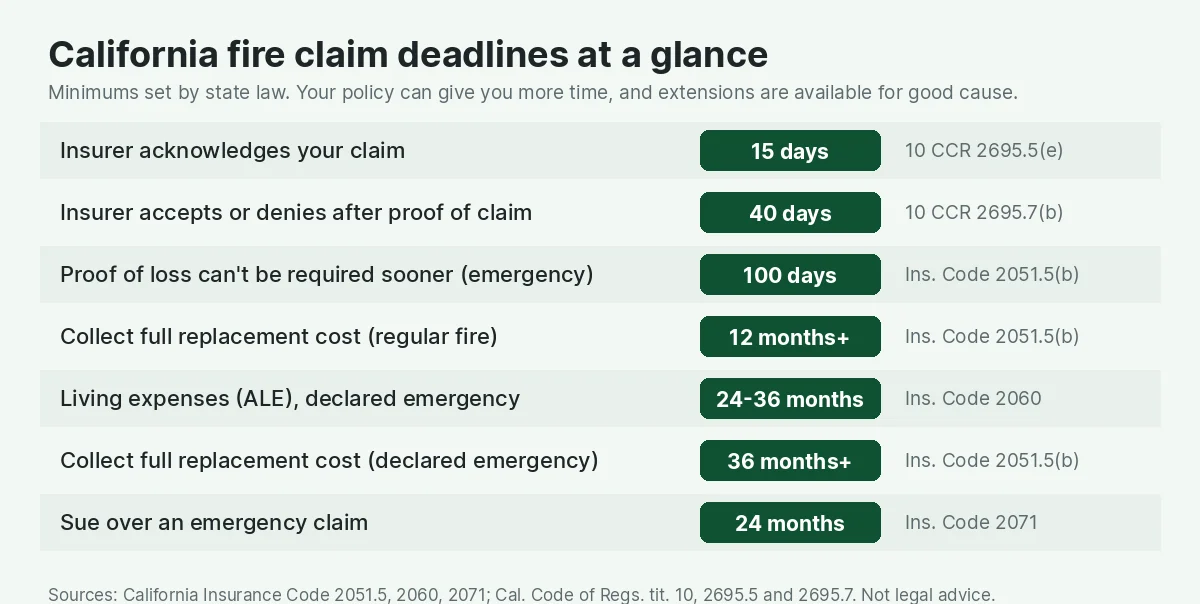
The two that matter most for a sale:
- Replacement cost: you have at least 12 months from the first ACV payment to collect full replacement cost, or at least 36 months after a declared emergency, plus six-month extensions for good cause (Ins. Code 2051.5(b) (opens in a new tab)).
- Living expenses: after a declared emergency, ALE runs for at least 24 months, with up to 12 more months for delays outside your control. For a regular house fire, the limit comes from your policy.
If you have questions about a claim, the California Department of Insurance's disaster insurance guidebook (opens in a new tab) is a good free resource, and the department takes complaints at 800-927-4357.
4 ways to sell a fire-damaged house
Every fire is different. A small kitchen fire with smoke damage is a very different sale from a house that's down to the studs. Here are the four realistic paths, and when each one makes sense.
| Item | Repair, then list | List as-is | Sell to a cash buyer | Sell the lot |
|---|---|---|---|---|
| Best for | Light to moderate damage, owners with time and insurance money | Moderate damage in a strong neighborhood | Heavy damage, no time, or no wish to manage a rebuild | Total loss or a house that has to come down |
| Typical timeline | Many months: estimates, permits, repairs, then a normal sale | Often slower than average; few buyers can finance it | As little as 7 days, or the date you choose | Depends on cleanup, then a land sale |
| Who buys | Regular buyers with loans | Investors and contractors, mostly cash | The cash buyer, directly | Builders, neighbors and investors |
| Agent commission | Yes | Yes | None | Usually |
| Price | Highest, minus what you spent | Discounted for damage and risk | Discounted for repairs, risk and speed | Land value only |
| Your work | Managing contractors and inspections | Showings, disclosures, cleanup | One walkthrough | Debris removal and disclosures |
1. Repair it, then list it
If the damage is mostly smoke, soot and one room, and your insurance pays enough to fix it, repairing and listing usually puts the most money in your pocket. It's also the slowest option. You'll get bids, wait on permits, live with surprises once walls are opened, and then list the house on top of that. As a realtor, I'll tell you honestly when this is the better move. Our guide to seller closing costs in Fresno shows what comes out of a listing at the closing table.
2. List it as-is
You can put a fire-damaged house on the open market as-is. The catch is financing. Most loans require the home to be safe and livable, so a house with fire damage often doesn't qualify. That leaves you mostly with cash investors anyway, but now you're paying a commission and waiting through showings to reach them.
3. Sell it to a cash buyer
A cash buyer purchases the house in its current condition, with no repairs, no cleanup and no lender. This is what we do at Cash For Houses Fresno. It makes the most sense when the damage is heavy, the repair estimate is bigger than the insurance payout, you've already moved on, or you simply don't want to spend the next year as a general contractor. If your house is in the Fresno area, here's how to sell your fire-damaged house as-is to us.
4. Sell the lot
If the house is a total loss, you may end up selling land. You'll want to know who is handling debris removal (your insurer, a government program after a declared disaster, or you), whether the lot has any code violations, and whether the utilities and permits are in order. A cash buyer can often buy before the debris is cleared, which saves you from fronting that cost.
How much is a fire-damaged house worth?
There's no single discount for fire damage, because no two fires are alike. Buyers figure value the same way they do for any house that needs work: start from what it would sell for fully repaired, the after-repair value (ARV), and subtract everything it takes to get there.
Offer = ARV − repairs − resale costs − holding costs − buyer's closing costs − buyer's profit
Here's an illustrative example on a house with a burned garage, smoke through the living areas and a damaged roof section. The ARV is $430,000, the August 2026 Fresno County median price from our Fresno housing market report.
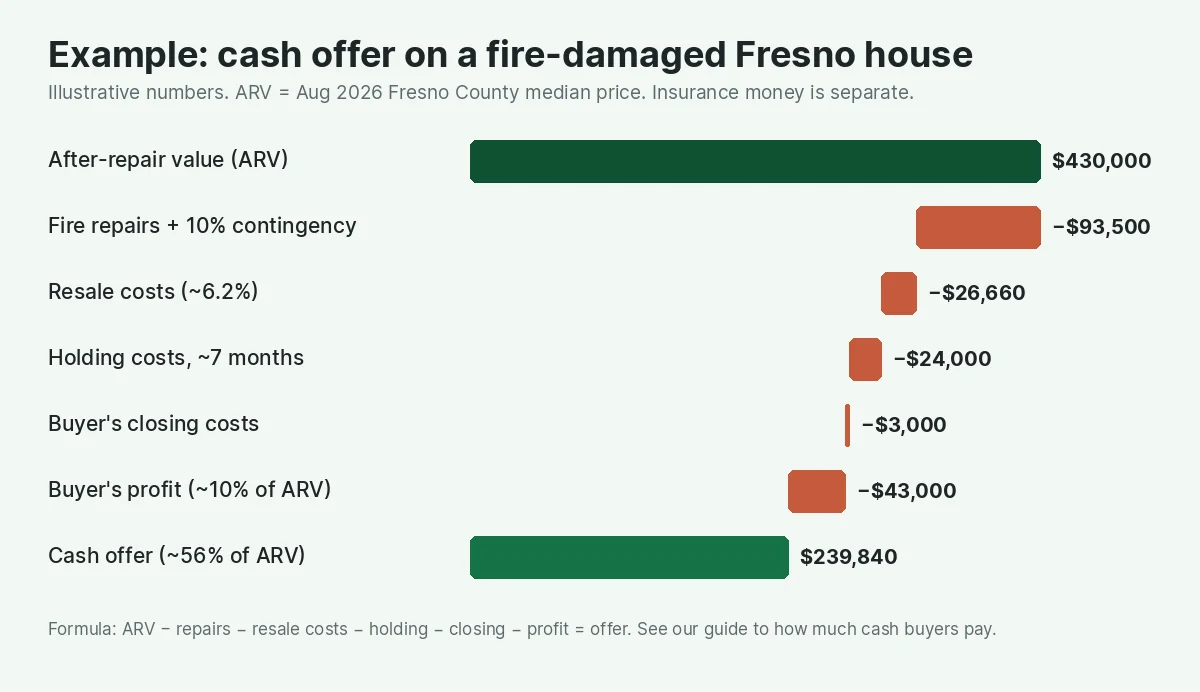
Fire jobs tend to come in lower than other repair jobs for three reasons:
- Hidden damage. Heat and water from firefighting can damage framing, wiring and drywall far from the burned room. Smoke odor gets into insulation and ductwork. Buyers add a bigger cushion for what they can't see.
- Permits and inspections. Structural and electrical repairs after a fire usually need permits, which adds months.
- Longer holding time. More months of loan interest, property tax, insurance and utilities. That's why the example uses about 7 months instead of the 5 to 6 months of a typical flip.
Two things work in your favor. First, the insurance money is separate. In most cases you collect your claim and the sale price, so compare the total, not just the offer. Second, you skip the commission, the repairs and the months of carrying costs. Our guide to how much cash buyers pay for houses breaks down each line of this formula, and our cash offer vs. listing comparison shows how to put the two paths side by side.
Get an all-cash offer on a fire-damaged house
Tell us about the property and the damage. We'll send a no-obligation all-cash offer for the house as it sits. You keep your insurance claim, there's nothing to fix or clean, and you can close in as little as 7 days.
What you must disclose in California
Selling "as-is" doesn't let you skip disclosures. Under Civil Code section 1102.6 (opens in a new tab), most California home sellers fill out the Transfer Disclosure Statement (TDS), and two of its questions come up after almost every fire:
- Item 9 asks whether you know of "major damage to the property or any of the structures from fire, earthquake, floods, or landslides." That covers past fires, even ones that were fully repaired.
- Item 4 asks about repairs made without the necessary permits. If any fire repairs were done without permits, that has to be disclosed too.
Disclose the date of the fire, what burned, what was repaired and by whom, and whether permits were finaled. Hand over the fire report and any insurance scope of loss. Being upfront protects you: a buyer who learns about an undisclosed fire after closing can sue. When we buy a fire-damaged house, we see the report before making an offer, so the damage is already priced in and won't come back as a surprise at closing.
If the house is in probate or you inherited it, the estate may be exempt from the TDS, but it still has to disclose known problems. Our guide to selling an inherited house in Fresno covers that situation.
Taxes when you sell after a fire
Taxes after a fire can get complicated quickly, so this is the section where a CPA earns their fee. A few things to raise with them:
- Insurance money can create a gain. If your insurance payout is more than your tax basis in the house, the IRS can treat the difference as a gain. IRS Publication 547 (opens in a new tab) explains casualties and insurance reimbursements.
- The home sale exclusion can still apply. If it was your main home, the usual exclusion of up to $250,000 of gain ($500,000 for married couples filing jointly) may cover the insurance money and the sale of what's left.
- Property tax relief. In California you can ask the county assessor to lower your assessed value after a fire or other disaster, and when you rebuild or buy a replacement home you may be able to keep your old base value. In Fresno, our Fresno County property tax guide covers calamity reassessment and the county's deadlines.
Step-by-step: selling your fire-damaged house
- Make it safe and secure. Board it up, fence it if needed and keep trespassers out.
- Open the claim and document everything. Fire report, photos, contents list, receipts for living expenses.
- Get the numbers in writing. Ask your adjuster for the ACV, the replacement cost and the holdback, and how a sale would affect each one.
- Get a repair estimate. Even a rough contractor bid tells you whether repairing and listing makes sense.
- Get an as-is offer and a listing estimate. Compare insurance + as-is sale price against insurance + repaired sale price − repair costs − months of carrying costs.
- Talk to your lender if you have a mortgage, so the payoff and any insurance funds they hold are handled cleanly at closing.
- Fill out disclosures honestly and attach the fire report and insurance scope.
- Pick your closing date. With a cash buyer, that can be as soon as about a week, or later if you need time to collect belongings or finish the claim.
We buy fire-damaged houses all over the Central Valley, from Fresno and Clovis to Madera, Visalia and Hanford. You can read more about Christian or contact us directly.
Ready to be done with the fire house?
Get an all-cash offer for the house as it sits. No repairs, no cleanup, no commissions, and you can close in as little as 7 days. Call or text (559) 512-6998.
Call (559) 512-6998Get My All-Cash OfferSelling a fire-damaged house: FAQ
Can I sell a fire-damaged house before the insurance claim is settled?
Yes. Selling the house and settling the insurance claim are separate. The claim normally stays with you, the policyholder at the time of the fire. Tell your adjuster before you sign a sale contract and ask how the sale affects any replacement cost holdback.
Do I keep the insurance money if I sell my fire-damaged house?
In most cases, yes. The insurer pays the policyholder, plus the mortgage lender if there is one. The buyer doesn't get your claim unless you assign it to them in writing. If you sell a partially damaged house without repairing it, you may not collect the replacement cost holdback, so get those numbers from your adjuster first.
Can I buy a different house instead of rebuilding and still get replacement cost in California?
After a total loss, yes. California Insurance Code 2051.5(c) says an insurer can't deny replacement cost benefits because you buy an already-built home at a new location. The payment is capped at what it would cost to rebuild on your original lot, and the insurer can't deduct the value of the land under your new home.
How much less is a fire-damaged house worth?
It depends on the damage. Buyers start from the after-repair value and subtract repairs, holding costs, resale costs and profit. A house with light smoke damage may sell close to normal value after cleanup, while a house with structural fire damage often sells to a cash buyer for roughly half to two-thirds of its repaired value.
Do I have to disclose a past fire when selling a house in California?
Yes. The California Transfer Disclosure Statement asks about major damage from fire, even if it was repaired, and about any repairs done without permits. Selling as-is doesn't remove the duty to disclose known problems.
Can you get a mortgage on a fire-damaged house?
Usually not until it's repaired. Most loans require the home to be safe and livable, which is why fire-damaged houses mostly sell to cash buyers, investors and contractors, or with a renovation loan.
How fast can I sell a fire-damaged house for cash in Fresno?
With Cash For Houses Fresno you can close in as little as 7 days, or on the date you choose. We buy the house as it sits, so there's no cleanup, no repairs and no commission.
Sources
- California Insurance Code: section 2051.5 (opens in a new tab) (replacement cost, time limits, rebuilding or buying elsewhere) and SB 872 (2020) (opens in a new tab).
- United Policyholders: Insurance claim rules in California (opens in a new tab) (ALE, claim handling deadlines, time to sue).
- California Department of Insurance: Disaster Insurance Guidebook (opens in a new tab).
- Consumer Financial Protection Bureau: How do home insurance companies pay out claims? (opens in a new tab)
- California Civil Code section 1102.6 (opens in a new tab) (Transfer Disclosure Statement).
- National Safety Council: Fire-related fatalities and injuries (opens in a new tab) (NFPA 2024 data).
- Fire Engineering: Unsecured buildings, absent owners lead to fires in Fresno (opens in a new tab) (December 2025).
- IRS: Publication 547, Casualties, Disasters, and Thefts (opens in a new tab).
Sharing this guide? You're welcome to use the California fire claim deadlines chart. Please credit "Cash For Houses Fresno" and link back to this page.