If you owe more on your house than it's worth and can't keep up the payments, it usually comes down to short sale vs. foreclosure. In a short sale, you sell the house for less than you owe with the lender's approval. In a foreclosure, the lender sells it at auction. For most California homeowners, a short sale is the better choice: you stay in control, you can qualify for a conventional mortgage years sooner, and California law bars the lender from coming after the shortfall in both cases. But it takes paperwork and patience, and it isn't always possible.
I'm Christian Castro, a licensed California realtor (DRE #02195959) and the owner of Cash For Houses Fresno. Below I compare the two side by side using the actual rules: Fannie Mae's waiting periods, California's anti-deficiency laws and the 2026 tax picture. It's general information; for your situation, talk to a real estate attorney and a tax professional.
The short answer
- Credit: both stay on your report for seven years. A short sale shows as "settled," a foreclosure as a foreclosure. See credit.
- Next mortgage: Fannie Mae makes you wait 4 years after a short sale and 7 after a foreclosure. See waiting periods.
- Deficiency: in California, a lender that approves a short sale on a 1 to 4 unit home can't sue you for the balance (CCP 580e). See deficiency.
- Taxes: the federal break for forgiven home mortgage debt expired at the end of 2025. See taxes.
- Have equity? Then you don't need either one. Just sell. See when to do neither.
Short sale vs. foreclosure: the basic difference
A short sale is a normal sale with one twist: the price won't cover the mortgage, so the lender agrees in advance to take less than it's owed and release its lien. You list the house, pick a buyer and close through escrow, but the lender has the final say on the price and terms.
A foreclosure is what happens when nothing else works. In California, it's almost always nonjudicial: the trustee records a Notice of Default, then a Notice of Trustee Sale, then auctions the house. Our guide to pre-foreclosure in California walks through that timeline step by step. The short version is that you can usually start a short sale at any point before the auction, and the earlier you start, the better your odds.
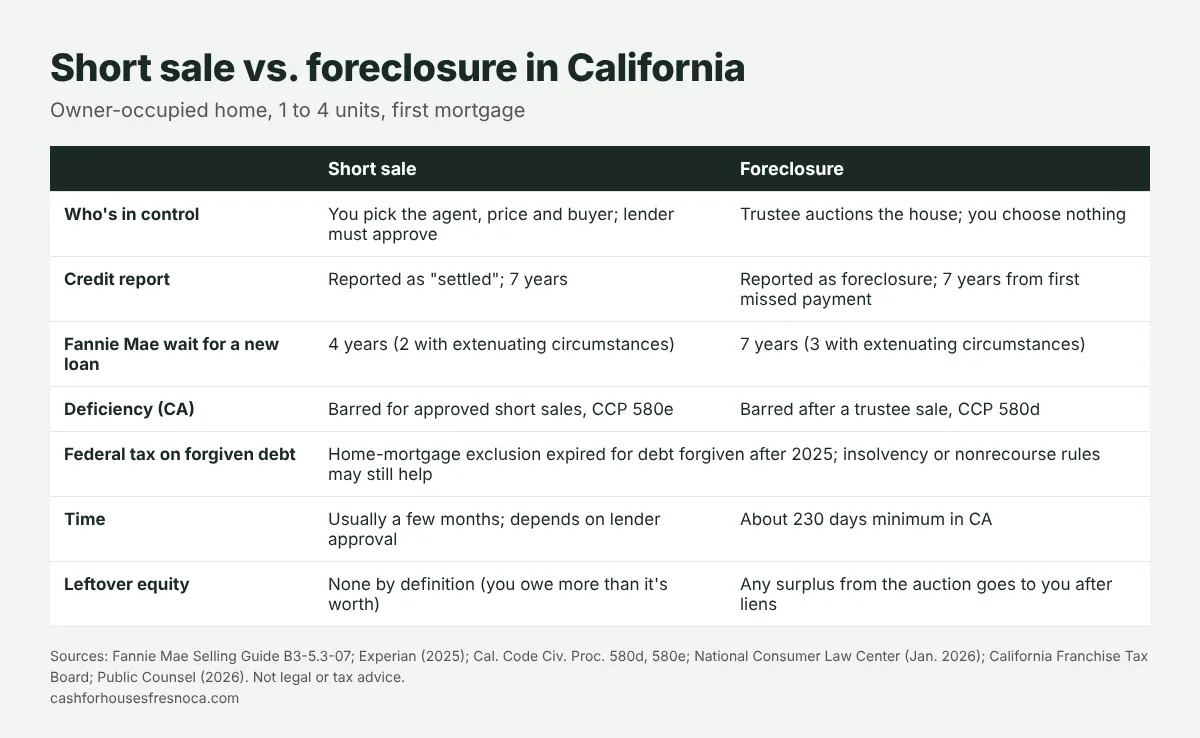
Side-by-side comparison
Credit impact
Here's where the internet oversells short sales a bit. Both show up for seven years. According to Experian (opens in a new tab), a short sale is reported as a settled account for seven years, while a foreclosure stays for seven years from the first missed payment that led to it. Experian says a short sale typically does less damage, and the harm tends to be smaller and shorter.
FICO's own research, though older (2011), found no significant difference in score drop between a short sale, deed in lieu and foreclosure, and said full recovery could take seven to ten years. The real-world reason is simple: by the time most people do a short sale, they've already missed several payments, and those late payments do much of the damage. A short sale done while you're still current, or only a month or two behind, hurts far less than one done after a year of missed payments.
So the credit report itself is close to a tie. The bigger difference shows up when you apply for your next mortgage.
How soon you can buy again
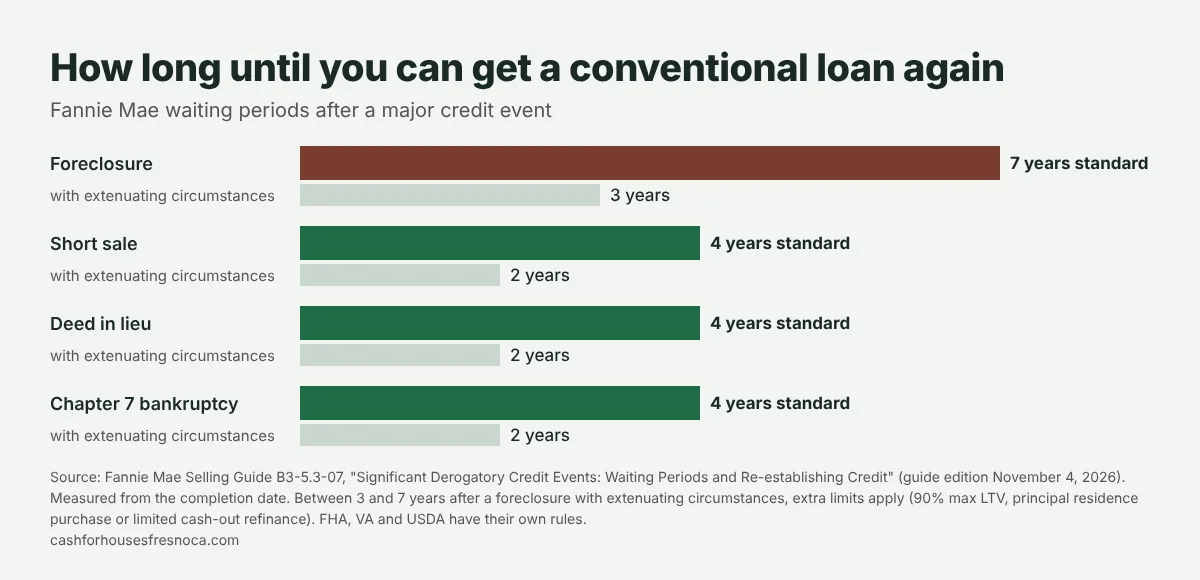
For conventional loans, the Fannie Mae Selling Guide (opens in a new tab) sets the rules:
- After a foreclosure: 7 years from the date it was completed. With documented extenuating circumstances (a one-time event beyond your control, like a job loss or serious illness), it can be 3 years, but between years 3 and 7 you're limited to a 90% loan-to-value purchase of a primary home or a limited cash-out refinance.
- After a short sale (Fannie calls it a "preforeclosure sale"): 4 years, or 2 years with extenuating circumstances.
- After a deed in lieu: 4 years, or 2 with extenuating circumstances.
That three-year gap is the clearest advantage of a short sale. FHA, VA and USDA loans have their own, generally shorter waiting periods, so ask a loan officer which program fits before you decide.
Deficiency: can the lender come after you?
A "deficiency" is the gap between what you owed and what the house brought in. In many states, the lender can sue you for it. California is one of the most borrower-friendly states here:
- Short sale: under Code of Civil Procedure 580e (opens in a new tab), when the holder of a loan secured by a dwelling of one to four units agrees in writing to a short sale and the proceeds are paid as agreed, no deficiency can be owed or collected. This applies to every lienholder that consents, including a second mortgage or HELOC. The lender also can't charge you extra for giving consent, and any waiver you sign is void. Exceptions: fraud, waste, and borrowers that are a corporation, LLC or limited partnership.
- Foreclosure: after a nonjudicial trustee sale, CCP 580d bars a deficiency judgment on that loan. Purchase-money loans on owner-occupied 1 to 4 unit homes are also protected under CCP 580b. But a junior lender whose lien is wiped out by the first lender's foreclosure may still be able to sue on a loan that isn't purchase money, such as a cash-out HELOC.
Read your short sale approval letter carefully. It should say the debt is satisfied or that the lender waives any deficiency. If anything in it asks you to sign a new note or pay a "contribution," talk to an attorney before signing.
Taxes on forgiven debt in 2026
When a lender forgives debt, the IRS can treat it as income, and you may get a Form 1099-C. For years the Mortgage Forgiveness Debt Relief Act shielded forgiven debt on a main home. That exclusion expired for debt discharged after December 31, 2025, unless it was discharged under a written agreement made before January 1, 2026, according to the National Consumer Law Center. A bill to bring it back (H.R. 917) was introduced in 2025 but hasn't passed.
That doesn't automatically mean a tax bill. Two things still matter:
- Recourse vs. nonrecourse. If the debt was nonrecourse (the lender's only remedy is the house), the forgiven amount is generally treated as part of the sale price instead of as cancellation income. California's anti-deficiency rules can make many home loans work this way. The California Franchise Tax Board says that since 2014 California generally doesn't tax forgiven nonrecourse debt, though part of forgiven recourse debt may be taxable.
- Insolvency. If your debts were bigger than the value of everything you owned right before the debt was forgiven, you can exclude forgiven debt up to that amount on IRS Form 982.
The same rules apply whether the debt is forgiven in a short sale or a foreclosure, so taxes are rarely the deciding factor between the two. They are a good reason to see a CPA before you close. If the house has gone up in value since you bought it, our guide to capital gains tax in California covers the other side of the tax picture.
Owe more than your Fresno house is worth?
We can buy it as part of a lender-approved short sale, or with cash if you still have equity. We'll show you the numbers both ways. Call or text (559) 512-6998.
Call (559) 512-6998Get My All-Cash OfferTime and control
A foreclosure follows the lender's schedule. In California the minimum is roughly 230 days from the first missed payment to the auction (Public Counsel, 2026), and many take much longer. You can stay in the house until the sale, but you don't choose the date, the price or the buyer, and auction houses usually sell at a discount.
A short sale follows a buyer's offer and the lender's review. Approval can take weeks to several months, especially with two lenders or a mortgage insurer involved. You choose the agent and the buyer, you can plan your move, and some lenders offer relocation money to help you leave. The risk is that the lender says no or takes so long that the foreclosure catches up. Keep the trustee informed, and since 2025 remember that a qualifying listing and purchase contract can postpone the auction (see AB 2424).

How a short sale works, step by step
- Get your numbers. Ask for a payoff statement for every lien and a realistic value from a local agent. Our Fresno housing market report has current prices.
- Call the servicer's loss mitigation department and ask for its short sale package.
- Gather documents: hardship letter, two years of tax returns, recent pay stubs and bank statements, and a financial statement.
- List the house with an agent who has done short sales, at a price the market will support.
- Accept an offer "subject to lender approval" and send it to the lender with your package.
- The lender orders a valuation (a broker price opinion or appraisal) and reviews the file. Expect counteroffers.
- Get the written approval letter, check it for deficiency language, then close escrow by the lender's deadline.
Here's an illustrative example (not a real deal): a Fresno house is worth $300,000 and the owner owes $330,000. Selling costs of about 7% ($21,000) mean the lender would net about $279,000, roughly $51,000 short. If the lender approves, the owner walks away owing nothing more on that loan under CCP 580e, though the lender may report the forgiven amount to the IRS. Our breakdown of seller closing costs in Fresno shows what goes into that 7%.
When you should do neither
A short sale only makes sense if you're underwater. Many Fresno homeowners who fall behind today actually have equity, because prices are much higher than they were a few years ago. If the house is worth more than everything you owe plus selling costs, don't let it go to auction and don't do a short sale. Sell it, pay off the loan in escrow and keep the difference. Our guide to selling a house with a mortgage shows how the payoff works.
Other options worth checking before either one:
- Loan modification, repayment plan or forbearance if the hardship is temporary. A free HUD-approved housing counselor can help.
- Deed in lieu of foreclosure if the house won't sell and the lender agrees to take it back. Fannie Mae treats it like a short sale for waiting periods.
- Chapter 13 bankruptcy if you want to keep the house and can catch up over three to five years.
- A fast cash sale if you have equity but the sale date is close or the house needs work. Compare a cash offer vs. listing first.
Our stop foreclosure in Fresno page lays out the local options in more detail.
Not sure which way to go?
Tell us about the house, what you owe and your sale date if you have one. We'll show you your numbers for a cash sale, a listing and a short sale, with no obligation.
FAQ: short sale vs. foreclosure
Is a short sale better than a foreclosure?
For most California homeowners, yes. You keep control of the sale, Fannie Mae lets you get a new conventional mortgage after 4 years instead of 7, and the lender can't pursue the shortfall on a 1 to 4 unit home under CCP 580e. A foreclosure takes less work on your part, but you have no say in the outcome.
Which hurts your credit more, a short sale or a foreclosure?
Both stay on your credit report for seven years. Experian says a short sale typically does less damage, while older FICO research found little difference in the score drop. The late payments before either event often cause most of the damage.
Can the lender sue me after a short sale in California?
Not for the deficiency, if the house has 1 to 4 units and the lender agreed to the short sale in writing. CCP 580e bars it for every lienholder that consents. Exceptions include fraud, waste and borrowers that are corporations or LLCs.
Do I have to pay taxes on a short sale in 2026?
Possibly. The federal exclusion for forgiven mortgage debt on a main home expired for debt discharged after 2025. You may still owe nothing if the debt was nonrecourse or you were insolvent. California generally doesn't tax forgiven nonrecourse debt. Ask a tax professional before closing.
How long after a short sale can I buy a house?
For a Fannie Mae conventional loan, 4 years after the short sale, or 2 years with documented extenuating circumstances. After a foreclosure, it's 7 years, or 3 with extenuating circumstances. FHA and VA loans have their own rules.
Can I do a short sale if the foreclosure date is already set?
Often, yes, but time is tight. Tell the trustee and lender right away. Since 2025, a signed listing delivered at least 5 business days before the sale can postpone it 45 days, and a qualifying purchase contract can add another 45.
Can a cash buyer do a short sale?
Yes. The lender still has to approve the price, but a cash buyer with no loan contingency can make approval and closing easier. We buy Fresno-area houses in short sales and in pre-foreclosure. Call or text (559) 512-6998.
Sources
- Waiting periods: Fannie Mae Selling Guide B3-5.3-07 (opens in a new tab) (guide edition November 4, 2026).
- Credit reporting: Experian, "Short Sale vs. Foreclosure" (opens in a new tab) (June 2025); FICO, "Research Looks at How Mortgage Delinquencies Affect Scores" (opens in a new tab) (2011).
- Deficiency: California Code of Civil Procedure 580e (opens in a new tab); CCP 580b and 580d.
- Taxes: National Consumer Law Center, "New Consumer Law Changes Taking Effect in 2026" (opens in a new tab); California Franchise Tax Board, Mortgage forgiveness debt relief (opens in a new tab); IRS Publication 4681.
- Foreclosure timeline: Public Counsel, "California Nonjudicial Foreclosure Process, Primary Mortgage" (updated June 12, 2026); AB 2424 (Civil Code 2924f).
- Photos: cover, "Manhattan Bridge Tower, Brooklyn" by Danny Lyon, June 1974, EPA DOCUMERICA project, public domain, via the Fotograma WordPress theme; green staircase (rawpixel, CC0, via the Jenn WordPress theme). Neither shows a client's property.
Sharing this data? You're welcome to use the charts on this page. Please credit "Cash For Houses Fresno" and link back to this page.