Pre-foreclosure is the stretch between falling behind on your mortgage and the day the house is sold at auction. In California it officially starts when the lender records a Notice of Default, and it lasts at least about four months after that, often longer. The good news: during pre-foreclosure the house is still yours. You can catch up, work out a deal with the lender, or sell it yourself and keep whatever equity you have.
I'm Christian Castro, a licensed California realtor (DRE #02195959) and the owner of Cash For Houses Fresno. I talk with Fresno-area homeowners in pre-foreclosure every month, and most of them have more time and more choices than they think. This guide walks through what pre-foreclosure means in California, the exact timeline, the 2025 law that can buy you extra weeks, and how to pick your way out. It's general information, not legal advice.
The short answer
- What it is: the period after a Notice of Default is recorded and before the trustee sale. You still own the house. See what pre-foreclosure means.
- How long: about 230 days minimum from the first missed payment to the sale, and often much longer. See the timeline.
- Catch up: you can reinstate the loan until 5 business days before the sale. See your rights.
- More time to sell: since 2025, a signed listing with a California broker can postpone the sale 45 days, and a qualifying purchase contract can add another 45. See AB 2424.
- Your way out: reinstate, modify, sell (on the market or for cash), short sale or deed in lieu. See your options.
What does pre-foreclosure mean?
Pre-foreclosure isn't a legal term in California's statutes. It's the industry name for the window between the lender starting a foreclosure and the house actually being sold. In California, almost every home loan is a deed of trust with a "power of sale," so lenders use nonjudicial foreclosure: no lawsuit, no judge, just a series of recorded notices and a public auction run by a trustee.
That's why the line is clear here. Once the trustee records a Notice of Default at the Fresno County Recorder, the house is "in pre-foreclosure." It becomes public record, which is also why homeowners suddenly get a flood of letters and postcards from investors. Before that notice, you're "delinquent" but not technically in pre-foreclosure.
| Stage | What has happened | Who owns the house |
|---|---|---|
| Delinquent | One or more missed payments, late fees, calls and letters from the servicer | You |
| Pre-foreclosure | Notice of Default recorded; later a Notice of Trustee Sale | You |
| Foreclosed | House sold at the trustee sale, or taken back by the lender (REO) | The auction buyer or the lender |
The pre-foreclosure timeline in California
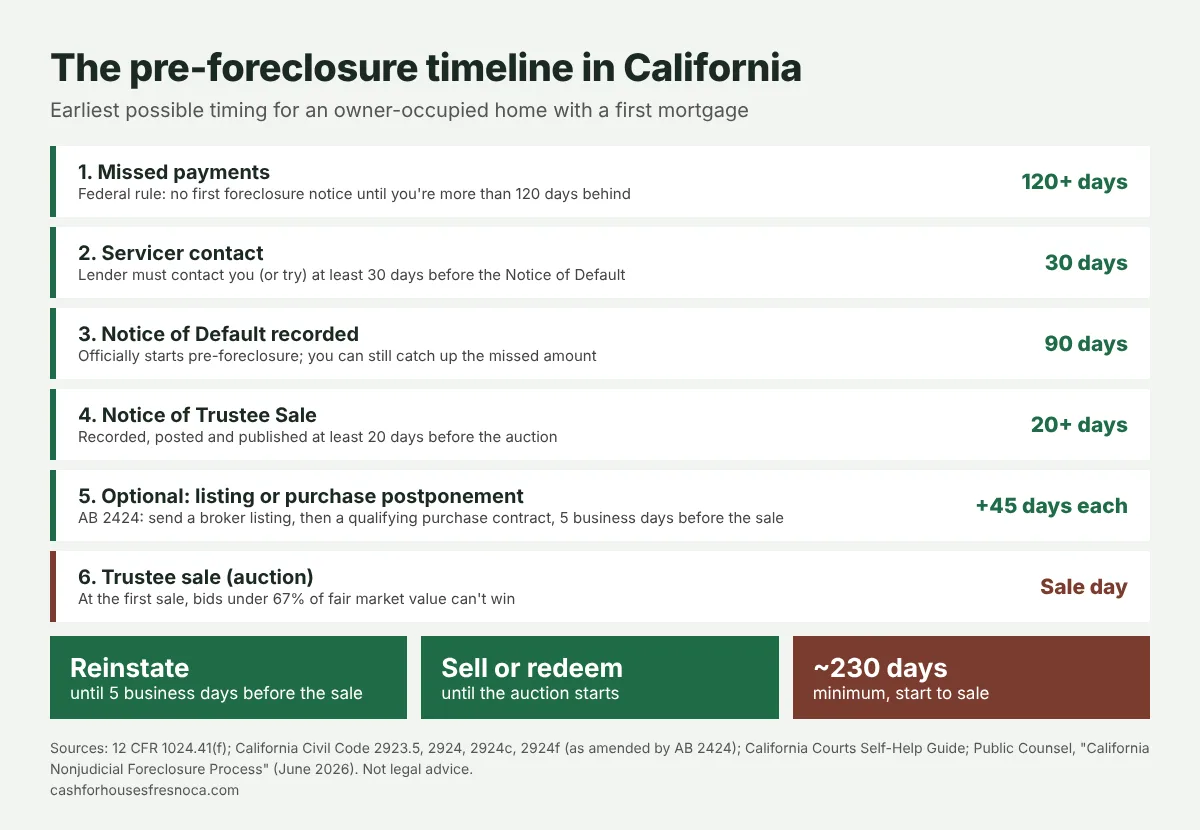
Here's how pre-foreclosure plays out for a typical owner-occupied house in California, step by step:
- You miss payments (at least 120 days). Under the federal mortgage servicing rule (12 CFR 1024.41(f)), a servicer generally can't make the first foreclosure filing until you're more than 120 days behind. During this time you'll get calls, late notices and a written notice about loss mitigation options.
- The servicer must contact you (30 days). California Civil Code 2923.5 requires the servicer to contact you, or make a diligent effort to, to talk about your finances and options at least 30 days before recording a Notice of Default. If you ask for another meeting, it has to happen within 14 days.
- Notice of Default (90 days). The trustee records the NOD with the county and mails you a copy within 10 business days. From here you have at least 90 days, about three months, before the next step. This is the heart of pre-foreclosure.
- Notice of Trustee Sale (20+ days). After the three months, the trustee can record a Notice of Trustee Sale with a sale date. It must be recorded, posted on the property and published at least 20 days before the auction (Civil Code 2924f).
- Possible postponements. Sales get postponed all the time: for loan modification reviews, bankruptcy filings, lender delays and, since 2025, a listing or purchase contract (more on that below).
- Trustee sale. The house is auctioned, usually at the county courthouse or a set public location. If no one bids enough, the lender takes it back.
Add it up and the minimum is roughly 230 days from the first missed payment to the auction, according to Public Counsel's 2026 California foreclosure timeline. In practice it's often longer. ATTOM found that foreclosures completed nationally in the second quarter of 2026 had taken an average of 563 days from the first public notice. Don't count on that, though. A California lender who stays on schedule can move much faster than the national average.
Your rights during pre-foreclosure
- You keep the house, and the right to live in it, until the sale. Nobody can make you move out during pre-foreclosure.
- Right to reinstate. Under Civil Code 2924c, you can stop the foreclosure by paying the past-due amount plus allowed fees and costs (not the whole loan) up until 5 business days before the sale. Ask the servicer for a written reinstatement quote.
- Right to redeem. Until the auction starts, you can pay off the entire loan, for example by selling or refinancing.
- Right to sell. You can list or sell the house at any point before the sale. The lender gets paid from escrow, and you keep the rest.
- No dual tracking. California's Homeowner Bill of Rights bars the servicer from moving ahead with a foreclosure sale while a complete first-lien loan modification application is pending.
- Single point of contact. When you ask for help avoiding foreclosure, the servicer must give you a single point of contact who knows your file.
- Surplus funds. If the house sells at auction for more than what's owed to all lienholders, the extra goes to you. It has to be claimed, so watch your mail after a sale.
The California Courts' self-help guide to nonjudicial foreclosure (opens in a new tab) covers these rights in plain English. A free HUD-approved housing counselor (opens in a new tab) can also read your notices and call the servicer with you.
Got a Notice of Default on a Fresno-area house?
We'll give you an honest look at every option, including the ones where you keep the house. If selling makes sense, we can make an all-cash offer and close before the sale date. Call or text (559) 512-6998.
Call (559) 512-6998Get My All-Cash OfferAB 2424: extra time if you're selling
Assembly Bill 2424 changed California's foreclosure rules starting January 1, 2025, for houses with one to four units. It gives owners who are actively selling a little more room, and it puts a floor under auction prices:
- 45-day postponement for a listing. If the trustee receives a copy of your signed listing agreement with a California licensed real estate broker at least 5 business days before the sale (sent by certified mail or a tracked overnight courier), and the listing is on a public marketing platform, the sale is pushed back at least 45 days. This can only be used once.
- Another 45 days for a purchase contract. If, after that, you deliver a fully signed purchase agreement at least 5 business days before the new sale date, the trustee has to postpone to at least 45 days after receiving it. The contract's price must cover the unpaid balance of all liens of record, and it must be accepted by an escrow holder. This can also only be used once.
- 67% minimum at the first auction. The lender must give the trustee a fair market value at least 10 days before the first scheduled sale, and the trustee can't sell for less than 67% of that value at that first sale. On a house worth Fresno County's September 2026 median of $429,450, that floor is about $287,700. If nobody bids that much, the sale is postponed at least 7 days and then goes to the highest bidder.
- Third-party notices. Servicers now have to tell borrowers that a relative, attorney or housing counselor can record a request to receive copies of the Notice of Default and Notice of Sale.
The two postponements only help if the sale price pays everyone off. If you owe more than the house is worth, you're in short sale territory instead. Our guide to short sale vs. foreclosure compares those two paths.
Pre-foreclosure in Fresno and California: the numbers
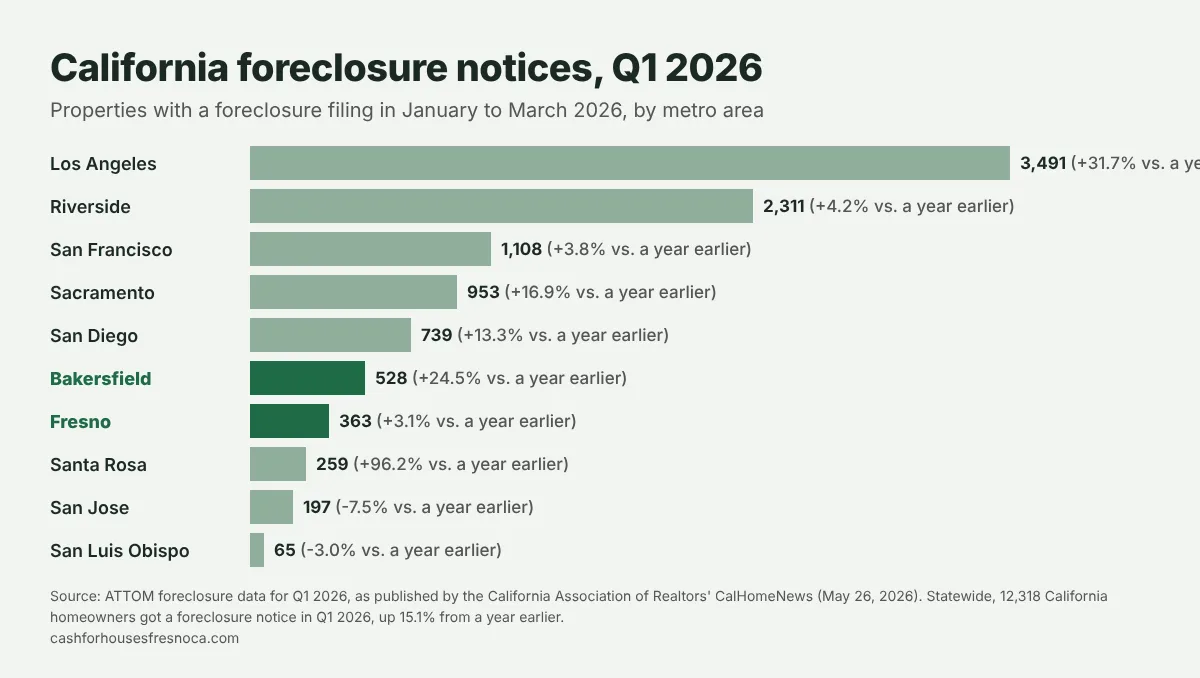
Foreclosure activity is rising again, though it's still far below the 2008 to 2012 wave:
- Fresno: 363 properties got a foreclosure notice in the first quarter of 2026, up 3.1% from a year earlier. Bakersfield had 528, up about 25% (CalHomeNews, May 2026 (opens in a new tab)).
- California: 21,543 properties had a foreclosure filing in the first half of 2026, about one in every 680 housing units. Foreclosure starts were 16,040, third-most in the country behind Florida and Texas (ATTOM, July 2026 (opens in a new tab)).
- Latest month: in August 2026, 2,565 California properties started the foreclosure process (ATTOM, September 2026 (opens in a new tab)).
Most Fresno homeowners in pre-foreclosure today still have equity. Home values are well above where they were five or ten years ago, so the real risk for many families isn't owing too much. It's losing equity they already have at an auction, where houses usually sell at a discount and fees pile up. Check the Fresno housing market report to see roughly what your house could sell for.

How to get out of pre-foreclosure
Which option fits depends on two questions: can you afford the house going forward, and do you have equity (is the house worth more than everything you owe)?
| Option | Best when | Keep the house? | Keep your equity? |
|---|---|---|---|
| Reinstate | You can pay the past-due amount now | Yes | Yes |
| Repayment plan or forbearance | Short-term hardship that's ending | Yes | Yes |
| Loan modification | Income is steady but the payment is too high | Yes | Yes |
| Sell on the open market | You have equity and 2 to 4 months | No | Yes, most of it |
| Sell for cash | You have equity but little time, or the house needs work | No | Yes, minus the investor discount |
| Short sale | You owe more than it's worth | No | None to keep |
| Deed in lieu | Underwater, no buyer, lender agrees | No | None to keep |
| Chapter 13 bankruptcy | You want to keep it and can pay arrears over 3 to 5 years | Often | Yes |
If you want to keep the house, call the servicer and a housing counselor first, and get any deal in writing. Send a complete loss mitigation application as early as you can; the dual-tracking protection only applies once it's complete.
If you have equity and want out, selling before the auction almost always beats letting it go. Listing usually brings the highest price if you have time and the house shows well; with AB 2424, a signed listing can also buy you 45 days. A cash sale trades some price for speed and certainty, which matters when the sale date is close or the house needs repairs. Our side-by-side of a cash offer vs. listing and our guide to how much cash buyers pay show the real math. For how the payoff works at closing, see can you sell a house with a mortgage.
If you're underwater, a short sale or deed in lieu usually does less damage than a completed foreclosure. Also check for other liens, such as a second mortgage, HELOC, tax lien or judgment; they all have to be dealt with at closing. Our guide to selling a house with a lien explains how. If you're behind on property taxes too, see our Fresno County property tax guide.
Our stop foreclosure in Fresno page has local resources and what we can do when time is short. Going through a divorce at the same time? See selling a house during a divorce.
Facing a trustee sale date in the Fresno area?
Tell us about the house and your sale date. We'll send a no-obligation all-cash offer, pay the closing costs and can close before the auction, so the rest of your equity goes to you, not the lender.
Selling to an investor in pre-foreclosure: your protections
California has a special law for this exact situation. The Home Equity Sales Contract Act (Civil Code 1695 and following) applies when an investor buys an owner-occupied home of one to four units after a Notice of Default has been recorded. It requires a written contract in a set format, in the same language you negotiated in, and it gives you the right to cancel the contract until midnight of the fifth business day after you sign it, or 8 a.m. on the day of the trustee sale, whichever comes first. The buyer also can't take a deed from you or pay you until that cancellation period ends.
A legitimate buyer will follow these rules without being asked. If someone rushes you to sign a deed at your kitchen table, that's a red flag.
Pre-foreclosure scams to avoid
Once a Notice of Default is recorded, your name and address are public, and scammers read the same records investors do. Watch out for:
- Upfront fees for "saving" your house. California bars foreclosure consultants from collecting a fee until they've fully done what they promised (Civil Code 2945.4). Housing counselors are free.
- "Sign the deed over and rent it back." Some schemes take title, collect rent and never pay the mortgage, leaving you evicted and the loan still in your name.
- "Stop paying your lender and pay us." No legitimate company asks you to send them your mortgage payment.
- Forensic loan audits and "secret" legal theories that promise to wipe out your mortgage.
- Anyone who won't put the full deal in writing or tells you not to talk to a lawyer, counselor or family member.
Before you sign anything, look up the person's license on the California Department of Real Estate website and read every page. Here's who I am and how we work.
FAQ: pre-foreclosure
What does pre-foreclosure mean?
Pre-foreclosure is the period after a lender starts foreclosure, in California by recording a Notice of Default, and before the house is sold at a trustee sale. The owner still owns and can live in the house, and can still catch up, negotiate with the lender or sell during this time.
How long does pre-foreclosure last in California?
At least about 110 days from the Notice of Default to the sale (90 days, then a Notice of Sale at least 20 days before the auction), and roughly 230 days from the first missed payment. Postponements often make it longer, and a signed listing or purchase contract can add 45 days each under AB 2424.
Can I sell my house in pre-foreclosure?
Yes. You can sell any time before the trustee sale. The lender is paid from escrow, and you keep the remaining equity. If you owe more than the house is worth, the lender has to approve a short sale.
How late can I stop a foreclosure in California?
You can reinstate by paying the past-due amount plus fees until 5 business days before the sale. After that, you can still stop it by paying off the whole loan, for example through a sale that closes before the auction.
Does pre-foreclosure hurt my credit?
The late payments that lead to pre-foreclosure already hurt your credit, and they stay on your report for seven years. Getting out before a completed foreclosure avoids a foreclosure entry on top of them.
Why am I getting so many letters from house buyers?
A Notice of Default is a public record, and investors and agents watch those filings. Some letters are legitimate, some are scams. Never pay an upfront fee to stop a foreclosure, and know you can cancel a contract with an investor for five business days under California's Home Equity Sales Contract Act.
Can you buy a house to stop a pre-foreclosure in Fresno?
Yes. We buy Fresno-area houses in pre-foreclosure for cash, as-is, and can usually close before the trustee sale if there's enough time to open escrow and get a payoff. Call or text (559) 512-6998.
Sources
- Foreclosure steps, contact requirement, 90-day period, notice of sale, reinstatement and redemption: California Courts Self-Help Guide (opens in a new tab); California Civil Code 2923.5, 2924, 2924c and 2924f.
- 230-day minimum timeline and AB 2424 postponements: Public Counsel, "California Nonjudicial Foreclosure Process, Primary Mortgage" (updated June 12, 2026).
- AB 2424 text (45-day postponements, 67% fair market value rule, third-party notices): AB 2424 enrolled text (opens in a new tab); Snell & Wilmer summary (opens in a new tab).
- 120-day federal rule: 12 CFR 1024.41(f) (CFPB Regulation X).
- Foreclosure data: ATTOM Mid-Year 2026 report (opens in a new tab) (California filings and starts; 563-day national average in Q2 2026), ATTOM August 2026 report (opens in a new tab), and CalHomeNews (opens in a new tab) (Q1 2026 metro notices).
- Investor contract rules and consultant fees: California Civil Code 1695 to 1695.17 (Home Equity Sales Contract Act) and 2945.4.
- Photos: cover, apartment facade (rawpixel, CC0, via the Jenn WordPress theme); lamp and shutters (rawpixel, CC0, via the Margarethe WordPress theme). Neither shows a client's property.
Sharing this data? You're welcome to use the charts on this page. Please credit "Cash For Houses Fresno" and link back to this page.