
Can you sell a house with a mortgage? Yes, and most people do. You don't have to pay off the loan before you list. When the house sells, the escrow company uses the buyer's money to pay your lender in full, and you get whatever is left. The real question isn't whether you can sell. It's how much you'll walk away with after the payoff and selling costs, and what to do if that number comes out negative.
I'm Christian Castro, a licensed California realtor (DRE #02195959) and the owner of Cash For Houses Fresno. Almost every house I buy still has a loan on it, and some have two or three. This guide walks through how selling a house with a mortgage works in California, step by step, with the legal deadlines your lender has to meet, a Fresno example at four different loan balances, and your options if you're underwater or behind on payments. It's general information, not legal or tax advice.
The short answer
- Yes, you can sell a house with a mortgage. Escrow pays off the loan at closing out of the sale price. You never write the lender a check unless you owe more than the house nets.
- Your lender has deadlines. It must send a payoff statement within 7 business days of a written request, refund your escrow account within 20 business days of payoff, and, in California, get the lien released within about 30 to 51 days. See the payoff timeline.
- Selling costs come out first. On Fresno County's $429,450 median, listing costs run about $29,200. If you owe more than about $400,000, you could be short at closing even though the house is worth more than the loan.
- Owe too much? You can bring cash, ask the lender for a short sale, or in some cases let a buyer assume an FHA or VA loan.
- Behind on payments? You can still sell, right up to the foreclosure sale date, if the price covers the reinstatement or payoff. See selling while behind.
How selling a house with a mortgage works
When you take out a mortgage in California, you sign two documents: a promissory note (your promise to repay) and a deed of trust, which makes the house the lender's collateral. You still own the house. The lender just has a lien on it, recorded with the county, that has to be cleared before anyone else can take clean title.
That's why selling a house with a mortgage is routine. A buyer's title company won't insure the sale until every recorded loan is paid or otherwise released, so paying off your mortgage is built into every California escrow:
- You accept an offer and open escrow. You give the escrow officer your lender's name and loan number and sign an authorization so they can talk to the lender for you.
- Escrow orders a payoff demand. This is the exact amount needed to pay the loan off as of a certain date, including interest and fees.
- Title runs a search and lists every lien against the property: your first mortgage, any second mortgage or HELOC, unpaid property taxes, judgments and so on.
- At closing, the buyer's money comes in (from their lender or their own cash), and escrow pays everyone in order: your lender, any other liens, the commissions and closing costs, then you.
- The lien is released. Your lender signs off and the trustee records a reconveyance, which clears the deed of trust from the county records.
You keep making your normal monthly payments until the sale closes. Missing one because "the house is selling anyway" just adds late fees and interest to the payoff, and can ding your credit.

The payoff timeline and your lender's legal deadlines
Federal and California law put real deadlines on each step, which helps when a servicer drags its feet.
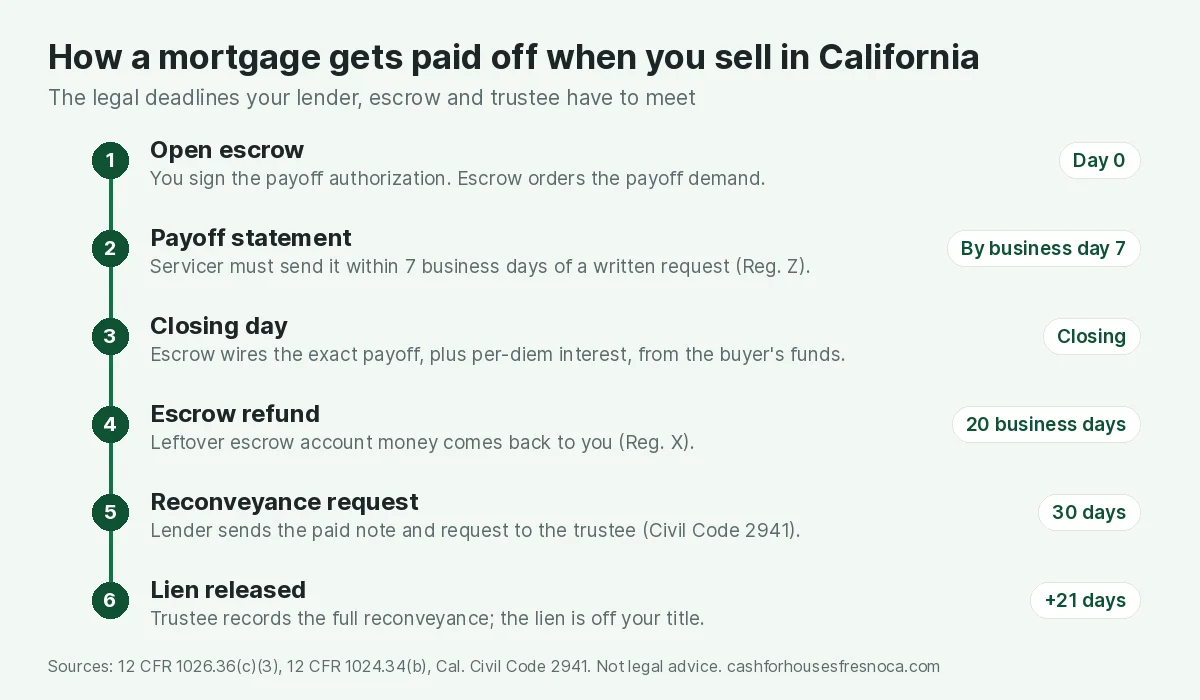
- Payoff statement: 7 business days. Under federal Regulation Z, a servicer generally must send an accurate payoff statement within seven business days (opens in a new tab) of a written request. As Nolo explains (opens in a new tab), the deadline doesn't apply if the loan is in bankruptcy or foreclosure, is a reverse mortgage, or after a natural disaster. Then it's "a reasonable time."
- Escrow account refund: 20 business days. If your loan has an impound account for taxes and insurance, the servicer must refund what's left within 20 days, not counting weekends and holidays (opens in a new tab), after you pay the loan in full. It arrives as a separate check, not on your closing statement.
- Lien release: about 30 + 21 days. California Civil Code 2941 (opens in a new tab) gives the lender 30 days after payoff to send the paid note and a request for reconveyance to the trustee, and the trustee 21 days after that to record the reconveyance. If nothing is recorded in 75 days, a title company can record a release. A lender or trustee who breaks the rule owes your actual damages plus a $500 penalty.
Tip: once the sale closes, check the Fresno County Recorder's index a couple of months later for the reconveyance. If it never shows up, it can cause headaches for the buyer's title later, and the paper trail starts with your payoff date.
How much you'll keep: a Fresno example
Here's what selling a house with a mortgage looks like on Fresno County's September 2026 median sale price of $429,450 (C.A.R.). Using the numbers from our breakdown of seller closing costs in Fresno, a traditional listing costs about 6.8% of the price, or roughly $29,200, for commissions, title, escrow, transfer tax and the rest. That leaves about $400,250 before the mortgage payoff.
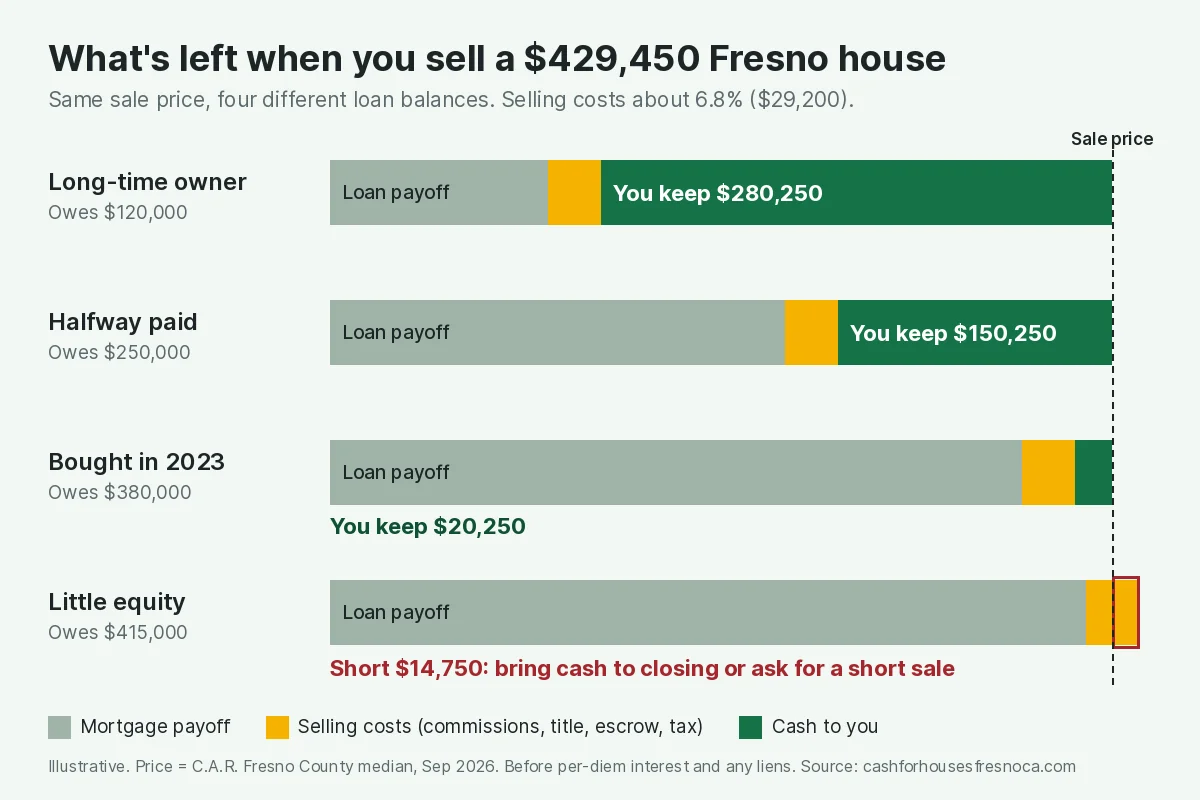
The key takeaway: a house can be worth more than the loan and still not sell for enough to pay it off. In the fourth example, the seller owes $415,000 on a $429,450 house. On paper they have $14,450 of equity. After selling costs, they're about $14,750 short. A quick rule of thumb for Fresno listings:
Break-even loan balance ≈ sale price × 0.93
If your payoff is above about 93% of what the house will sell for, you'll probably have to bring money to closing on a traditional sale. Fresno County prices have nearly doubled since 2016 (see our Fresno housing market report), so most owners who bought before 2020 are well clear of that line. Recent buyers with small down payments, especially FHA buyers who put 3.5% down, are the ones most likely to be close.
Nationally, very few owners are actually underwater. Cotality's Q1 2026 homeowner equity report (opens in a new tab) found only 1.9% of mortgaged homes had negative equity, and the average California borrower had about $626,900 of equity, the second highest of any state. Fresno equity is lower because prices are lower, but the pattern is the same: most sellers have room to spare.
Want your real number?
Tell us your address and roughly what you owe. We'll show you an all-cash offer and an honest estimate of what you'd net by listing, side by side. Close in as little as 7 days if cash wins.
Call (559) 512-6998Get My All-Cash OfferWhat's in your payoff amount
Your payoff is almost never the "principal balance" on your monthly statement. Expect these items:
| Item | What it is | Example |
|---|---|---|
| Unpaid principal | The loan balance after your last payment | $250,000 |
| Interest to the payoff date | Mortgage interest is paid in arrears: your November 1 payment covers October's interest. So at closing you owe interest from your last payment to the payoff date, at a daily (per-diem) rate. | $250,000 × 3.25% ÷ 365 = $22.26 a day; 20 days = $445 |
| Fees | Recording or reconveyance fee, payoff statement or fax fee where allowed, any late charges | Usually under $100 if you're current |
| Prepayment penalty | Rare on home loans today. For most loans made since January 10, 2014, federal rules only allow one on certain fixed-rate qualified mortgages, only in the first three years, capped at 2% of the balance in years one and two and 1% in year three (Nolo (opens in a new tab)). | Check your note |
| Escrow shortage or advances | If the servicer paid taxes or insurance for you and the impound account is short | Varies |
Escrow will ask for a payoff good through your expected closing date, with a per-diem figure in case closing slips a few days. Any overpayment is refunded to you by the lender after closing.
If you owe more than the house is worth
You can still sell a house with a mortgage that's bigger than the sale will net. You have four main options:
- Bring cash to closing. The simplest route if the gap is small, like the $14,750 in our example. Savings, a family gift or a personal loan can cover it.
- Negotiate selling costs. A lower commission, asking the buyer to pay some costs, or a cash buyer who covers closing costs can close a small gap. On a sale where you'd be short $15,000, cutting costs by $15,000 is the whole problem solved.
- Ask for a short sale. The lender agrees to accept less than it's owed. In California, Code of Civil Procedure 580e (opens in a new tab) says that once the lender gives written consent to a short sale of a 1 to 4 unit home, it has to accept the sale proceeds as full payment and can't get a deficiency judgment against you. A 2011 amendment (SB 458) extended that protection to second mortgages and other junior liens, though each lienholder still has to consent. Short sales take longer, often months, and hurt your credit, though usually less than a foreclosure.
- Wait and pay down the loan. If you don't need to move now, each payment and any price growth narrows the gap.
Watch the tax on forgiven debt. When a lender forgives part of a mortgage, the IRS can treat the forgiven amount as income. The federal exclusion for forgiven debt on a main home covered debt discharged before January 1, 2026 (opens in a new tab) (or under a written agreement signed before then), and Congress hasn't renewed it. Other exceptions, like insolvency, may still apply. Talk to a CPA before you sign a short sale agreement.
Selling a house with a mortgage when you're behind on payments
Being behind doesn't stop you from selling. In fact, selling before the foreclosure sale is often the best way to protect your equity and your credit. A few things to know:
- Your payoff grows. Missed payments, late fees and foreclosure costs are added to the payoff, so ask for an updated figure.
- The clock matters. Federal servicing rules generally keep a servicer from starting foreclosure until you're more than 120 days behind. After a California notice of default is recorded, there are usually at least three months before a notice of sale, and the sale can't happen until at least 20 days after that. Our page on how to stop foreclosure in Fresno walks through the timeline and your options.
- The 7-day payoff rule may not apply once a loan is in foreclosure, so order the payoff the day you open escrow.
- Closing speed is everything. A financed buyer typically needs 30 to 45 days. If your sale date is close, a cash buyer may be the only buyer who can close in time. Our guide to how long it takes to sell a house has Fresno timelines.
Behind on property taxes too? Those are a separate lien that gets paid from escrow as well. See our Fresno County property tax guide.
Behind on payments or close to underwater?
Get a no-obligation all-cash offer. We pay off your mortgage through escrow, cover the closing costs, and can close in as little as 7 days, or on the date you choose.
Second mortgages, HELOCs, reverse mortgages and assumable loans
Second mortgages and HELOCs
Every lien gets paid at closing, in order of priority. If you have a HELOC, escrow will ask the lender to freeze and close the line so nothing new is drawn after the payoff is quoted. Make sure you're not still writing checks against it during escrow. If a creditor has recorded a judgment lien, California's homestead exemption may protect some or all of your equity, so talk to an attorney before you pay it in full. For tax, judgment, contractor and HOA liens, see our guide to selling a house with a lien.
Reverse mortgages
You can sell a house with a reverse mortgage the same way: the loan is paid from the proceeds. For a federally insured HECM, heirs who inherit the house get a special break. They can pay off the loan for the lesser of the loan balance or 95% of the appraised value (opens in a new tab), with FHA insurance covering the rest. Heirs start with 30 days after the due-and-payable notice, and servicers can extend that to about six months, then up to two more 90-day extensions with HUD approval. If you inherited a house, start with our guide to selling an inherited house in Fresno.
Assumable FHA and VA loans
FHA, VA and USDA loans can usually be assumed by a qualified buyer, with lender approval. The buyer takes over your loan, rate and remaining balance, and pays you the difference in cash or with a second loan. If your rate is 3%, that's a strong selling point. The catch: the buyer often needs a big down payment to cover your equity, and approval takes time. With a VA loan, make sure you get a release of liability, and know that your VA entitlement may stay tied up unless the buyer is a veteran who substitutes theirs.
"Subject to" sales
Some investors offer to buy "subject to" your existing loan, meaning the loan stays in your name and they make the payments. Most loans have a due-on-sale clause that lets the lender demand the full balance when the house is sold, and if the buyer stops paying, it's your credit that takes the hit. We don't recommend it unless an attorney reviews the deal.

Should you give up a low mortgage rate?
This is the question that's kept so many owners from selling. Freddie Mac's survey put the average 30-year fixed rate at 7.40% on October 15, 2026 (opens in a new tab). Meanwhile, about half of all outstanding mortgages still carry a rate under 4%.
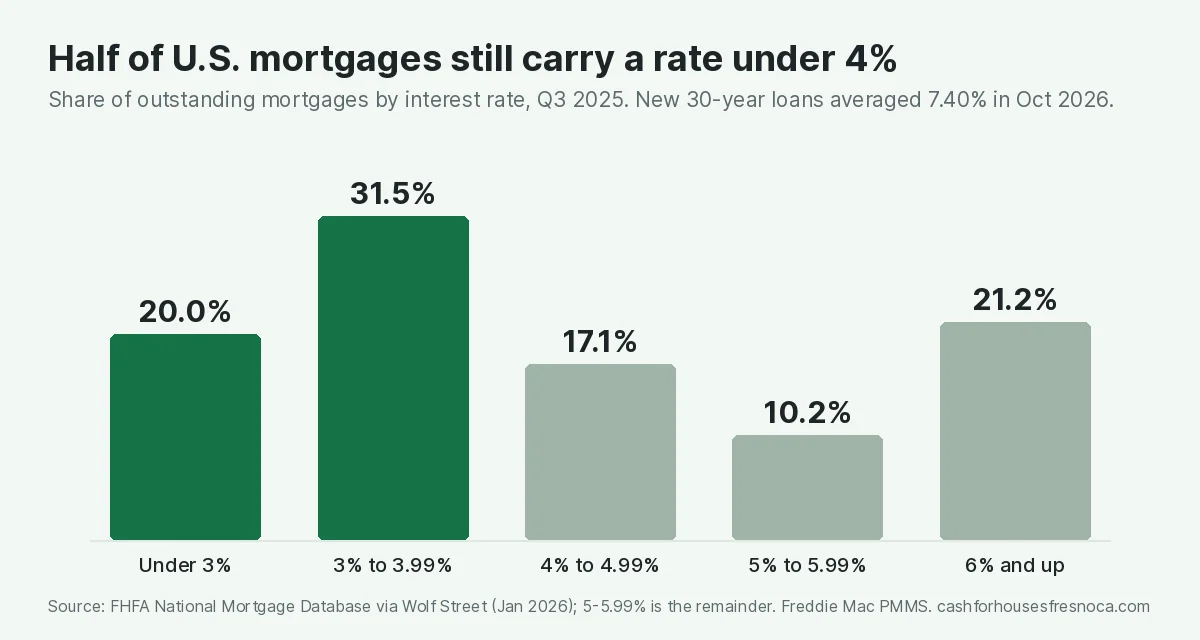
That gap is real money. On a $300,000 loan, the principal and interest payment is about $1,265 a month at 3% and about $2,077 at 7.40%. Still, a low rate shouldn't keep you in a house that no longer works. Selling often makes sense when:
- you're downsizing or moving somewhere cheaper and need a smaller loan, or none;
- you're relocating for work or family (our page on selling when you're relocating covers this);
- you're going through a divorce and neither spouse can keep the house alone;
- the payment, repairs or property taxes are straining your budget; or
- it's an inherited house or rental you don't want to manage.
If you're selling a house that went up a lot in value, check our guide to capital gains tax in California. Paying off the mortgage doesn't affect your gain, but most homeowners can exclude up to $250,000 (or $500,000 married) of it.
Selling a house with a mortgage for cash
A cash sale works exactly the same way. The cash buyer wires funds to escrow, escrow pays off your mortgage and any other liens, and you get the rest. There's no buyer loan, so there's no appraisal and no lender underwriting, which is why cash sales can close in about a week once the payoff and title are ready.
When we buy a house with a mortgage on it, we also pay the normal closing costs and there's no commission, so on a tight equity situation the cash offer can net about the same as a listing that sells higher but carries 6% to 7% in costs. Sometimes listing still wins, and we'll tell you if it does. Our comparisons of a cash offer vs. listing and how much cash buyers pay for houses show the math, and if you'd rather skip agents altogether, here's how to sell a house by owner in California.
We buy houses as-is in Fresno, Clovis, Madera, Visalia and across the Central Valley, including houses with two loans, back payments or a long repair list.
Owe money on your house? That's normal.
Call or text (559) 512-6998. We'll pull your numbers, show you what you'd net with a cash sale vs. listing, and pay off your loan through escrow at closing.
Call (559) 512-6998Get My All-Cash OfferCan you sell a house with a mortgage? FAQ
Can you sell a house with a mortgage?
Yes. Most homes in the U.S. sell with a mortgage still on them. The escrow or title company pays the lender in full from the sale proceeds at closing, and the seller keeps what's left after the payoff and selling costs.
Do I need my lender's permission to sell my house?
No, not if the sale pays the loan off in full. You only need the lender's approval for a short sale, where the price won't cover what you owe, or for a buyer to assume your loan.
What happens to my mortgage when I sell my house?
It's paid off at closing. Escrow sends your lender the exact payoff amount, including interest up to the payoff date. In California, the lender then has 30 days to send a reconveyance request to the trustee, who has 21 days to record it and release the lien.
Can I sell my house if I still owe on it and it's worth less than the loan?
Yes. You can bring cash to closing to cover the difference, negotiate lower selling costs, or ask the lender to approve a short sale. In California, a lender that gives written consent to a short sale of a 1 to 4 unit home can't seek a deficiency judgment under Code of Civil Procedure 580e. Forgiven debt may be taxable, so check with a CPA.
How long does a mortgage payoff take when you sell?
The payoff itself happens on closing day when escrow wires the funds. Getting the payoff statement takes up to 7 business days after a written request, and the lien release is usually recorded within about 30 to 51 days after payoff in California.
Do I keep paying my mortgage while my house is in escrow?
Yes. Keep making payments until closing. Missed payments add late fees and interest to the payoff and can hurt your credit. Any overpayment is refunded after the loan is paid off.
Will I get my escrow account money back when I sell?
Yes. Federal rules require the servicer to refund any remaining escrow account balance within 20 business days after the loan is paid in full. It usually comes as a separate check after closing.
Is there a penalty for paying off a mortgage early when you sell?
Usually not. For most home loans made since January 10, 2014, a prepayment penalty is only allowed on certain fixed-rate qualified mortgages in the first three years, and it's capped at 2% of the balance in years one and two and 1% in year three. Check your promissory note to be sure.
Sources and how to cite this guide
- Federal rules: 12 CFR 1026.36 (opens in a new tab) (payoff statements), 12 CFR 1024.34 (opens in a new tab) (escrow refunds); Nolo on payoff statement deadlines (opens in a new tab); Nolo on prepayment penalty limits (opens in a new tab).
- California: Civil Code 2941 (opens in a new tab) (reconveyance deadlines and $500 penalty); Code of Civil Procedure 580e as summarized by Buchalter (opens in a new tab), and the SB 458 analysis (opens in a new tab) extending it to junior liens.
- Data: Cotality homeowner equity report (Q1 2026 data) (opens in a new tab); FHFA National Mortgage Database via Wolf Street (opens in a new tab); Freddie Mac PMMS (opens in a new tab); C.A.R. Fresno County median as reported in our Fresno housing market report.
- Tax and reverse mortgages: expiration of the principal residence debt exclusion (opens in a new tab); HUD's 95% rule for HECM heirs (opens in a new tab); HousingWire on heir timelines (opens in a new tab).
- Photos: cover photo by Jade Stephens (Unsplash license), laptop photo from Foodiesfeed, wood-paneled room from rawpixel (CC0). None show our clients or their homes.
Sharing this data? You're welcome to use the payoff timeline, the Fresno net proceeds chart and the mortgage rate chart. Please credit "Cash For Houses Fresno" and link back to this page.