The homestead exemption in California protects the equity in the home you live in from most creditors who win a court judgment against you. Since 2021 it's been far bigger than most people realize: it equals your county's median single-family home price from the year before, but never less than a floor or more than a cap. Bankruptcy practitioners calculate those limits at $371,547 and $743,459 for 2026, after inflation. For most Fresno homeowners, that means every dollar of equity is protected. It applies automatically, without filing anything, as long as the house is your main home.
I'm Christian Castro, a licensed California realtor (DRE #02195959) and the owner of Cash For Houses Fresno. I buy houses from people dealing with judgment liens, old medical or credit card lawsuits, business debts and bankruptcy, and the homestead exemption comes up more often than you'd think. Many sellers assume a creditor will take their equity when they sell. Often the law says otherwise. This guide covers how the homestead exemption in California works, how much it protects in Fresno County, when recording a declaration helps, what happens when you sell, and the separate $7,000 "homeowners' exemption" that lowers your property tax. It's general information, not legal advice. If you're facing a lawsuit or thinking about bankruptcy, talk to a California attorney.
The short answer
- It protects equity, not the whole house. The exemption shields up to your county's median home price in equity (after your mortgage) from judgment creditors. In 2026 that's between $371,547 and $743,459. See the 2026 amounts.
- In Fresno it's roughly $440,000. Fresno County's median sits between the floor and the cap, so the median sets the number. Most local homeowners have less equity than that. See the Fresno examples.
- It's automatic. You don't have to file anything to get the basic protection. Recording a declared homestead adds extra protection when you sell voluntarily. See automatic vs. declared.
- It doesn't stop your mortgage lender, property taxes, or child and spousal support. See what it doesn't protect.
- The "other" homestead exemption is the homeowners' property tax exemption: $7,000 off your assessed value, worth about $70 to $90 a year in Fresno. File form BOE-266 by February 15. See the $7,000 exemption.
What the homestead exemption in California is
When someone sues you and wins, they get a money judgment. To collect, a judgment creditor can record an abstract of judgment with the county recorder, which creates a lien on any real estate you own in that county, and in some cases ask a court to order your house sold. The homestead exemption, found in Code of Civil Procedure 704.730 (opens in a new tab), sets aside a protected amount of equity in your home that those creditors can't reach.
The protection covers your "homestead," which the law defines in CCP 704.710 (opens in a new tab) as the principal dwelling you or your spouse lived in when the creditor's lien attached, and kept living in continuously after that. A dwelling can be a house, a condo, a mobilehome or even a boat you live on. A rental house or vacation cabin isn't a homestead, because you don't live there.
Two other things in California get called "homestead exemptions," which is why searches for this topic get confusing:
- The homeowners' property tax exemption, which cuts $7,000 off your home's assessed value. Different law, different purpose. It's covered below.
- A recorded "declaration of homestead," which is an optional add-on to the same creditor protection, not a separate exemption.

How much is the homestead exemption in California in 2026?
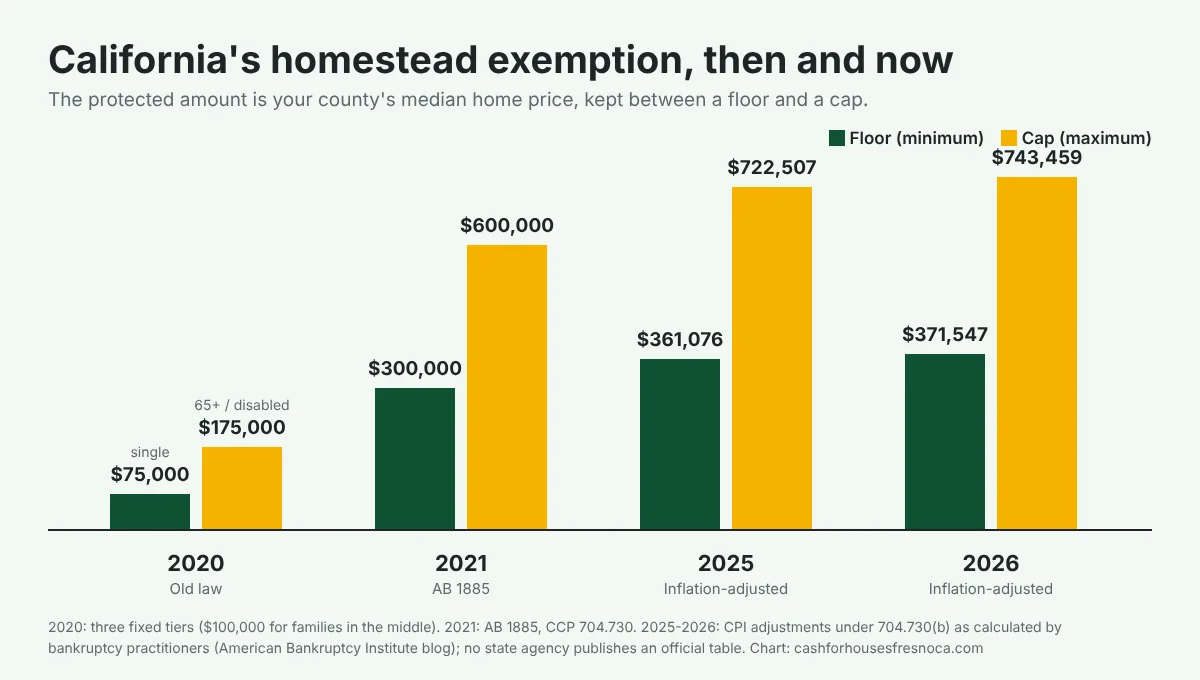
Before 2021, California's homestead exemption was small and depended on who you were: $75,000 for a single person, $100,000 for a family, and $175,000 for people 65 and older or disabled. In a state where houses cost hundreds of thousands of dollars, a lot of equity was exposed. Assembly Bill 1885, which took effect January 1, 2021, replaced those tiers with a formula (Snell & Wilmer summary (opens in a new tab)).
Under CCP 704.730 today, the homestead exemption in California is the greater of:
- the countywide median sale price for a single-family home in the calendar year before you claim the exemption, capped at $600,000; or
- $300,000.
Both dollar figures adjust every year for inflation using the California Consumer Price Index, rounded to the nearest $25. No state agency publishes an official table of the adjusted numbers, so lawyers and bankruptcy trustees calculate them. A bankruptcy attorney writing on the American Bankruptcy Institute blog (opens in a new tab) put the limits at $361,076 to $722,507 for 2025 and $371,547 to $743,459 for 2026. Your attorney may come out a few dollars different depending on rounding, which is normal. The same author noted that a trustee once came up $5 apart from her figure.
In practice, that means three kinds of counties:
- Lower-priced counties where the median is below the floor get the floor: $371,547 in 2026.
- High-cost coastal counties such as Los Angeles, Orange or Santa Clara, where medians are far above the cap, get the cap: $743,459.
- Middle counties, including Fresno, get their own median, because it lands between the two.
What the homestead exemption protects in Fresno: three examples
The statute doesn't say which median to use, and courts and trustees usually look at California Association of Realtors (C.A.R.) or similar county sales data. C.A.R. reported a Fresno County median of $446,390 in August 2025 and $430,000 in August 2026 (see our Fresno housing market report). So for a claim in 2026, which looks back at 2025 sales, a Fresno homeowner's exemption is probably in the neighborhood of $440,000. Treat that as an estimate. If it matters for your case, your attorney will pin down the exact number.
The exemption is measured against your equity: the home's value minus your mortgage and any other liens that were already recorded before the judgment lien. Here's what that looks like:
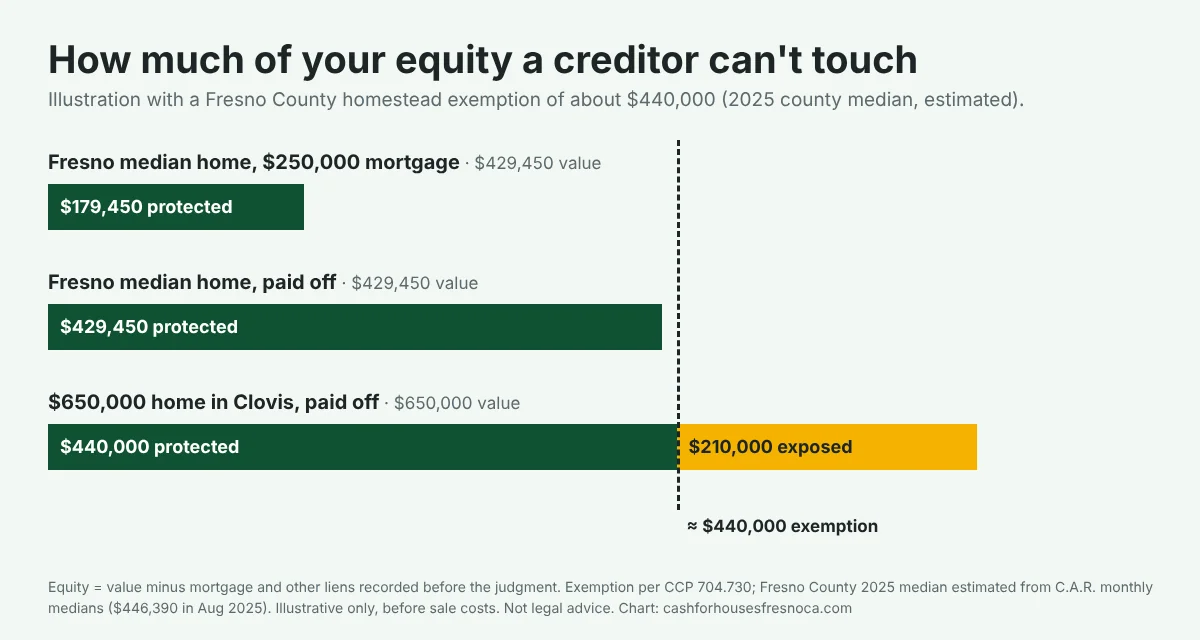
- Typical Fresno owner with a mortgage. A house worth $429,450 (C.A.R.'s September 2026 Fresno County median) with a $250,000 loan has $179,450 of equity. All of it is protected. A creditor with a $40,000 judgment can't force a sale, because there's nothing above the exemption to collect.
- Fresno owner who's paid off the house. Even with zero mortgage, $429,450 of equity is under the roughly $440,000 exemption. Still fully protected.
- Owner of a pricier, paid-off home. A $650,000 house in Clovis or north Fresno with no loan has $210,000 of equity above the exemption. That slice is reachable by a judgment creditor.
Before 2021, the paid-off Fresno owner would have had $329,000 or more exposed. That's the practical difference AB 1885 made in the Valley.
What the homestead exemption doesn't protect
The homestead exemption works against unsecured creditors who sue you: credit cards, medical bills, personal loans, a car repossession deficiency, a business debt you personally guaranteed, a lawsuit after a car accident. It does not protect you from:
- Your mortgage or a home equity loan. You agreed to those liens. If you stop paying, the lender can foreclose regardless of the exemption. If that's where you are, see our page on how to stop foreclosure in Fresno.
- Property tax. Unpaid county property tax eventually leads to a tax sale. Our Fresno County property tax guide walks through the deadlines.
- Child, family or spousal support liens. CCP 704.950(b) (opens in a new tab) specifically carves these out of the declared homestead protection.
- Federal tax liens. State exemptions don't bind the IRS, which has its own rules for seizing a residence.
- Mechanic's liens and HOA liens tied to work or assessments on the property itself. Talk to an attorney about these, because the rules are specific.
Also note that a revocable living trust doesn't add creditor protection. A house in your own trust is treated as yours, which we cover in our living trust in California guide.
Automatic homestead vs. declared homestead
California has two layers of homestead protection, and many homeowners only need the first.
The automatic homestead applies without filing anything. If a creditor asks a court to sell your home, you claim the exemption in that court process, and the court won't order a sale unless a buyer would pay enough to cover your mortgage, other liens and the full exemption amount (CCP 704.800 (opens in a new tab)). If nobody bids that much, the house isn't sold, and the same creditor has to wait a year to try again.
A declared homestead is a document you record with the county recorder. Under CCP 704.930 (opens in a new tab), it must name the owner, describe the property, state that it's your principal dwelling and that you live there on the day it's recorded, and be signed and notarized. Its main benefit shows up when you sell voluntarily. If the declaration is recorded before a creditor records its abstract of judgment, the judgment lien only attaches to equity above your mortgage and the exemption (CCP 704.950). Without one, a judgment lien attaches to the whole property, and the title company will usually want it paid or resolved before closing.
A declared homestead is worth considering if you have significant equity and expect trouble: a business that might fail, a lawsuit on the horizon, or a divorce with shared debt. It's cheap: just the notary and a recording fee on the Fresno County Recorder's fee schedule (opens in a new tab). It won't help with a judgment that's already recorded, so timing matters.
Judgment lien on your Fresno house?
Call or text Christian at (559) 512-6998. We buy houses with judgment liens, tax liens and old debts attached, work with your attorney and the title company on the payoffs, and close in as little as 7 days.
Call (559) 512-6998Get My All-Cash OfferSelling your house with a judgment lien in California
This is where the homestead exemption in California matters most to the sellers I work with. When you sell, escrow pulls a title report, and every recorded abstract of judgment shows up. What happens next depends on the facts:
- If you recorded a declared homestead first, the judgment lien only reaches equity above the exemption. On a typical Fresno sale, that's often zero, and the attorney or title company can work through releasing the lien so you keep your proceeds.
- If there's no declaration, the lien attaches to the property, and in a voluntary sale the creditor usually gets paid from escrow unless you negotiate a reduced payoff or your attorney goes to court to establish the exemption. Many creditors will settle for less than the full balance, especially on old debts.
- Your sale proceeds stay protected for six months. Under CCP 704.720(b) (opens in a new tab), proceeds from selling a homestead are exempt, up to the exemption amount, for six months after you receive them. That gives you time to buy your next home. Put the money toward a new homestead within that window and the protection carries over.
Judgment liens are just one of the payoffs that come out of escrow (our guide to selling a house with a lien covers tax, mechanic's and HOA liens too). Your mortgage, any tax liens and the seller's closing costs all come off the top. Our breakdown of payoffs and prorations at closing and our guide to selling a house with a mortgage show how the money flows. If a divorce is behind the debts, CCP 704.720(d) can keep the exemption alive for a spouse who moved out while the other still lives there. Our page on selling a house during a divorce in Fresno covers the rest.
The homestead exemption in bankruptcy
If you file Chapter 7 or Chapter 13 bankruptcy in California, you choose between two sets of state exemptions:
- The CCP 704 set, which includes the full homestead exemption discussed above. Homeowners with equity usually pick this one.
- The CCP 703.140(b) set, which has a much smaller homestead amount but a bigger "wildcard." It tends to fit renters and people with little home equity.
In Chapter 7, a trustee can sell a house only if there's equity above the exemption and the sale costs, so in Fresno most homeowners with modest equity keep their homes. In Chapter 13, you keep the house but pay unsecured creditors at least what they'd have received from non-exempt equity.
One federal limit applies: if you bought your home less than 1,215 days (about 40 months) before filing, federal bankruptcy law caps the homestead exemption at $214,000 for cases filed between April 1, 2025 and March 31, 2028, under 11 U.S.C. 522(p) (Federal Register, Feb. 4, 2025 (opens in a new tab)), unless the equity was rolled over from a previous California home. Bankruptcy is a decision for a bankruptcy attorney, not a blog post. But if you're comparing it with selling, it helps to know that your home equity is likely safe either way.
Get a cash offer on a house with liens or judgments
Tell us about the property. We'll send a no-obligation all-cash offer and coordinate the lien payoffs with title. No repairs, no cleanout, no agent commissions, and close in as little as 7 days.
The $7,000 homeowners' exemption: California's property tax "homestead exemption"
When people search for the homestead exemption in California, many are actually looking for the property tax break that other states call a homestead exemption. California calls it the homeowners' exemption, and it works like this (State Board of Equalization (opens in a new tab)):
| Item | Homeowners' exemption (property tax) | Homestead exemption (creditors) |
|---|---|---|
| What it does | Lowers your taxable value by $7,000 | Protects home equity from judgment creditors |
| Worth in Fresno | About $70 to $90 a year in tax | Roughly $440,000 of equity (2026 estimate) |
| Who qualifies | Owner whose principal residence it is on January 1 | Owner or spouse who lives there when the lien attaches |
| How to get it | File form BOE-266 once with the county assessor | Automatic; optional recorded declaration |
| Deadline | February 15 for the full amount | None |
| Law | Rev. & Tax. Code 218 and 275 | Code of Civil Procedure 704.710 to 704.995 |
A few details worth knowing:
- It's a one-time filing. The Fresno County Assessor usually mails the form after you buy. Once granted, it renews automatically until you move or rent the house out.
- Filing late still helps. Under Rev. & Tax. Code 275 (opens in a new tab), if you miss February 15 but file by December 10, you get the lesser of $5,600 or 80% of the home's value off that year's bill.
- Tell the assessor when you move out. If you rent the house or move, you're supposed to cancel the exemption, by December 10 to avoid penalties.
- Bigger tax breaks exist for some owners. Disabled veterans can get a much larger exemption, and owners 55 and older can move their low Prop 13 tax base to a new home under Prop 19. Our Fresno County property tax guide covers both, and our capital gains tax in California guide covers the separate $250,000/$500,000 home sale exclusion, which people also mix up with homestead rules.
When selling makes more sense than fighting
The homestead exemption is strong protection, and you shouldn't sell your home just because a creditor sent a scary letter. But some situations point toward selling: several judgments stacking up on a house you can't afford anyway, a property that needs repairs you can't pay for, mortgage payments you're behind on, or an inherited house with the previous owner's liens on it. In those cases, a clean sale can pay off what has to be paid, protect what the law lets you keep, and let you start over.
If the house is in good condition and you have time, listing it with an agent will usually bring the highest price. If you need speed, certainty or an as-is sale, a cash offer may be the better fit. Our comparison of a cash offer vs. listing runs both scenarios, and our sell your house as-is in Fresno page explains how we buy. Either way, have your attorney review the lien situation first so you know exactly what the homestead exemption protects.
Want to know what you'd walk away with?
Call or text (559) 512-6998. We'll give you an all-cash offer and an honest estimate of your net after liens and payoffs, so you and your attorney can compare. We buy in Fresno, Clovis, Madera, Visalia, Bakersfield and across the Central Valley.
Call (559) 512-6998Get My All-Cash OfferHomestead exemption California: FAQ
How much is the homestead exemption in California in 2026?
It's your county's median single-family home price from the prior year, but no less than about $371,547 and no more than about $743,459 in 2026 after inflation adjustments. In Fresno County, the median falls between those limits, so the exemption is roughly $440,000.
Do I have to file for the homestead exemption in California?
No. The basic homestead exemption is automatic for the home you live in. You can optionally record a declaration of homestead with the county recorder, which adds protection when you sell voluntarily if it's recorded before a judgment creditor records a lien.
Does the homestead exemption protect my house from foreclosure?
No. It protects equity from unsecured creditors who win a judgment. Your mortgage lender, the county tax collector and support liens can still enforce their liens on the home.
Is the homestead exemption the same as the homeowners' exemption?
No. The homestead exemption protects equity from creditors. The homeowners' exemption is a property tax break that takes $7,000 off your assessed value, saving roughly $70 to $90 a year in Fresno. You file form BOE-266 with the county assessor, ideally by February 15.
Can I claim the homestead exemption on a rental property?
No. It only covers your principal dwelling, the home you or your spouse actually lived in when the creditor's lien attached and continuously after that. Rentals and second homes aren't protected.
What happens to the homestead exemption when I sell my house?
Your sale proceeds stay exempt, up to the exemption amount, for six months after you receive them under CCP 704.720(b). If you buy a new home with that money within six months, the protection carries over to the new home.
Can a creditor force the sale of my home in California?
Only with a court order, and only if a buyer bids enough to pay your mortgage, other liens and your full homestead exemption. In Fresno, most homeowners have less equity than the exemption, so a forced sale wouldn't net the creditor anything.
Sources
- California Code of Civil Procedure sections 704.710 (opens in a new tab) (definitions), 704.720 (opens in a new tab) (proceeds), 704.730 (opens in a new tab) (amount), 704.800 (opens in a new tab) (forced sale minimum bid), 704.930 (opens in a new tab) (declaration contents) and 704.950 (opens in a new tab) (judgment liens on declared homesteads).
- 2025 and 2026 inflation-adjusted amounts: American Bankruptcy Institute blog (2026) (opens in a new tab) and (2025) (opens in a new tab); AB 1885 history: Snell & Wilmer (opens in a new tab).
- Federal 522(p) cap: Federal Register, Feb. 4, 2025 (opens in a new tab).
- Homeowners' exemption: California State Board of Equalization (opens in a new tab); Rev. & Tax. Code 275 (opens in a new tab).
- Fresno County medians: C.A.R. September 2026 sales report (opens in a new tab) and our Fresno housing market report; Fresno County Recorder fee schedule (opens in a new tab).
Information in this guide is current as of October 2026 and is not legal advice. You're welcome to share the charts with a link back to this page.