A living trust in California is a legal document that holds your house and other assets while you're alive and hands them to the people you choose after you die, without probate. You stay in charge as trustee while you're alive, you can change it or cancel it at any time, and when you die or can't manage your affairs, the successor trustee you named takes over. In a state where probate on a typical Fresno house runs more than $23,000 in statutory fees alone and takes 9 to 18 months, that's the main reason so many California homeowners have one.
I'm Christian Castro, a licensed California realtor (DRE #02195959) and the owner of Cash For Houses Fresno. I buy a lot of houses from successor trustees and from executors stuck in probate, so I see both sides: the family that can sell the house in a few weeks because Mom put it in a trust, and the family waiting a year on a court calendar because she didn't, or because she signed a trust and never moved the deed into it. This guide covers what a living trust in California costs, how to set one up, how to put your house in it the right way and what happens when the trustee has to sell. It's general information, not legal advice. Talk to a California estate planning attorney about your own situation.
The short answer
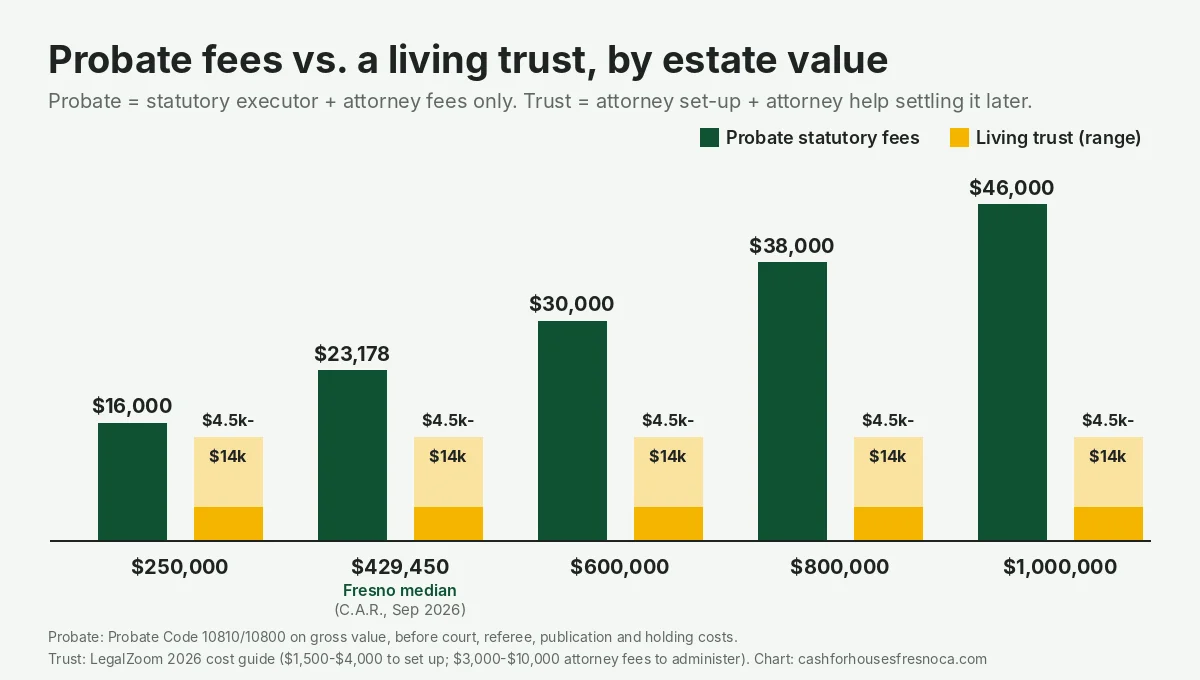
- A living trust avoids probate. Assets titled in the trust pass by the trustee's signature, not a court order. That skips California's statutory probate fees: $23,178 on a $429,450 Fresno house. See the cost chart.
- It costs $1,500 to $4,000 with an attorney for most families, or a few hundred dollars online. Settling it later usually costs $3,000 to $10,000 in attorney fees, still far less than probate on most estates.
- The trust only controls what's in it. You have to record a new deed putting your house in the trust. An unfunded trust doesn't avoid probate. See how to put your house in a trust.
- Moving your house into your own trust doesn't trigger a property tax reassessment or documentary transfer tax, and it doesn't trigger your mortgage's due-on-sale clause.
- It won't avoid taxes or Prop 19. A revocable trust doesn't cut income or estate tax, doesn't protect you from creditors and doesn't stop a property tax reassessment when your kids inherit. See what a trust won't do.
What a living trust in California is
A living trust (the formal name is a revocable living trust, sometimes called an inter vivos trust) is an agreement in which you, the trustor or settlor, transfer assets to a trustee to manage for beneficiaries. The twist that makes it practical: in a typical California living trust, you are all three while you're alive. You put your house in the trust, you manage it as trustee and you keep living in it and using it as the beneficiary. Nothing about your daily life changes.
Three rules from the California Probate Code make it work:
- It's revocable unless it says otherwise. Under Probate Code 15400 (opens in a new tab), a California trust can be revoked by the person who created it unless the document expressly says it's irrevocable. You can amend it, restate it or cancel it whenever you want.
- A trust that holds real estate must be in writing. Probate Code 15206 (opens in a new tab) says a trust of real property isn't valid unless it's evidenced by a written document signed by the trustee or the trustor.
- The successor trustee takes over without a court. When you die or become incapacitated, the person you named as successor trustee steps in with the power the document gives them. No judge appoints them and no letters are issued.
The trust is the core of what estate planners call a "trust package." It usually comes with a pour-over will (which sends anything you forgot into the trust), a durable power of attorney for finances, an advance health care directive and the deed that moves your house into the trust. The California Attorney General's estate planning page (opens in a new tab) has a plain-English overview of wills and trusts and warns about "trust mills" that sell overpriced packages door to door.
Do you need a living trust in California?
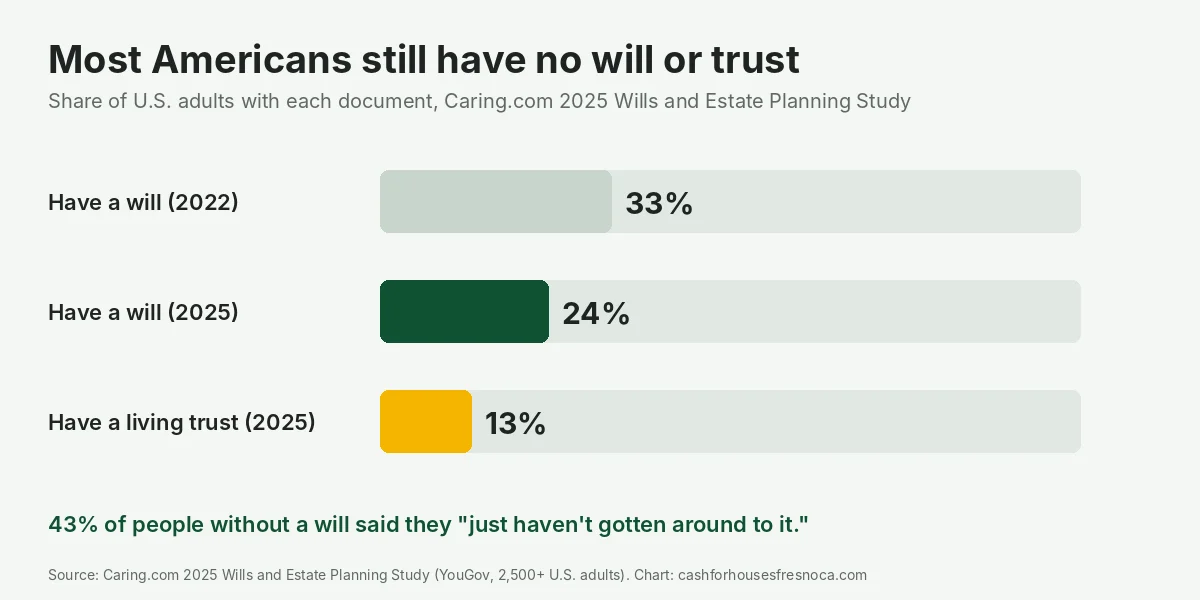
Most Americans don't have one. In the Caring.com 2025 Wills and Estate Planning Study (opens in a new tab), only 24% of U.S. adults said they had a will, down from 33% in 2022, and just 13% had a living trust. The most common reason people gave for having nothing was procrastination.
Whether you need one comes down mostly to your house. California's simpler ways to pass property without probate have limits, and real estate blows through most of them fast. A living trust in California is usually worth it if:
- You own a house. Even a modest Fresno home is worth more than the $208,850 small estate limit for deaths after April 1, 2025 (Sacramento County Public Law Library (opens in a new tab)). Without planning, the house usually means a court case.
- You own property in more than one state. A trust can hold both, avoiding a second probate in the other state.
- You want someone to manage things if you can't. A trust covers incapacity, not just death. The successor trustee can pay the property tax and the mortgage, or sell the house to pay for care, without a court conservatorship.
- Your heirs are young, have special needs or don't get along. A trust can hold an inheritance until a child reaches a certain age, protect a disabled beneficiary's benefits or spell out exactly how a house should be split.
- You have a blended family. A trust can make sure a surviving spouse can stay in the house while still leaving it to your kids from a first marriage.
You may not need one if you rent and have few assets, or if your only real asset is a house that's going to one person, where a cheaper transfer on death deed may do the job (see the comparison below).
How much a living trust costs in California vs. probate
Here's the money comparison that sells most people on a trust. California is one of the few states where probate fees are set by statute as a percentage of the estate. Under Probate Code 10810 (opens in a new tab), the attorney gets 4% of the first $100,000, 3% of the next $100,000 and 2% of the next $800,000, and the executor is entitled to the same amount again. The fees are figured on the gross value of the estate. A $429,450 house with a $300,000 mortgage still pays fees on $429,450.
And here's the cost side of a living trust, from LegalZoom's 2026 living trust cost guide (opens in a new tab) and SmartAsset's California estimate:
| Option | Typical cost | Good fit for |
|---|---|---|
| Online trust service or software | About $400 and up | Simple estates: one house, one or two heirs, no special situations |
| Estate planning attorney (flat fee) | $1,500 to $4,000; about $2,000 is a common California average (SmartAsset (opens in a new tab)) | Most homeowners, married couples, blended families |
| Complex plan (business, rentals, special needs) | $5,000 and up | Larger or complicated estates |
| Recording the deed into the trust (Fresno County) | Roughly $22 for a two-page deed ($19 first page + $3 each extra page), plus the $75 SB2 fee unless an exemption applies | Everyone with a house |
| Settling the trust after death | $3,000 to $10,000 in attorney fees for a straightforward, uncontested trust; trustee pay is "reasonable," not a percentage | The successor trustee, paid from the trust |
Put the two side by side on a typical Fresno house worth the September 2026 county median of $429,450 (opens in a new tab): probate statutory fees of $23,178, plus roughly $1,000 to $1,500 in court, referee and newspaper costs, and a year or more of property tax and insurance while the case is open. Our guide to how long probate takes in California puts the all-in number at about $29,880. A living trust done by an attorney plus attorney help settling it later usually lands somewhere between $4,500 and $14,000, and the house can be sold months sooner.
To be fair about it: on a small estate with one heir, a trust can cost about the same as the probate it avoids, and an online trust that's drafted wrong or never funded can cost more in the end. The savings get bigger as the house gets more valuable, because probate fees grow with the estate and trust costs mostly don't.
How to set up a living trust in California
Creating a living trust in California is a paperwork project, not a court process. Nothing gets filed with a court. Here are the steps:
- Take inventory. List your house (with the APN from your property tax bill), any rentals, bank and brokerage accounts, vehicles, life insurance and retirement accounts. Note how each one is titled now.
- Choose your beneficiaries. Who gets what, and when. Decide whether kids inherit outright or at a set age, and name backups.
- Choose a successor trustee. This is the person who will sell or hand over the house. Pick someone organized and trusted by the rest of the family, and name a backup. Married couples usually serve as co-trustees, with the survivor continuing alone.
- Decide on an individual or joint trust. Married couples in California usually make one joint trust that keeps track of community and separate property.
- Have the trust drafted. An attorney, or a reputable online service for a simple estate. Have the pour-over will, power of attorney and health care directive done at the same time.
- Sign it. California doesn't require a trust to be notarized to be valid, but attorneys almost always have it notarized because banks and title companies expect it. The pour-over will needs two witnesses.
- Fund the trust. This is the step people skip, and it's the one that matters most. Retitle your house and accounts into the trust's name. The next section covers the house.
- Keep it current. Review it after a marriage, divorce, death, birth, move or the purchase or sale of a house. Every time you buy or refinance a house, make sure it ends up titled in the trust.

How to put your house in a living trust in California
A trust doesn't own anything until you move assets into it. For your house, that means signing and recording a new deed from you, as an individual, to you as trustee of your trust: for example, "Maria Lopez, Trustee of the Lopez Family Trust dated March 3, 2026." Here's how it works in Fresno County:
- Get the current vesting. Pull a copy of your current deed so the new one names the owners exactly as they appear now and uses the correct legal description and APN.
- Prepare the deed. Most attorneys use a grant deed or a trust transfer deed; a quitclaim deed also works, though some title insurers prefer a grant deed. Write the exemption on the face of the deed: no documentary transfer tax is due because it's a transfer to a revocable trust with no consideration (Rev. & Tax. Code 11930 (opens in a new tab)).
- Sign before a notary. Every current owner signs.
- Fill out a Preliminary Change of Ownership Report (BOE-502-A). Check the box showing the transfer is to a revocable trust. Under Rev. & Tax. Code 62(d) (opens in a new tab), a transfer into a trust you can revoke is not a change in ownership, so your Prop 13 assessed value stays the same.
- Record it. Take or mail the deed to the Fresno County Recorder at 1250 Van Ness Ave. Fees start at $19 for the first page and $3 for each additional page. The Recorder also charges a $75 SB2 housing fee (opens in a new tab) unless the document states an exemption, such as a transfer of a home to an owner-occupier; ask your attorney or the Recorder whether your deed qualifies before you record.
- Tell your insurer. Ask your homeowners insurance company to add the trust or the trustee as an insured.
Two common worries that turn out to be fine:
- Your mortgage. Federal law (the Garn-St Germain Act, 12 U.S.C. 1701j-3(d)(8)) bars lenders from calling a home loan due when you move your home into a living trust where you stay a beneficiary and keep living there.
- Your homeowners' exemption. You still live there and still own it as trustee, so you keep the $7,000 homeowners' exemption on your property tax bill. Our Fresno County property tax guide explains the exemption and the tax calendar.
What if the house never made it into the trust? It happens all the time, usually because someone refinanced and the lender took the house out of the trust, or the deed simply never got recorded. If the trust document lists the house, the trustee can often ask the court to confirm it belongs to the trust through a "Heggstad petition" under Probate Code 850 (opens in a new tab). It's much faster and cheaper than full probate, but it's still a court case with a filing fee and attorney fees. Checking your deed once costs nothing.
Inherited a house that's in a trust?
Call or text Christian at (559) 512-6998. We buy houses from successor trustees all over Fresno and the Central Valley, as-is, with the belongings still inside, and close in as little as 7 days.
Call (559) 512-6998Get My All-Cash OfferLiving trust vs. will in California (and other ways to avoid probate)
A will says who gets your property, but in California a will does not avoid probate. The executor still has to take it to court. A living trust is the most complete way to avoid probate in California, but it isn't the only one. Here's how the options compare for a house:
| Tool | Avoids probate on the house? | Covers incapacity? | Rough cost | Best for |
|---|---|---|---|---|
| Will only | No (unless a small-estate shortcut applies) | No | A few hundred dollars and up | Renters and people with few assets |
| Living trust | Yes, if the house is deeded into it | Yes | $1,500 to $4,000 with an attorney | Most homeowners, blended families, minor or special-needs heirs |
| Transfer on death deed | Yes | No | About $100 to record in Fresno County | One house going to one or a few adults |
| Joint tenancy / community property with right of survivorship | Only until the second owner dies | No | Recording a deed | Married couples, as a first layer |
| Primary residence petition (Probate Code 13151) | Replaces full probate with one hearing for homes up to $750,000 | No | Filing fee plus attorney | Heirs after a death with no plan |
The new $750,000 primary residence petition for deaths on or after April 1, 2025 is a big help for families who didn't plan, and with Fresno's median around $429,450 it covers most local homes. But it still takes a court hearing, and it doesn't help with incapacity. A trust handles both, and it keeps the details out of the public court file.

What a living trust in California won't do
Trust salespeople sometimes oversell. A revocable living trust does not:
- Cut income taxes. While you're alive, the IRS ignores the trust and you report everything on your own return under your own Social Security number.
- Avoid estate tax by itself. California has no estate or inheritance tax, and the federal exemption is high enough that it touches very few Fresno families. A trust can include planning for very large estates, but that's a separate design choice.
- Protect your assets from creditors or lawsuits. You control a revocable trust, so your creditors can reach what's in it. Real asset protection takes a different kind of trust and separate advice. Your home does get the state's homestead exemption either way.
- Stop a property tax reassessment when your kids inherit. Under Prop 19, a house passing from parents to children is reassessed unless the child moves in as their primary residence, and even then only up to an extra $1,044,586 of value is excluded for transfers from February 16, 2025 through February 15, 2027 (State Board of Equalization (opens in a new tab)). A trust doesn't change that. Our Prop 19 California guide covers the rules and how siblings and trusts fit in.
- Hurt your stepped-up basis. Good news: assets in a revocable trust still get a stepped-up basis at death, so heirs who sell the house soon after usually owe little or no capital gains tax. For a married couple's community property, both halves step up. See our guide to capital gains tax in California.
- Control assets outside it. Retirement accounts and life insurance go to the beneficiary on the form, not the trust, unless you name the trust. Anything left out goes through the pour-over will, and possibly probate.
What happens after you die: the trustee's job
When the last trustor dies, the living trust becomes irrevocable and the successor trustee takes over. Here's what they do, and the deadlines that matter:
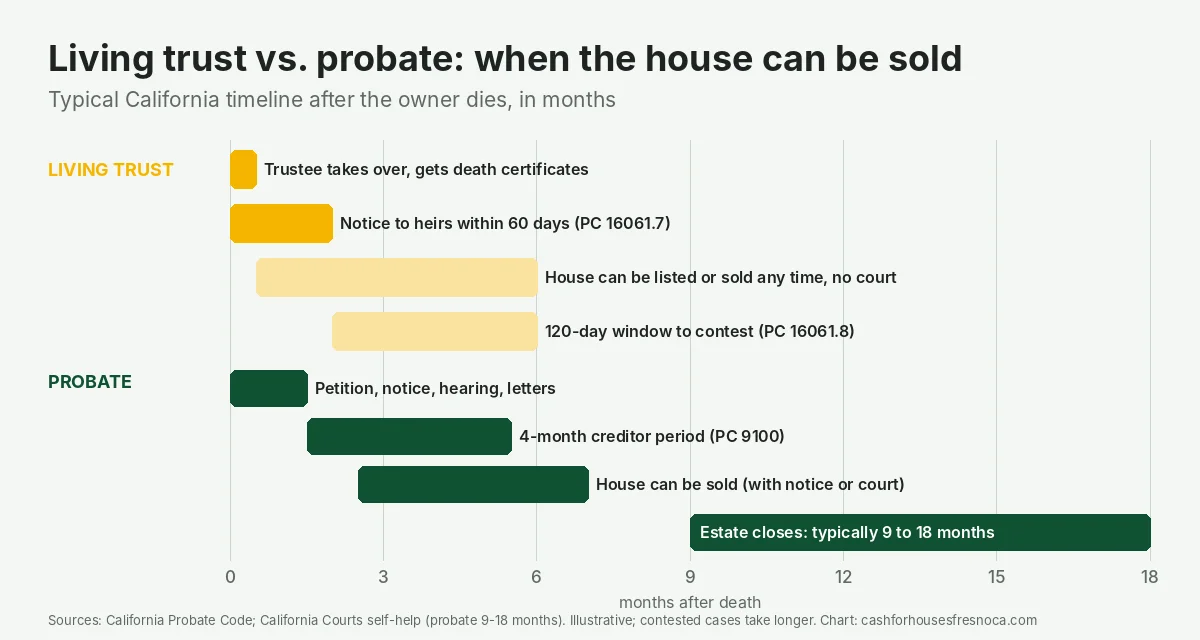
- Get death certificates and find the documents. The trustee needs the original trust, any amendments and several certified death certificates (order them through the funeral home or the Fresno County Recorder).
- Record an affidavit of death of trustee. This short form, recorded with a death certificate, shows the world that the successor trustee now controls the house.
- Get a tax ID for the trust. Once it's irrevocable, the trust is a separate taxpayer and needs its own EIN for bank accounts and the sale.
- Send the notice within 60 days. Probate Code 16061.7 (opens in a new tab) requires the trustee to notify every beneficiary and the deceased's heirs within 60 days. Under section 16061.8 (opens in a new tab), anyone who wants to contest the trust has 120 days from the notice (or 60 days after getting a copy of the trust, if later). Sending the notice early starts that clock.
- Protect and value the property. Keep insurance in force, pay the property tax and get a date-of-death appraisal for the stepped-up basis.
- Pay debts and final taxes. The trustee pays valid bills, files the final income tax returns and keeps clear records.
- Distribute or sell. Deed the house to the beneficiaries, or sell it and split the money as the trust says, then give the beneficiaries an accounting.
A simple, uncontested trust is often fully settled within a year, and there's no statutory fee: the trustee is entitled to "reasonable" compensation, and family trustees often take nothing. Notice what's missing from the list: no petition, no newspaper publication, no court hearing and no judge approving the sale.
Get a cash offer on a house held in a trust
Tell us about the property. We'll send the successor trustee a no-obligation all-cash offer. No repairs, no cleanout, no agent commissions, and close in as little as 7 days.
Selling a house held in a trust in California
This is where a living trust pays for itself. A successor trustee can usually list the house or accept an offer within weeks of the death. The title company typically asks for:
- a certification of trust under Probate Code 18100.5 (opens in a new tab), a short signed summary that proves the trust exists and the trustee's power to sell, so the whole trust doesn't have to be handed over;
- the recorded affidavit of death of trustee and a certified death certificate;
- the trust's EIN, and California withholding paperwork (FTB Form 593) at closing.
The trustee's duty is to the beneficiaries, so they should get a fair price and keep everyone informed. Many trustees sign the sale during the 120-day contest window without trouble, but if a family member is threatening a fight, talk to the trust attorney first. A trustee selling during trust administration is generally exempt from the standard Transfer Disclosure Statement under Civil Code 1102.2, but they still have to disclose defects they know about.
Whether to list or take a cash offer depends on the house. If it's in good shape and the beneficiaries can wait, listing it with an agent may bring a higher price. If it needs work, is full of a lifetime of belongings, has tenants, or the beneficiaries live out of state and want it handled, a cash sale can make more sense. Our comparison of a cash offer vs. listing runs the numbers both ways, and our guide to selling an inherited house in Fresno covers the family side. If the house didn't make it into a trust, see our page on selling a probate house in Fresno.
Successor trustee with a house to sell in Fresno or the Valley?
Call or text (559) 512-6998. You'll get an all-cash offer plus an honest listing estimate so you can show the beneficiaries both. We buy as-is in Fresno, Clovis, Madera, Visalia, Bakersfield and the rest of the Central Valley.
Call (559) 512-6998Get My All-Cash OfferLiving trust California: FAQ
How much does a living trust cost in California?
Most families pay $1,500 to $4,000 for an attorney-prepared living trust package, and about $2,000 is a common California average. Online services start around $400 for simple estates. Recording the deed that puts your house in the trust costs roughly $22 in Fresno County, plus a $75 SB2 fee unless an exemption applies.
Do I need a living trust in California if I own a house?
Usually it's the simplest way to keep a house out of probate. Almost any California house is worth more than the $208,850 small estate limit, so without a trust, a transfer on death deed or joint ownership, heirs typically need a court case. A trust also lets someone manage the house if you become incapacitated.
Is a living trust better than a will in California?
For homeowners, usually yes. A will doesn't avoid probate in California; a funded living trust does, and it covers incapacity too. Most people with a trust also sign a pour-over will to catch anything left out of the trust.
Does putting my house in a trust change my property taxes?
No. Moving a house into your own revocable trust isn't a change in ownership under Rev. & Tax. Code 62(d), so it isn't reassessed, and you keep the homeowners' exemption. File a Preliminary Change of Ownership Report with the deed. A reassessment can still happen later when the house passes to your children, under Prop 19.
Can I make my own living trust in California?
Yes. California doesn't require a lawyer, and online services can work for simple estates. The common mistakes are drafting errors and never deeding the house into the trust. If you own a house, have kids from more than one relationship or have a beneficiary with special needs, an attorney is usually worth the cost.
How long does a successor trustee have to settle a trust in California?
There's no fixed deadline, but the trustee must send the Probate Code 16061.7 notice within 60 days of the death, and beneficiaries can contest for 120 days after it. A simple trust is often settled within a year. The house can be sold well before then, with no court approval.
What happens if the house was never put in the trust?
If the trust lists the house, the trustee can often ask the court to confirm it belongs to the trust with a Heggstad petition under Probate Code 850. If not, the house may go through the pour-over will and probate, or the $750,000 primary residence petition if it qualifies.
Sources
- California Probate Code sections 15206 (opens in a new tab) (written trust for real property), 15400 (opens in a new tab) (revocable by default), 16061.7 (opens in a new tab) and 16061.8 (opens in a new tab) (notice and 120-day contest period), 18100.5 (opens in a new tab) (certification of trust), 850 (opens in a new tab) (Heggstad petitions) and 10810 (opens in a new tab) (statutory probate fees).
- Revenue and Taxation Code 62 (opens in a new tab) and 11930 (opens in a new tab); State Board of Equalization Prop 19 adjusted exclusion (opens in a new tab).
- California Attorney General: Estate planning, wills and trusts (opens in a new tab); Sacramento County Public Law Library: small estate limits (opens in a new tab).
- Caring.com 2025 Wills and Estate Planning Study (opens in a new tab); LegalZoom: how much does a living trust cost (2026) (opens in a new tab); SmartAsset: cost of a living trust in California (opens in a new tab).
- Fresno County Recorder: SB2 fee exemptions (opens in a new tab) and fee schedule (opens in a new tab); median price from the C.A.R. September 2026 sales report (opens in a new tab).
Information in this guide is current as of October 2026 and is not legal or tax advice. You're welcome to share the charts with a link back to this page.