A quitclaim deed in California is the simplest way to hand over whatever ownership you have in a property. You fill out a one or two page form, sign it in front of a notary, and record it with the county. In Fresno County that can cost less than $125. The catch is what the deed doesn't do: it makes no promise that you actually own anything, it doesn't take your name off the mortgage, and when parents use it to give a house to their kids, it can trigger a property tax reassessment and a much bigger capital gains bill later.
I'm Christian Castro, a licensed California realtor (DRE #02195959) and the owner of Cash For Houses Fresno. Quitclaim deeds show up in a lot of the houses I look at, usually from a divorce, a family member added to title years ago, or a parent who "put the house in the kids' names." This guide covers what the deed does, what it costs to record in Fresno County, and the tax math families should run first. It's general information, not legal or tax advice. For your own situation, talk to a California real estate attorney and a CPA.
The short answer
- A quitclaim deed transfers only what you have, with no guarantees. A grant deed carries two promises under Civil Code 1113 (opens in a new tab). A quitclaim carries none.
- It's best for transfers between people who trust each other: spouses, ex-spouses, family members, or moving a house into your own living trust.
- Recording in Fresno County runs about $37 to $112 for a typical two-page deed with one signer: $19 for the first page, $3 for each extra page, a notary fee of up to $15, plus a $75 SB2 fee unless an exemption applies. See the cost table.
- It doesn't touch the loan. If you quitclaim your interest, you're still liable on any mortgage you signed.
- Gifting a house by quitclaim can be expensive. In our Fresno example, a son who gets the house by quitclaim and later sells could owe about $75,000 in tax. If he inherits it instead, the tax is about $0.
What is a quitclaim deed in California?
A quitclaim deed is a document where one person (the grantor) gives up, or "quits," any claim they have to a piece of real estate in favor of someone else (the grantee). The Sacramento County Public Law Library's quitclaim deed page (opens in a new tab) puts it simply: the grantor transfers any and all ownership rights they have, and it's often used in divorces and probate.
The key word is any. If you own half the house, the grantee gets your half. If you own the whole thing, they get the whole thing. If you own nothing, they get nothing, and they have no one to sue over it. That's the big difference from a grant deed, which comes with built-in promises about the title.
A quitclaim deed in California is valid once it's signed and delivered, but in practice you'll always want it notarized and recorded with the county recorder. Recording puts the world on notice of the new owner, and the recorder won't accept a deed without a notary's acknowledgment.

Quitclaim vs. grant deed and other California deeds
California uses a handful of deeds for most home transfers. Under Civil Code 1113 (opens in a new tab), using the word "grant" in a deed automatically promises two things: that the seller hasn't already sold the same property to someone else, and that the property is free of liens the seller created, except those disclosed. A quitclaim makes neither promise.
| Deed | Promises about title | Typical use |
|---|---|---|
| Grant deed | Yes, the two Civil Code 1113 promises | Most home sales; the deed we use when we buy a house |
| Quitclaim deed | None | Divorce, adding or removing a family member, clearing up a possible claim, moving into your own trust |
| Interspousal transfer deed | Depends on wording | Transfers between spouses, often at a refinance or in a divorce |
| Revocable transfer on death (TOD) deed | None; takes effect only at death | Passing a home to a beneficiary without probate |
| Trust transfer deed | Depends on wording | Moving a home into or out of a living trust |
Buyers and lenders want a grant deed because of those promises, and title insurance backs them up. That's why you'll almost never see a quitclaim used in an arm's-length sale to a stranger.
When a quitclaim deed makes sense
Quitclaims work best when the grantor and grantee know each other and aren't relying on the deed's promises. Common California examples:
- Divorce. One spouse keeps the house and the other signs away their community property interest. Many couples use an interspousal transfer deed instead, but both are common. Our page on selling a house during a divorce in Fresno covers the other option: selling and splitting the proceeds.
- Adding or removing a family member. A parent adds an adult child to title, or a sibling signs off so another can refinance.
- Clearing up title. A title company may ask someone who might have a claim, like a former spouse or a relative named on an old deed, to quitclaim so the sale can close cleanly.
- Funding your own living trust. Moving your house into a revocable trust you control (our living trust in California guide walks through it). Many attorneys use a trust transfer deed for this, and it usually doesn't trigger reassessment.
- Heirs giving up their share. One heir buys out or signs over their interest to another. If the house is still in probate, the court process controls; see our page on selling a house in probate.
A quitclaim is usually the wrong tool when you're selling to someone you don't know, when you're trying to get off a mortgage, or when a parent wants to leave the house to their kids. More on that last one below, because it's where families lose the most money.
How to file a quitclaim deed in California, step by step
Here's the process for a quitclaim deed in California, using Fresno County as the example. The county recorder's staff can't help you fill it out. In the office's own words on its recorded documents page (opens in a new tab), "Employees of the County Recorder are prohibited from giving legal advice or assisting you in preparing a document."
- Get the current vesting and legal description. Copy the legal description and assessor's parcel number (APN) exactly from the last recorded deed. A typo here can cloud the title.
- Fill out the deed. Use a California quitclaim form on standard 8.5 x 11 paper. Include who it's being recorded for and where to mail it back, the grantor and grantee names, how the grantee will hold title, the APN and the legal description.
- Complete the transfer tax statement. If no money changes hands, the deed must say no documentary transfer tax is due and give the reason. A gift is exempt under Revenue and Taxation Code 11930 (opens in a new tab). A transfer between spouses in a divorce is exempt under section 11927 (opens in a new tab), which requires a written statement signed by either spouse.
- Sign in front of a notary. Every grantor signs. California caps the notary fee at $15 per signature (opens in a new tab).
- Fill out the Preliminary Change of Ownership Report (PCOR). This form (BOE-502-A) tells the assessor what happened. If you record without one, the recorder can charge an extra $20 under Revenue and Taxation Code 480.3 (opens in a new tab).
- Record it. In Fresno County, take the deed, PCOR and payment to the Recorder at 1250 Van Ness Ave in downtown Fresno, or mail them in with a check or money order payable to "Fresno County Recorder." The original is mailed back to the address on the deed after it's recorded.
- Handle the follow-ups. File any property tax exclusion claim the transfer qualifies for (like Prop 19 for a parent-to-child transfer), update the homeowners insurance, and answer any later letter from the assessor. If the assessor asks for a change in ownership statement and you don't file it within 90 days, the penalty is $100 or 10% of the new taxes, whichever is more, under section 482 (opens in a new tab).
What a quitclaim deed costs to record in Fresno County
Recording fees are set by state law and county ordinance. Fresno County lists its fees on the Recorder's fee schedule page (opens in a new tab). The dollar amounts below come from that schedule as published by Deeds.com (opens in a new tab) and Levelset (opens in a new tab). Fees change, so call the Recorder before you go.
| Item | Amount | Notes |
|---|---|---|
| First page | $19 | Standard 8.5 x 11 page |
| Each additional page | $3 | Most quitclaims are 1 to 2 pages |
| SB2 housing fee | $75 per parcel, $225 max | Doesn't apply when transfer tax is paid or the home goes to an owner-occupier; the exemption has to be stated on the deed |
| Documentary transfer tax | $0.55 per $500 of value paid ($1.10 per $1,000) | $0 for gifts and divorce transfers with the exemption stated |
| Missing PCOR | $20 | Avoid it by filing the PCOR with the deed |
| Notary | Up to $15 per signature | Paid to the notary, not the county |
| Card payment | $2.50 | Added for in-person debit or credit payments |
So a typical two-page quitclaim with one signer costs about $37 when the SB2 fee doesn't apply ($19 + $3 + $15 notary), or about $112 when it does. Fresno County's SB2 exemption notice (opens in a new tab) explains when the $75 applies. Paying an attorney or document preparer adds more, often a few hundred dollars, and for anything beyond a simple family transfer that's money well spent.
Inherited a house with messy title?
We buy Fresno-area houses with title issues, missing signatures and family disputes. Get an all-cash offer and close in as little as 7 days once title is clear, or on the date you choose.
Call (559) 512-6998Get My All-Cash OfferThe tax trap: quitclaiming a house to your kids
This is the part most "free quitclaim form" websites skip. When a parent quitclaims a house to a child while the parent is alive, it's a gift, and gifts carry two hidden costs in California.
1. The child keeps the parent's low tax basis
For a gift, the IRS says your basis is generally the donor's adjusted basis (opens in a new tab), which is what the parent paid plus improvements. Inherited property is different: the basis usually "steps up" to the value on the date of death. Our guide to capital gains tax in California explains the step-up and the rates in detail.
Here's what that difference looks like on a typical Fresno house, using the county's roughly $430,000 median price from our Fresno housing market report.
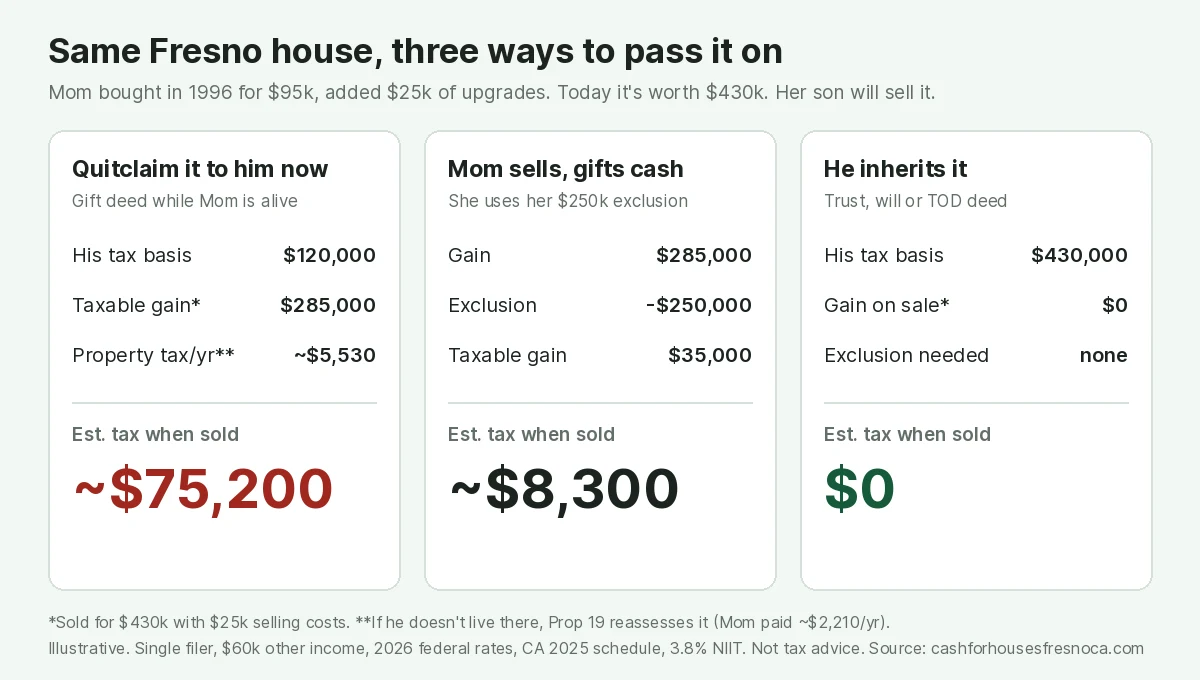
Same house, same family, and the tax ranges from $0 to about $75,000 depending on how it changes hands. The quitclaim is the most expensive option because the son inherits his mother's 1996 basis and, since he never lived there, gets no home sale exclusion. If he moved in and lived there for 2 of the 5 years before selling, he could use his own $250,000 exclusion, which would change the math.
There's also a paperwork cost. A house is a gift for federal tax purposes, and the 2026 annual gift exclusion is $19,000 (opens in a new tab) per person. Gifting a $430,000 house means the parent should file a federal gift tax return (Form 709). With a $15 million lifetime exemption in 2026, very few Fresno families will actually owe gift tax, but the return still has to be filed.
2. Prop 19 can reassess the property tax
Under Prop 19, a parent-to-child transfer is only excluded from reassessment if the home becomes the child's principal residence and the child files for the homeowners' exemption within a year. Even then, the exclusion is capped: the Board of Equalization set the limit at the existing taxable value plus $1,044,586 for transfers from February 16, 2025 through February 15, 2027 (opens in a new tab). If the child keeps it as a rental or a second home, it's reassessed to market value. See our Prop 19 California guide for the full rules.
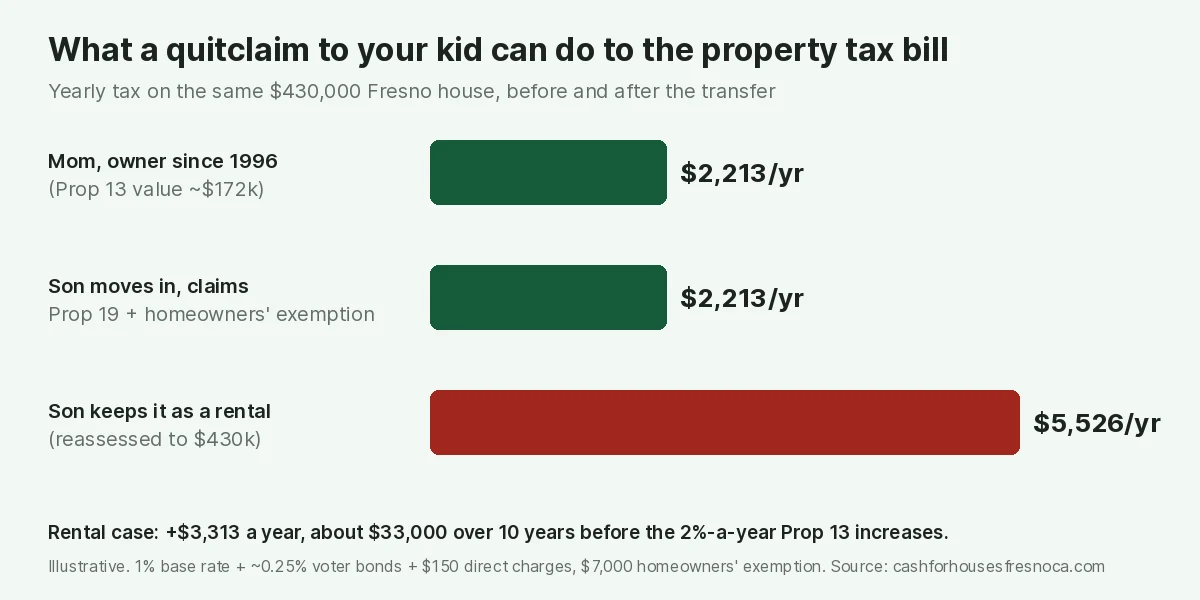
Our Fresno County property tax guide explains how the bill is built. For parents who want the house to go to their kids, a living trust or a revocable transfer on death deed (opens in a new tab) usually keeps the step-up in basis. Since 2022, a California TOD deed has to be signed in front of a notary and two witnesses who aren't beneficiaries, and recorded within 60 days. Our guide to the transfer on death deed in California compares its cost with probate and a living trust. An estate planning attorney can tell you which fits your family.
What a quitclaim deed does to the mortgage
Nothing, and that surprises a lot of people. The deed changes who owns the house. The loan is a separate contract between the borrower and the lender. If you sign a quitclaim in a divorce, you're still on the hook for the mortgage until your ex refinances, sells or pays it off. Late payments will still show on your credit.
The flip side: most mortgages have a "due on sale" clause, but federal law (12 U.S.C. 1701j-3(d) (opens in a new tab)) stops lenders from calling the loan on a 1 to 4 unit home for certain transfers, including:
- a transfer where the borrower's spouse or children become an owner,
- a transfer to a spouse under a divorce decree or legal separation agreement,
- a transfer to a relative after the borrower's death, and
- a transfer into a living trust where the borrower remains a beneficiary.
Quitclaiming to anyone else, like a friend, a business partner or an LLC, can give the lender the right to demand the full balance. Check with your lender before you record.
Other risks of a quitclaim deed, and how to undo one
- No title protection for the grantee. If there's a lien, a missing heir or an old claim, the person receiving the deed has no one to go after.
- Liens follow the property. A quitclaim doesn't wipe out a tax lien, judgment or HELOC against the house.
- The grantee's problems become the house's problems. Once your child is on title, their creditors, divorce or bankruptcy can reach their share.
- It's hard to take back. A recorded quitclaim can't simply be "cancelled." The usual fix is for the grantee to sign a new deed back to you. If they won't, you'd need a court order, which generally means proving fraud, undue influence or a similar problem.
- Elder pressure and deed fraud. Quitclaims are a common tool in scams against older homeowners. If a relative or "helper" is pushing a parent to sign one, slow down and get an independent attorney involved.
Need to sell a house with title or family complications?
Tell us about the property and get a no-obligation all-cash offer. We work with your escrow officer to clear old deeds and liens, and you can close in as little as 7 days.
Selling a house after a quitclaim
If you received the house by quitclaim, you can sell it like any other owner. Expect the buyer's title company to look harder at how you got title. They may ask for the recorded quitclaim, a death certificate if a co-owner passed away, or a signature from anyone with a possible claim. If the quitclaim was a gift from a parent, bring your basis records (the parent's purchase price and improvement receipts) to your tax preparer.
When the paperwork is messy, a cash sale can be simpler. We buy houses in Fresno, Clovis, Madera, Visalia and the rest of the Central Valley as-is, including inherited houses and homes going through a divorce. We'll also tell you honestly if listing with an agent would net you more. Our guides to seller closing costs in Fresno and cash offer vs. listing show both sides of the math, and if you just inherited the property, start with how to sell an inherited house in Fresno.
Get a straight answer on your house
Call or text (559) 512-6998 for an all-cash offer and an honest listing estimate on the same house. No repairs, no showings, no commissions.
Call (559) 512-6998Get My All-Cash OfferQuitclaim deed California: FAQ
Do you need a lawyer to do a quitclaim deed in California?
No, California doesn't require one. You can fill out the form, sign it before a notary and record it yourself. But because the tax, mortgage and Prop 19 consequences can cost far more than the deed, it's worth paying a real estate or estate planning attorney to review anything other than a simple transfer.
How much does it cost to record a quitclaim deed in California?
It varies by county. In Fresno County, it's $19 for the first page and $3 for each additional page, plus a $75 SB2 fee per parcel unless an exemption applies, plus up to $15 per notarized signature. A typical two-page deed costs roughly $37 to $112. A gift or divorce transfer pays no documentary transfer tax if the exemption is stated on the deed.
What are the disadvantages of a quitclaim deed?
It gives no title guarantee, it doesn't remove anyone from the mortgage, it's hard to reverse, and when parents use it to gift a house, the child loses the step-up in basis and the house may be reassessed for property tax under Prop 19.
How does a quitclaim deed work in California?
The current owner signs a deed transferring whatever interest they have to the new owner, gets it notarized, and records it with the county recorder along with a Preliminary Change of Ownership Report. Ownership changes when the deed is delivered, and recording gives public notice.
Does a quitclaim deed trigger reassessment in California?
It can. Transfers between spouses and into your own revocable trust are generally excluded. A parent-to-child transfer is excluded only if the home becomes the child's principal residence and the value stays within the Prop 19 limit. Most other transfers are reassessed to market value.
Can a quitclaim deed be reversed?
Not by the person who signed it alone. The grantee can deed the property back, or a court can cancel the deed if it was obtained by fraud, undue influence or a similar problem.
Is a quitclaim deed the same as an interspousal transfer deed?
No. Both can transfer a spouse's interest, but the interspousal transfer deed is made for transfers between spouses and is often what lenders and title companies prefer at a refinance. Either one can work in a divorce.
Sources and how to cite this guide
- California Civil Code 1113 (opens in a new tab) (grant deed covenants); Revenue and Taxation Code 11927 (opens in a new tab), 11930 (opens in a new tab), 480.3 (opens in a new tab) and 482 (opens in a new tab); Government Code 8211 (opens in a new tab) (notary fees).
- County of Fresno Recorder: Recorded documents (opens in a new tab), fee schedules (opens in a new tab) and SB2 exemptions (opens in a new tab); fee amounts as published by Deeds.com (opens in a new tab) and Levelset (opens in a new tab).
- California State Board of Equalization: Prop 19 parent-child exclusion amount for 2025-2027 (opens in a new tab).
- IRS: basis of property received as a gift (opens in a new tab); Morgan Lewis: 2026 gift and estate tax exemption amounts (opens in a new tab).
- 12 U.S.C. 1701j-3 (opens in a new tab) (Garn-St Germain due-on-sale exemptions); Nolo: California TOD deeds now require witnessing (opens in a new tab); Sacramento County Public Law Library: Quitclaim deed (opens in a new tab).
- Photos: cover desk photo from pxhere, picket fence and typewriter photos from rawpixel, all CC0 public domain. They are not photos of our clients or their homes.
Sharing this data? You're welcome to use the Fresno County recording cost table, the gift vs. inheritance tax comparison and the property tax reassessment chart. Please credit "Cash For Houses Fresno" and link back to this page.