
Capital gains tax in California works differently than most people expect. The state has no special rate for capital gains: your profit is taxed as ordinary income at 1% to 13.3%, on top of the federal 0%, 15% or 20%. The good news for most homeowners is the home sale exclusion. If the house was your main home for 2 of the last 5 years, you can usually leave up to $250,000 of profit ($500,000 for married couples filing jointly) off both your federal and California returns.
I'm Christian Castro, a licensed California realtor (DRE #02195959) and the owner of Cash For Houses Fresno. Taxes come up in almost every conversation I have with sellers, especially landlords, heirs and people who've owned for decades. This guide pulls the IRS and Franchise Tax Board rules into one place, with a tax table and three worked examples. It's general information, not tax advice, so run your own numbers past a CPA or enrolled agent before you sell.
The short answer
- California taxes capital gains as regular income. In the FTB's words, "California does not have a lower rate for capital gains." Rates run from 1% to 12.3%, plus 1% on income over $1 million.
- The home sale exclusion applies to both returns. California follows the federal rule: up to $250,000 of gain tax-free if single, $500,000 if married filing jointly, when you've owned and lived in the home 2 of the last 5 years.
- On a taxable gain, expect roughly 24% to 28% combined for a typical middle-income seller once you add federal tax, California tax and, at higher incomes, the 3.8% net investment income tax. See the tax table.
- Rentals and second homes don't get the exclusion, and depreciation you took (or could have taken) is taxed at up to 25% federally.
- Inherited houses get a fresh start. Your tax basis is usually the value on the date of death, so selling soon after often means little or no gain.
- Most Fresno owner-occupants owe nothing. With the county median around $430,000, a typical local home sale gain fits inside the exclusion.
How capital gains tax works in California
A capital gain is the profit you make when you sell something for more than you have in it. When you sell a house in California, two governments can tax that profit:
- The IRS taxes long-term gains (property you owned for more than one year) at 0%, 15% or 20%, depending on your taxable income. Short-term gains are taxed like wages. Higher earners may also owe the 3.8% net investment income tax (NIIT).
- California's Franchise Tax Board taxes the same gain as ordinary income. The FTB's own page on capital gains and losses (opens in a new tab) says it plainly: "All capital gains are taxed as ordinary income." There is no long-term discount at the state level.
That second point is why the phrase "capital gains tax California" scares people. On a big gain, the state's share alone can be 9.3% or more. But for a primary residence, the first $250,000 or $500,000 of gain usually never gets taxed at all, so the scary rates only apply to what's left over.
The $250,000 / $500,000 home sale exclusion
The exclusion comes from Section 121 of the tax code, and the IRS explains it in Publication 523, Selling Your Home (opens in a new tab). The FTB's page on income from the sale of your home (opens in a new tab) says California conforms to the IRS rules. To qualify:
- Ownership test: you owned the home for at least 2 years (24 months) of the 5 years before the sale.
- Use test: you lived in it as your main home for at least 2 years of those 5. The two years don't have to be in a row, and they don't have to overlap with the ownership years.
- Look-back test: you didn't use the exclusion on another home sale in the 2 years before this one.
Married couples get the full $500,000 only if they file jointly, at least one spouse meets the ownership test, and both meet the use test. If only one spouse qualifies, the couple can usually exclude up to $250,000.
Partial exclusion. If you have to sell before you hit 2 years because of a job move of 50+ miles, a health reason, or an "unforeseeable event" such as a divorce, a death in the family or the home being destroyed, you can often claim part of the exclusion. Publication 523 walks through the math.
No age-based break. The old one-time exclusion for sellers over 55 ended in 1997 when the current rules took over. Today the same $250,000 / $500,000 applies at any age, and you can use it again every two years.

How to figure your gain
The gain isn't the sale price. It's the sale price minus what you have invested in the home:
- Start with the sale price and subtract your selling costs: commissions, escrow and title fees you paid, transfer tax and similar costs. The result is your "amount realized." Our guide to seller closing costs in Fresno lists them line by line.
- Figure your adjusted basis: what you paid for the home, plus some purchase closing costs (like owner's title insurance and recording fees), plus capital improvements such as a new roof, an addition, a remodeled kitchen or new HVAC. Routine repairs and maintenance don't count. If you rented the house out, subtract the depreciation you took.
- Subtract basis from the amount realized. That's your gain. Then subtract the exclusion, if you qualify.
Improvements are where most people leave money on the table. A $40,000 roof-and-HVAC job from 2009 cuts your gain by $40,000, but only if you can show it. Dig out old receipts, permits and contractor invoices before you sell. The City of Fresno and Fresno County permit records can help prove work you don't have paper for.
Selling and not sure what you'll owe?
Call or text Christian for an all-cash offer and an honest listing estimate on the same house, so you and your CPA can compare your real net numbers. You can close in as little as 7 days, or on the date that works best for your taxes.
Call (559) 512-6998Get My All-Cash Offer2026 federal and California rates
Federal long-term capital gains rates for 2026
For sales in 2026, the IRS taxes long-term gains at these rates, based on your total taxable income (including the gain), as reported by Kiplinger (opens in a new tab) from the IRS's inflation adjustments:
| Rate | Single | Married filing jointly | Head of household |
|---|---|---|---|
| 0% | Up to $49,450 | Up to $98,900 | Up to $66,200 |
| 15% | $49,451 to $545,500 | $98,901 to $613,700 | $66,201 to $579,600 |
| 20% | Over $545,500 | Over $613,700 | Over $579,600 |
Two federal add-ons matter for home sellers. The 3.8% net investment income tax applies to taxable gains when your modified adjusted gross income is over $200,000 (single) or $250,000 (married filing jointly), per IRS Topic 559 (opens in a new tab). Gain covered by the home sale exclusion isn't subject to it. And depreciation recapture on a rental ("unrecaptured Section 1250 gain") is taxed at your regular rate, capped at 25%, per IRS Topic 409 (opens in a new tab).
California income tax rates
California adds the gain to the rest of your income and taxes it on the normal brackets. Under the FTB's 2025 tax rate schedules (opens in a new tab) (the latest published; the brackets are adjusted for inflation each year):
- Single filers: 9.3% from $72,724 to $371,479 of taxable income, then 10.3%, 11.3%, and 12.3% over $742,953.
- Married filing jointly: 9.3% from $145,448 to $742,958, then 10.3%, 11.3%, and 12.3% over $1,485,906.
- Mental Health Services Tax: an extra 1% on taxable income over $1 million (from Proposition 63), which is where the 13.3% top rate comes from.
In practice, most middle-income Californians pay 9.3% on a taxable home sale gain, because the gain pushes them into that wide bracket.
How much tax on a $100,000, $200,000 or $300,000 gain?
Here's what a fully taxable long-term gain costs a typical seller, combining federal tax, the NIIT and California tax. "Taxable gain" means what's left after any exclusion, or the gain on a rental with no depreciation.
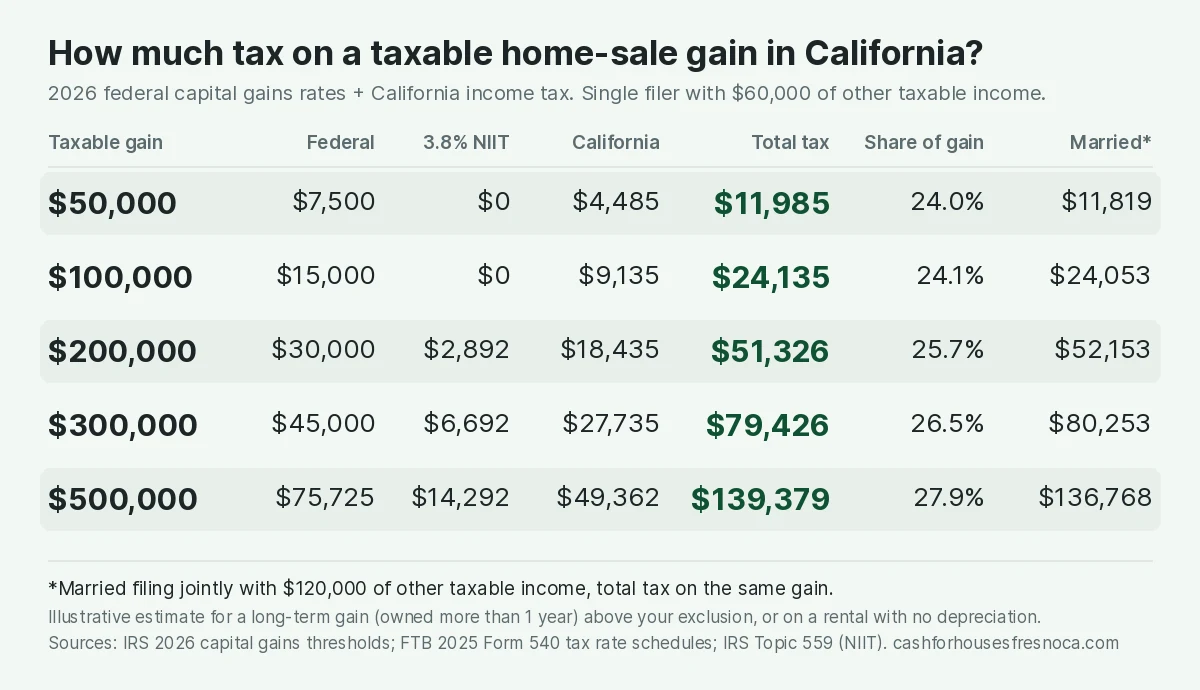
So if you're wondering "how much capital gains tax will I pay on $300,000 in California," the rough answer for a middle-income seller is about $80,000, a little over a quarter of the gain. On a $100,000 taxable gain it's about $24,000. The federal 15% rate does most of the work, California's 9.3% bracket adds the next big piece, and the NIIT kicks in once the gain pushes income past $200,000 or $250,000.
How we built it: federal tax uses the 2026 long-term rates above on top of the seller's other taxable income; the NIIT uses the IRS thresholds with the 2026 standard deduction; California tax is the difference between the tax on income with and without the gain, using the FTB's 2025 schedules. It doesn't account for AMT, credits, or differences between federal and California deductions.
Three Fresno examples
Fresno is a good place to see how much the exclusion matters. The Fresno County median sale price was about $430,000 in August 2026, and the FHFA price index for the Fresno metro has nearly doubled since 2016 (see our Fresno housing market report for the data). That's a big run-up, but for most local homeowners it still fits under $250,000 or $500,000. Where people get hit is long ownership, single filers, and rentals.
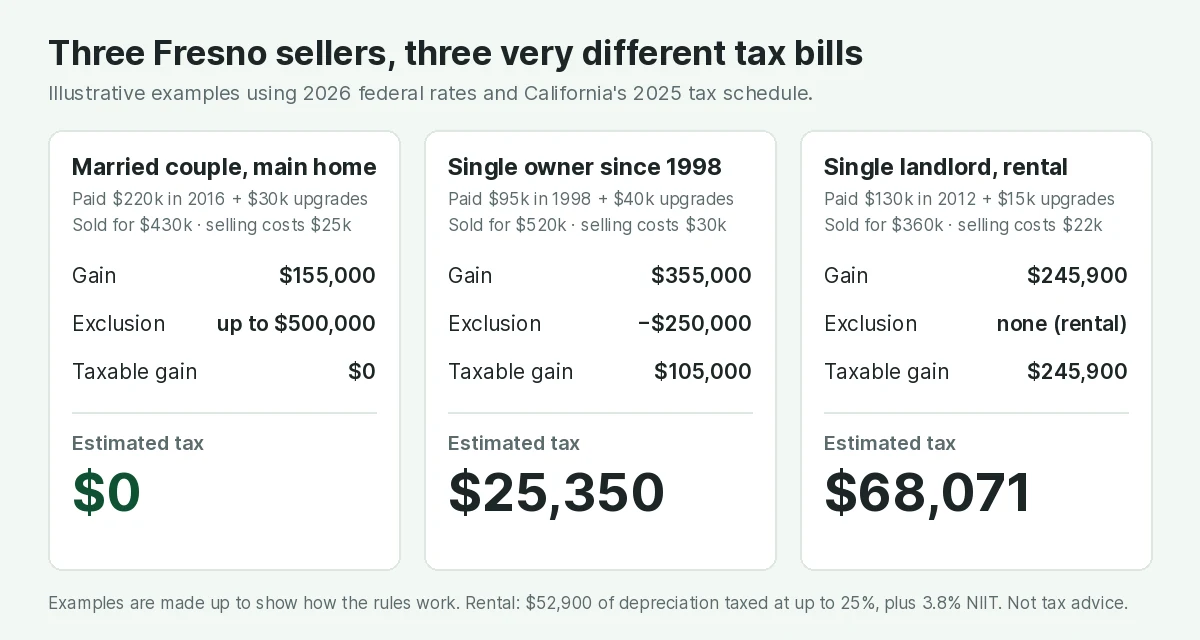
- The married couple pays nothing. Their $155,000 gain is well inside the $500,000 exclusion, and they don't even have to report the sale if escrow doesn't issue a 1099-S.
- The single long-time owner has $105,000 of taxable gain after the $250,000 exclusion: about $15,750 federal and $9,600 California. If this were a surviving spouse selling within two years of a spouse's death, they could often use the full $500,000 and owe nothing (more on that below).
- The landlord gets no exclusion. The $52,900 of depreciation is taxed at regular federal rates (up to 25%), the rest at 15%, plus about $4,600 of NIIT and $22,700 of California tax, for roughly $68,000 total. That's the seller who most needs a CPA before listing, because a 1031 exchange or installment sale could defer most of it.
Rentals, inherited homes, divorce and widows
Rental property
A rental doesn't qualify for the exclusion unless you also lived in it as your main home for 2 of the last 5 years, and even then the IRS limits the exclusion for years after 2008 when it was a rental (called "nonqualified use"), and any depreciation after May 6, 1997 is always taxable. If you're a tired landlord in Fresno or selling a house with tenants, get a tax estimate before you set your bottom-line price, because your net after tax can be very different from your net at closing.
Inherited houses
When you inherit a house, your tax basis is generally its fair market value on the date the owner died, not what they paid decades ago. This "stepped-up basis" wipes out the gain that built up during their lifetime. If Mom bought for $70,000 in 1985 and the house was worth $400,000 when she passed, your basis is about $400,000. Sell it for that, minus selling costs, and there's usually no gain to tax. In California, a community property home can get a step-up on both halves when one spouse dies (see IRS Publication 555 (opens in a new tab)). Get a date-of-death appraisal to document it. A house gifted during the owner's life is different: the child keeps the parent's old basis, which is why our guide to the quitclaim deed in California shows a family paying about $75,000 more by quitclaiming instead of inheriting. Our guide to selling an inherited house in Fresno covers probate, trusts and the rest of the process, and the inherited house page explains how we buy them.
Divorce
Transfers between spouses as part of a divorce generally aren't taxed. When the house is sold, each ex can usually claim up to $250,000 on their own return if they meet the tests. Publication 523 also lets a spouse who moved out count the time their ex lived there under the divorce agreement. See our page on selling a house during divorce for the non-tax side.
Widows and widowers
A surviving spouse who hasn't remarried can generally still claim the full $500,000 exclusion if the home is sold within 2 years of the spouse's death and the other tests were met just before the death. Combined with the community property step-up, many surviving spouses in California owe no tax at all on the sale. Timing matters here, so talk to a tax pro early.
Want to see your all-cash number?
Tell us about the house. We'll send a no-obligation all-cash offer you can hand to your CPA, and you choose the closing date, including after January 1 if that helps your taxes. Close in as little as 7 days.
Legal ways to lower the tax
- Meet the 2-of-5-year test before you sell. If you're a few months short, waiting can be worth tens of thousands of dollars. A move back into a former rental can also help, though the nonqualified-use rules limit it.
- Add up every improvement. Roofs, additions, solar, remodels, new windows, landscaping and HVAC all raise your basis.
- Count every selling cost. Commissions, escrow, title and transfer taxes all reduce your gain.
- Time the closing. Closing in January instead of December moves the gain to the next tax year, which can help if your income will be lower that year. With a cash buyer, you can pick the date.
- 1031 exchange (rentals and investment property). Rolling the proceeds into another investment property defers federal and California tax. Our 1031 exchange California guide covers the 45 and 180-day rules with a Fresno example. If you buy the replacement outside California, the FTB requires an annual Form 3840 and will tax the deferred gain when you eventually sell.
- Installment sale. Carrying the note and getting paid over time can spread the gain over several years (IRS Topic 705 (opens in a new tab)), though depreciation recapture is taxed in the year of sale.
- Hold until death. Not a strategy for everyone, but for older owners who don't need the cash, heirs get the step-up in basis. A transfer on death deed passes the house without probate and keeps that step-up, and so does a living trust.
- Harvest losses. Capital losses from stocks or other investments can offset a taxable home sale gain. Losses on your own home itself aren't deductible.
One thing that doesn't change your tax: who you sell to. A cash buyer, an iBuyer and a traditional buyer all produce the same kind of gain. What changes is the price and the selling costs, which is why we always suggest comparing your net side by side, like in our cash offer vs. listing comparison.
What happens at closing: Form 593 and 1099-S
- California withholding (Form 593). Escrow generally withholds 3 1/3% of the sale price and sends it to the FTB as a prepayment of your state tax, unless an exemption applies. The most common exemption is a principal residence that qualifies for the exclusion. Our closing costs guide explains the exemptions.
- Form 1099-S. Escrow reports most sales to the IRS. If the home was your main residence and the gain is fully covered by the exclusion, you can usually sign a certification so escrow doesn't file one. If you get a 1099-S, report the sale on your return even if you owe nothing.
- Property taxes are separate. Your share of the year's property tax is prorated at closing and isn't part of the capital gains math. See our Fresno County property tax guide.
Will Congress raise the exclusion?
The $250,000 and $500,000 limits were set in 1997 and have never been adjusted for inflation. Meanwhile, home prices have soared. The National Association of Realtors estimated in 2025 that about 29 million homeowners, roughly 34% of all owners, already have more gain than the $250,000 single exclusion (NAR (opens in a new tab)). In California, Cotality found that 28.8% of existing home sales at the end of 2023 had gross gains above $500,000, up from 13.2% before the pandemic (Cotality (opens in a new tab)).
The More Homes on the Market Act (H.R. 1340, with a Senate companion, S. 3332) would double the exclusion to $500,000 for single filers and $1 million for married couples and index it to inflation. As of August 2026 it had about 150 House cosponsors and 23 Senate backers, but it had not passed (Real Estate News (opens in a new tab)). A separate bill to eliminate the tax on home sales entirely didn't advance. Until a law is actually signed, plan with today's numbers. Even if federal law changes, California would have to pass its own conforming law before the state exclusion went up.
We buy houses all over the Central Valley, from Fresno and Clovis to Madera, Visalia and Hanford. You can read more about Christian or contact us directly.
Know your number before you decide
Get an all-cash offer with no repairs, no commissions and a closing date you choose. Call or text (559) 512-6998.
Call (559) 512-6998Get My All-Cash OfferCapital gains tax in California: FAQ
Does California have a capital gains tax?
Not a separate one. California taxes capital gains as ordinary income at its regular rates of 1% to 12.3%, plus 1% on taxable income over $1 million. There's no lower rate for long-term gains like the federal system has.
How much capital gains tax will I pay on $300,000 in California?
For a middle-income seller with a fully taxable $300,000 long-term gain, combined federal, California and net investment income tax comes to roughly $80,000, about 26% to 27% of the gain. If the $300,000 is from selling your main home and you qualify for the exclusion, most or all of it may be tax-free.
Does California follow the $250,000 / $500,000 home sale exclusion?
Yes. The Franchise Tax Board conforms to the federal rule. If you owned and lived in the home as your main residence for at least 2 of the 5 years before the sale, you can exclude up to $250,000 of gain, or $500,000 if married filing jointly, on your California return too.
How do I avoid capital gains tax when selling my house in California?
For a main home, meet the 2-out-of-5-year ownership and use test so the exclusion applies, and add every capital improvement and selling cost to cut your gain. For rentals, a 1031 exchange or installment sale can defer the tax. Heirs usually get a stepped-up basis that removes most of the gain.
Do I pay capital gains tax on an inherited house in California?
Only on growth after the date of death. Your basis is generally the home's fair market value when the owner died, so if you sell soon for about that value, there's usually little or no taxable gain. Get a date-of-death appraisal to support the basis.
Is there a capital gains exemption for seniors in California?
No. The over-55 one-time exclusion was replaced in 1997 by today's $250,000 / $500,000 exclusion, which anyone can use regardless of age, as often as once every two years.
Do I owe capital gains tax if I sell my house for cash?
The tax is the same whether you sell to a cash buyer or a financed buyer. What matters is your gain: sale price minus selling costs minus your basis. Selling for cash can mean lower selling costs and lets you choose the closing date, which can help with tax timing.
Sources and how to cite this guide
- Franchise Tax Board: Capital gains and losses (opens in a new tab), Income from the sale of your home (opens in a new tab), and 2025 Form 540 tax rate schedules (opens in a new tab).
- IRS: Publication 523, Selling Your Home (opens in a new tab); Topic 409, Capital gains and losses (opens in a new tab); Topic 559, Net investment income tax (opens in a new tab); Topic 705, Installment sales (opens in a new tab); Publication 555, Community Property (opens in a new tab).
- Kiplinger: IRS updates capital gains tax thresholds for 2026 (opens in a new tab).
- National Association of Realtors: Momentum builds for capital gains reform for home sales (opens in a new tab) (July 2025).
- Cotality: More homeowners paying capital gains taxes after strong price growth (opens in a new tab).
- Real Estate News: Capital gains exclusion bill draws more backers (opens in a new tab) (August 11, 2026).
- Fresno prices: C.A.R. and FHFA data via our Fresno housing market report.
- Photos: cover, "View from outside a house in a suburb," and living room, both from rawpixel under CC0 public domain. They are not photos of our clients' homes.
Sharing this guide? You're welcome to use the 2026 California capital gains tax table and the Fresno examples chart. Please credit "Cash For Houses Fresno" and link back to this page.