A 1031 exchange in California lets you sell a rental or other investment property and put off paying capital gains tax, as long as you roll the money into another investment property under strict IRS rules. On a typical Fresno rental bought in 2012, that can mean deferring about $77,000 of federal and California tax this year. California follows the federal rules but adds two of its own: an annual FTB filing that follows you if you buy out of state, and withholding rules your intermediary has to get right.
I'm Christian Castro, a licensed California realtor (DRE #02195959) and the owner of Cash For Houses Fresno. A lot of the houses I buy are rentals owned by landlords who are moving their money into something easier to manage, and many of them use a 1031 exchange to do it. This guide covers the 1031 exchange rules California investors have to follow, what the exchange actually saves, and the mistakes that blow up an exchange. It's general information, not tax or legal advice. Before you sell, talk to a CPA and a qualified intermediary.
The short answer
- Only investment and business real estate qualifies. A rental house, duplex, apartment building, land or commercial building can be swapped for any other U.S. investment real estate. Your own home and fix-and-flips don't qualify.
- Two deadlines, no extensions. You have 45 days after your sale closes to identify replacement property in writing and 180 days to close on it. See the timeline.
- You can't touch the money. A qualified intermediary has to hold the sale proceeds. California requires exchange facilitators to carry a $1 million bond or keep funds in a qualified escrow or trust.
- Buy out of state and California keeps watching. You file FTB Form 3840 every year until you sell, and California taxes the deferred gain then. That's the California clawback.
- The savings are real. On our Fresno example, a full exchange defers about $77,364 of tax and lets the investor buy roughly $309,000 more property.
What is a 1031 exchange in California?
A 1031 exchange, named after Section 1031 of the Internal Revenue Code, lets you defer the tax on the sale of investment real estate when you reinvest the proceeds in more investment real estate. The IRS describes it as exchanging "real property used for business or held as an investment solely for other business or investment property" (IRS, Like-kind exchanges: real estate tax tips (opens in a new tab)).
Two words matter. First, it's tax-deferred, not tax-free. The IRS specifically warns about promoters who call exchanges "tax-free" (IRS Fact Sheet 2008-18 (opens in a new tab)). Your old basis carries over into the new property, so the gain is still there. You just don't pay it until you sell without exchanging again. Second, it's a real estate tool. Since January 1, 2018, the Tax Cuts and Jobs Act limited Section 1031 to real property, and the July 2025 tax bill left it untouched. As exchange company IPX1031 (opens in a new tab) put it, "Section 1031 Like-Kind Exchanges remain fully intact."
California conforms to Section 1031 for state income tax, so a valid federal exchange also defers California tax. That matters more here than almost anywhere. California taxes capital gains as ordinary income at rates up to 13.3%, with no lower long-term rate, which our guide to capital gains tax in California walks through. For a California landlord, the state piece alone can be a third of the total bill.
What property qualifies (and what doesn't)
"Like-kind" sounds narrow, but for real estate it's broad. Almost any U.S. real estate held for investment or business is like-kind to any other. You can trade:
- A single-family rental in Fresno for a fourplex in Clovis
- A duplex for vacant land, a strip center or a warehouse
- Farmland in Kings County for an apartment building in Texas
- One rental for several smaller ones, or several for one larger one
- A rental for a fractional interest in a Delaware Statutory Trust (DST)
What doesn't qualify:
- Your primary residence. The IRS says property "used primarily for personal use, like a primary residence," doesn't qualify. Your own home has its own break, the $250,000/$500,000 Section 121 exclusion.
- Flips and inventory. Real property "held primarily for sale" doesn't qualify. A house you bought to fix and resell in four months is inventory, not an investment.
- Foreign property. U.S. real estate isn't like-kind to real estate outside the U.S.
- Personal property. Since 2018, equipment, vehicles and furniture no longer qualify, even if they come with the building.
- Most vacation homes. A second home you mostly use yourself isn't investment property. There's a narrow safe harbor, covered below.
The same taxpayer also has to sell and buy. If you and your spouse own the rental, you two take title to the replacement. If an LLC owns it, that LLC buys the replacement. Changing how title is held right before or after an exchange is a common way to lose it, so ask your CPA before you quitclaim anyone onto or off of title.

The 1031 exchange rules California investors must follow
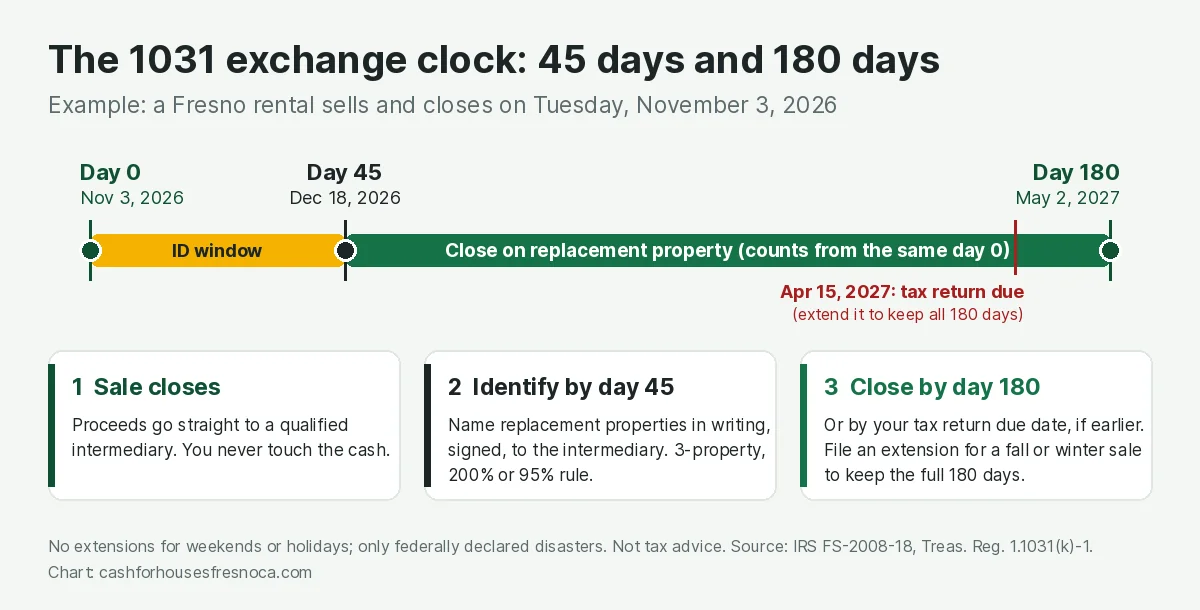
The rules are federal, so they're the same in California as in any other state. What makes exchanges fail is the calendar. Here's how the clock works, using a Fresno rental that closes escrow on November 3, 2026.
1. The 45-day identification rule
Within 45 calendar days of closing, you have to identify your replacement property in writing, signed by you and delivered to someone involved in the exchange, usually your qualified intermediary. Telling your agent or CPA doesn't count (IRS FS-2008-18 (opens in a new tab)). Under Treasury Regulation 1.1031(k)-1 (opens in a new tab), you can identify using one of three rules:
- Three-property rule: up to three properties of any value. This is what most investors use.
- 200% rule: any number of properties, as long as their total value is no more than 200% of what you sold.
- 95% rule: any number at any value, but you have to actually buy at least 95% of the total value you identified. It's rarely practical.
2. The 180-day exchange period
You must close on the replacement within 180 days of your sale, or by the due date of your tax return for that year, whichever comes first. That second part trips up fall and winter sellers. In our example, day 180 is May 2, 2027, but the 2026 return is due April 15, 2027. File an extension and the full 180 days come back. Weekends and holidays don't extend either deadline. The only exception is a federally declared disaster, which matters in a state with fire seasons.
3. A qualified intermediary holds the money
You can't receive or control the sale proceeds, even briefly. A qualified intermediary (QI, also called an accommodator or exchange facilitator) signs an exchange agreement with you before your sale closes, receives the proceeds from escrow and wires them to buy the replacement. Your own agent, attorney or accountant can't serve as your QI if they've worked for you in the last two years. If the money hits your bank account, the exchange is over.
4. Reinvest everything to defer everything
To defer all the tax, buy replacement property worth at least as much as what you sold (after selling costs), reinvest all the net cash, and replace any mortgage you paid off with new debt or extra cash. Anything you keep is called boot, and it's taxable. The IRS puts it simply: "you must recognize a gain to the extent of the other property and money received." Trading down from a $430,000 rental to a $380,000 one is allowed, but about $50,000 of your gain is taxed.
5. Related-party and reporting rules
If you exchange with a family member or a company you control, both of you generally have to hold the properties for two years, under Section 1031(f), or the deferral unwinds. Every exchange is reported on IRS Form 8824 (opens in a new tab) with your return for the year of the sale.
Selling a Fresno rental as part of a 1031 exchange?
Call or text (559) 512-6998. We buy rentals as-is, tenants and all, and we'll set the closing date around your exchange timeline. Close in as little as 7 days or on the date your intermediary needs.
Call (559) 512-6998Get My All-Cash OfferWhat a 1031 exchange saves: a Fresno rental example
Here's an illustrative example with round numbers. A married couple bought a Fresno rental in 2012 for $180,000. They sell it in late 2026 for $429,450, the C.A.R. Fresno County median for September 2026 (opens in a new tab). They have $100,000 of other income and take the standard deduction.
- Depreciation: 80% of the price was the building, depreciated over 27.5 years. After 14 years they've deducted about $73,309, which lowers their basis to $106,691.
- Selling costs: about 6.8%, or $29,200, in line with our breakdown of seller closing costs in Fresno.
- Taxable gain: $429,450 minus $29,200 minus $106,691 = $293,559.
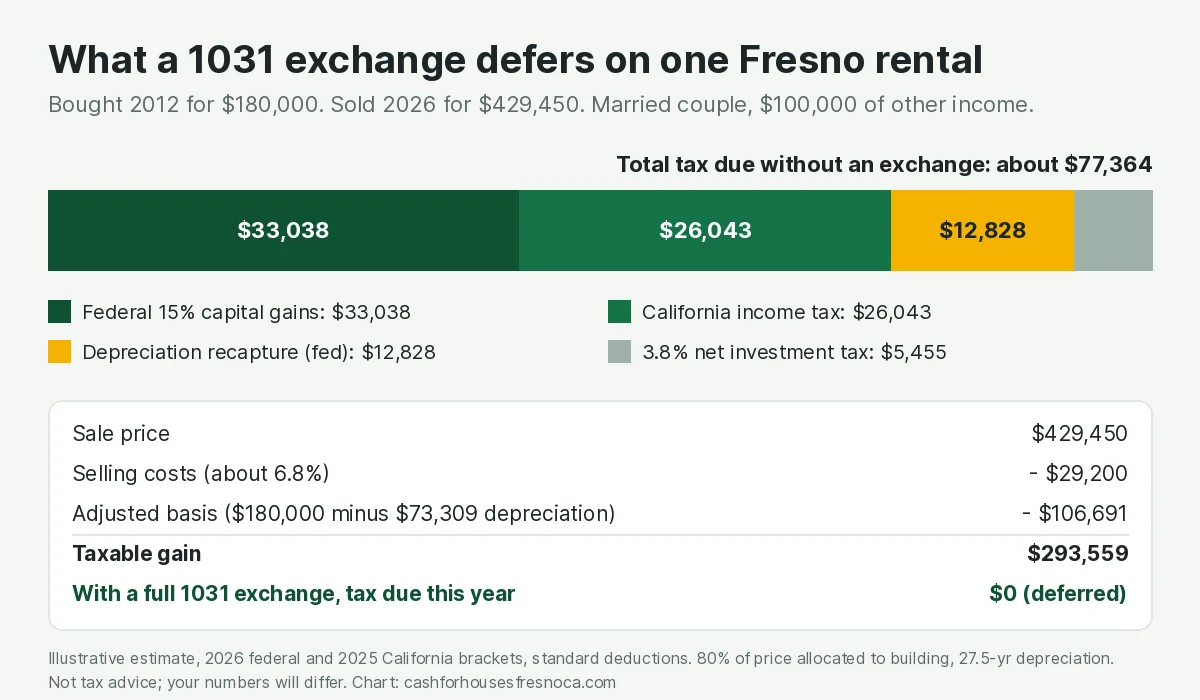
Without an exchange, the bill comes to roughly $77,364:
- Depreciation recapture: the $73,309 of depreciation is taxed at ordinary federal rates, capped at 25%. Here, about $12,828.
- Federal capital gains: the remaining $220,250 at 15%, about $33,038.
- Net investment income tax: 3.8% on the part of their income above $250,000, about $5,455.
- California: the whole gain taxed as ordinary income, mostly in the 9.3% bracket, about $26,043 using the FTB's 2025 rate schedule (opens in a new tab).
That's about 26% of their gain and 18% of the sale price. With a full 1031 exchange, they owe none of it this year. And the deferral compounds: the money that would have gone to tax keeps working as a down payment.
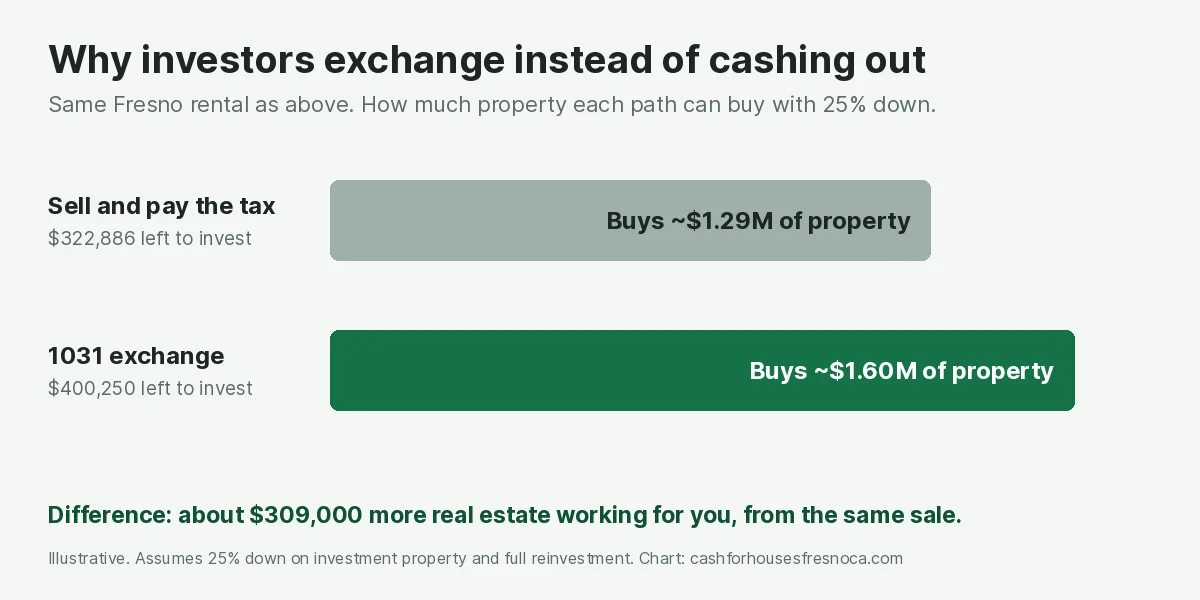
Your numbers will differ with your income, improvements, depreciation method and whether you lived in the property. Run your own figures with a CPA before you list. But the shape of it holds for most long-time Central Valley landlords: the older the rental, the bigger the deferral.
California-only rules: withholding, intermediaries and property tax
Form 593 withholding
When you sell California real estate, escrow normally withholds 3 1/3% of the price for the Franchise Tax Board unless you qualify for an exemption, as we covered in our closing costs guide. In an exchange, you certify on Form 593 (opens in a new tab) that it's a deferred exchange, and the duty shifts. The FTB says (opens in a new tab) "it is the QI's obligation to withhold and not the obligation of the real estate escrow person." If you take more than $1,500 of boot, the QI withholds 3 1/3% of the boot above $1,500. If the exchange fails, the QI withholds 3 1/3% of the entire sales price. A seller who qualifies for a full exemption, such as the principal-residence exemption, isn't withheld on at all.
Rules for intermediaries
Your QI holds what may be your entire life's equity for up to six months, and intermediary failures have cost investors their savings. California regulates exchange facilitators under the Financial Code. Section 51003 (opens in a new tab) requires each one to carry a fidelity bond of at least $1,000,000, deposit $1,000,000 in cash or securities, or hold all exchange funds in a qualified escrow or trust account that needs both the facilitator's and your written authorization to withdraw. Ask any QI which option it uses, whether your funds sit in a separate account, and for proof of the bond and errors and omissions insurance.
Property tax doesn't come with you
A 1031 exchange defers income tax, not property tax. Under Prop 13, your replacement property is reassessed at its purchase price, so a rental you've held since 2012 with a low assessed value will be replaced by one taxed on today's price. In Fresno County that's roughly 1.1% to 1.3% a year of the new price. Our Fresno County property tax guide shows how the bill is built. Budget for it when you compare cash flow. The county's documentary transfer tax is also still due on the sale.
1031 exchange from California to another state: the clawback
A lot of California landlords exchange into Texas, Arizona, Idaho or Nevada for cheaper prices and no state income tax. That's allowed. But California doesn't forget the gain you built up here. It taxes that gain when you finally sell the out-of-state property in a taxable sale, even if you've moved away. This is called the California clawback.
To keep track, California requires Form FTB 3840 (opens in a new tab) for any exchange of California property for property outside the state. You file it the year of the exchange and "for each subsequent taxable year, generally until the California sourced deferred gain or loss is recognized." That applies "regardless of residence status," so a landlord who moves to Boise still files it every year, even with no other reason to file in California. If you don't, the FTB says it "may estimate net income and assess tax plus any applicable penalties and interest." The requirement comes from Revenue and Taxation Code section 18032.
Two practical points. If you later exchange the out-of-state property for another one, the deferral continues and so does the annual form. And if you hold until death, your heirs generally get a stepped-up basis, which erases the deferred gain for both federal and California purposes.
Types of exchanges: delayed, reverse, improvement and DST
- Delayed exchange. The standard version described above: sell first, then buy within 180 days. Almost every exchange we see in Fresno is a delayed exchange.
- Simultaneous exchange. Both closings happen the same day. It's rare now, because lining up two escrows to the hour is hard.
- Reverse exchange. You buy the replacement first. An exchange accommodation titleholder holds title for up to 180 days while you sell the old property. It solves the "I found the perfect building but haven't sold yet" problem, but costs more and needs cash or financing for the purchase.
- Improvement (build-to-suit) exchange. Exchange funds pay for improvements on the replacement property before you take title. Only work finished within 180 days counts toward the value you need to match.
- Delaware Statutory Trust (DST). A fractional share of a large professionally managed property, like an apartment complex or medical office. DSTs qualify as like-kind real estate and are popular with landlords who are tired of tenants but don't want the tax bill. They're also illiquid securities with fees, so read the offering documents and get independent advice.
Moving into a property, vacation homes and "swap till you drop"
Converting a replacement into your home. You have to acquire the replacement with the intent to hold it as an investment. Renting it out for a meaningful period first is the safer path. And if you later live in it and want the Section 121 home sale exclusion, Section 121(d)(10) makes you own the property for at least five years after the exchange before the exclusion is available.
Vacation homes. Under the IRS safe harbor in Rev. Proc. 2008-16, a second home can qualify if you owned it for at least two years, rented it at fair market rent for at least 14 days in each of those two years, and your personal use stayed at or under 14 days or 10% of the rented days, whichever is more, each year (IPX1031 summary (opens in a new tab)). A cabin you use all summer won't make it.
Mixed-use property. If you lived in part of a duplex and rented the other unit, the part you lived in may qualify for the home sale exclusion and the rental part for a 1031 exchange. This split needs a CPA, but it can shelter a lot of gain.
Swap till you drop. Some investors exchange again and again and never pay the deferred tax. When they die, their heirs inherit with a basis stepped up to market value, and the deferred gain disappears. It's legal and common, and it's why exchanges are a core estate planning tool for Valley landlords. If that's your plan, pair it with a trust or a transfer on death deed so your heirs avoid probate too.
What a 1031 exchange costs
A standard delayed exchange isn't expensive compared with the tax it defers. BiggerPockets (opens in a new tab) found a median QI fee of $750 for one sale and one purchase, with a range from about $450 to more than $1,500, plus roughly $150 to $400 for each extra replacement property. Reverse and improvement exchanges cost much more because the accommodator has to take title. On top of the QI fee, budget for your CPA and, ideally, a real estate attorney to review the exchange agreement. Your normal selling costs are the same as in any sale.
The bigger cost is pressure. With 45 days to identify, investors sometimes overpay for a mediocre property just to save the tax. A bad building bought to avoid a $40,000 tax bill can lose more than that. Start shopping before you list, and if nothing good turns up, paying the tax is a valid choice.
Selling a rental in Fresno or the Central Valley?
Tell us about the property. You'll get a no-obligation all-cash offer and an honest listing estimate, and we'll work with your qualified intermediary on the exchange paperwork. Close in as little as 7 days, or on the date your exchange needs.
Mistakes that blow up an exchange
- Setting up the QI after closing. The exchange agreement has to be signed and assigned into your sale escrow before your sale closes. Once escrow wires the proceeds to you, it's too late.
- Taking cash at closing. Even a small check for "a few thousand to cover moving costs" is boot and taxable.
- Missing day 45. An email to your agent isn't an identification. Use the QI's form, sign it and deliver it before midnight on day 45.
- Forgetting the tax return deadline. A sale after mid-October can lose part of the 180 days unless you extend your return.
- Paying down debt without replacing it. If you pay off a $150,000 mortgage on the old property and buy the new one with cash equal only to your equity, the $150,000 of debt relief is boot.
- Using exchange funds for non-closing costs. Commissions and title fees are fine. Paying off a credit card, prorated rents or security deposits out of exchange funds can create taxable boot.
- Changing the taxpayer. Selling in your personal name and buying in a new LLC, or adding a child to title, can break the same-taxpayer rule.
- Forgetting FTB 3840. If you buy out of state, put the annual filing on your calendar for every year you own the property.
Selling a Fresno rental as part of a 1031 exchange
The exchange itself happens in escrow paperwork. The buyer of your old property doesn't need to do anything special except sign an acknowledgment that you're assigning the contract to your QI. That means you can sell to a regular buyer or to a cash buyer like us and still exchange.
Where a cash sale helps is the calendar. When you list a tenant-occupied rental, you're waiting on showings, inspections, an appraisal and a buyer's loan, and you don't know your closing date until late in the process. That makes the 45-day window hard to plan around. With a cash sale, you pick the closing date. Some sellers close in a week. Others wait until they've already found two or three replacement properties, so the 45-day window starts when they're ready. We buy rentals as-is, with tenants in place, deferred maintenance and all. See our pages for tired landlords and selling a house with tenants.
Being honest about it, a cash offer is usually below what a fully renovated, vacant rental would bring on the open market. If your rental is in great shape and you have time, listing may net you more, and our comparison of a cash offer vs. listing shows the trade-off. If it needs work, has difficult tenants, or you need a firm date to make the exchange work, an as-is cash sale is often the cleaner path. You can also see our guide to how long it takes to sell a house to plan the timeline. We buy across Fresno, Clovis, Madera, Visalia, Hanford and the rest of the Central Valley.
Ready to plan your exit from a rental?
Call or text (559) 512-6998 for an all-cash offer and an honest listing estimate on the same property. No repairs, no showings, no commissions, and a closing date that fits your 1031 exchange.
Call (559) 512-6998Get My All-Cash Offer1031 exchange California: FAQ
How does a 1031 exchange work in California?
You sell an investment property, a qualified intermediary holds the proceeds, you identify replacement property in writing within 45 days and close on it within 180 days. California follows the federal Section 1031 rules, so a valid exchange defers both federal and California income tax. If the replacement is outside California, you also file FTB Form 3840 every year.
What are the 1031 exchange rules in California?
The same as federal law: like-kind U.S. investment or business real estate, a qualified intermediary, a 45-day identification period, a 180-day exchange period (or the tax return due date if earlier), and reinvestment of all net proceeds to defer all the tax. California adds Form 593 withholding rules for intermediaries, a $1 million bond or escrow rule for exchange facilitators, and the FTB 3840 filing for out-of-state replacement property.
Can I do a 1031 exchange on my primary residence in California?
No. A primary residence isn't investment property. Your home sale may qualify instead for the Section 121 exclusion of up to $250,000 of gain, or $500,000 for a married couple. A property that was partly a home and partly a rental may qualify for both.
Can I do a 1031 exchange from California to another state?
Yes. Any U.S. investment real estate is like-kind to any other. But California will tax the gain you deferred when you later sell the out-of-state property, and you must file FTB Form 3840 every year until then, even if you no longer live in California.
How long do I have to hold a property for a 1031 exchange?
The law doesn't set a fixed holding period, except two years for exchanges between related parties. What matters is intent to hold for investment. Many advisors suggest at least a year, and longer is safer. If you later want the home sale exclusion on a replacement property, you must own it for at least five years after the exchange.
Does a 1031 exchange avoid California property tax reassessment?
No. A 1031 exchange defers income tax only. The replacement property is reassessed at its purchase price under Prop 13, and your old low assessed value doesn't transfer.
Can I sell my rental to a cash buyer and still do a 1031 exchange?
Yes. The buyer only needs to agree that you're assigning the sale to your qualified intermediary. A cash sale can make the exchange easier because you control the closing date. Set up the exchange with your intermediary before your sale closes.
How much does a 1031 exchange cost?
A typical delayed exchange with one sale and one purchase costs about $750 in intermediary fees, with most falling between $450 and $1,500. Reverse and improvement exchanges cost more. Add your CPA and any attorney review. That's usually small compared with the tax deferred.
Sources
- IRS: Like-kind exchanges, real estate tax tips (opens in a new tab); Fact Sheet 2008-18 (opens in a new tab); Form 8824 (opens in a new tab); Treas. Reg. 1.1031(k)-1 (opens in a new tab).
- California Franchise Tax Board: 2025 instructions for Form FTB 3840 (opens in a new tab); qualified intermediary withholding (opens in a new tab); Form 593 (opens in a new tab); 2025 tax rate schedules (opens in a new tab).
- California Financial Code section 51003 (opens in a new tab) (exchange facilitator bond and escrow requirements).
- IPX1031: current status of Section 1031 (opens in a new tab) and Rev. Proc. 2008-16 summary (opens in a new tab); BiggerPockets: 1031 exchange costs (opens in a new tab); 2026 federal brackets via CPA Practice Advisor (opens in a new tab); median price from the C.A.R. September 2026 sales report (opens in a new tab).
Data in this guide is as of October 2026. You're welcome to share the charts with a link back to this page.