A transfer on death deed in California (often called a TOD deed) lets you name who gets your house when you die, without giving up any ownership while you're alive and without sending the house through probate. In Fresno County, recording one costs about $112, while full probate on a median-priced house can run more than $23,000 in statutory fees. The catch: since 2022, a TOD deed is void if you skip a single step, including the two witnesses most people have never heard about.
I'm Christian Castro, a licensed California realtor (DRE #02195959) and the owner of Cash For Houses Fresno. I buy a lot of inherited houses, and how the owner left the property decides whether the family can sell in weeks or waits a year in probate. This guide covers how a California TOD deed works, how to make one valid, what it costs compared with probate and a living trust, and what your beneficiary has to do after you're gone. It's general information, not legal or tax advice. For your own plan, talk to a California estate planning attorney.
The short answer
- A TOD deed passes your house at death, outside probate. It does nothing while you're alive. You can still live there, sell, refinance or cancel it.
- Since January 1, 2022, it needs two witnesses. Under Probate Code 5624 (opens in a new tab), you sign and date it, two witnesses sign at the same time, and a notary acknowledges your signature. Then it has to be recorded within 60 days.
- It's cheap. About $112 to record a two-page deed in Fresno County, plus roughly $97 for the affidavit your beneficiary records later. See the cost comparison.
- Your heirs keep the step-up in basis. Unlike a quitclaim while you're alive, the house is treated as inherited, so the capital gains tax on a later sale is usually small or zero.
- Your beneficiary has deadlines. Notice to heirs, a recorded affidavit, a 120-day contest window and a 150-day property tax filing. See the timeline.
What is a transfer on death deed in California?
A revocable transfer on death deed is a recorded deed that says, in effect, "When I die, this property goes to the person I name." California has allowed them since 2016, and the rules live in Probate Code sections 5600 to 5698 (opens in a new tab). The 2022 amendments extended the law to January 1, 2032.
The key word is revocable. Recording a TOD deed doesn't give your beneficiary anything today. The State Board of Equalization's guidance to county assessors (opens in a new tab) puts it plainly: the recording "does not convey any right, title, or interest in the property." You keep full ownership. Your beneficiary can't stop you from selling, can't borrow against the house and doesn't need to sign anything.
Who can make one? Under Probate Code 5620 (opens in a new tab), any owner who has the capacity to contract. It works for most homes: a single-family house, a condo, residential property with up to four units, and smaller agricultural parcels with a home on them. Your beneficiary can be a person, several people, a trust or an organization like a church or charity.

The 2022 rules: witnesses, notary and 60 days
A lot of online forms and older articles still describe the pre-2022 version, which didn't require witnesses. For any transfer on death deed in California signed today, Probate Code 5624 (opens in a new tab) says the deed isn't effective unless all three of these happen:
- You sign and date the deed.
- Two witnesses sign it. They have to be present at the same time and either watch you sign or hear you acknowledge your signature.
- A notary acknowledges your signature. Only your signature needs to be notarized, not the witnesses'.
Then the deed must be recorded within 60 days of the notarization with the recorder in the county where the property sits (Probate Code 5626 (opens in a new tab)). Miss the window and the deed fails.
Pick your witnesses carefully. Nolo (opens in a new tab) points out that if a beneficiary serves as a witness, the law presumes fraud, duress or undue influence, and a court can throw the deed out unless the beneficiary proves otherwise. Use two adults who aren't getting anything from the deed, like a neighbor and a coworker. Deeds that were validly signed and recorded under the old rules before 2022 are still good.
How to make a TOD deed in California, step by step
Here's the process using Fresno County as the example. The Recorder's office records documents but its staff can't give legal advice or help fill out the form.
- Check how you hold title. Pull your last recorded deed. If you own the home in joint tenancy or as community property with right of survivorship, the surviving co-owner gets it automatically and a TOD deed is void under Probate Code 5664 (opens in a new tab). If the house is already in a living trust, you don't need one.
- Use the statutory form. California's TOD deed form is in Probate Code 5642, and it comes with a "common questions" page that explains how the deed works. Read it. Copy the assessor's parcel number (APN) and legal description exactly from your current deed.
- Name your beneficiaries by name. Say whether each person gets an equal share. If you want a backup beneficiary, ask an attorney how to word it.
- Sign in front of a notary and two witnesses at the same time. The notary charges up to $15 per signature (opens in a new tab).
- Record it within 60 days. In Fresno County, take it to the Recorder at 1250 Van Ness Ave in downtown Fresno or mail it in. No transfer tax applies and no Preliminary Change of Ownership Report is needed at recording, according to the BOE (opens in a new tab).
- Tell your beneficiary where the paperwork is. They'll need the recorded deed after your death, and a copy is easier than a records search.
To change your mind later, record a new TOD deed (the later one controls under Probate Code 5628 (opens in a new tab)) or record a revocation using the form in Probate Code 5644. Don't count on a will or a conversation to undo it. Get the change on record.
Inherited a house that already has a TOD deed?
Call or text (559) 512-6998. We'll walk you through the affidavit and title steps, give you an all-cash offer and an honest listing estimate, and you can close in as little as 7 days once title is clear.
Call (559) 512-6998Get My All-Cash OfferWhat a TOD deed costs vs. probate and a living trust
This is where a transfer on death deed in California shines. The table and chart below use Fresno County's median sale price of $429,450 for September 2026, from the California Association of Realtors (opens in a new tab).
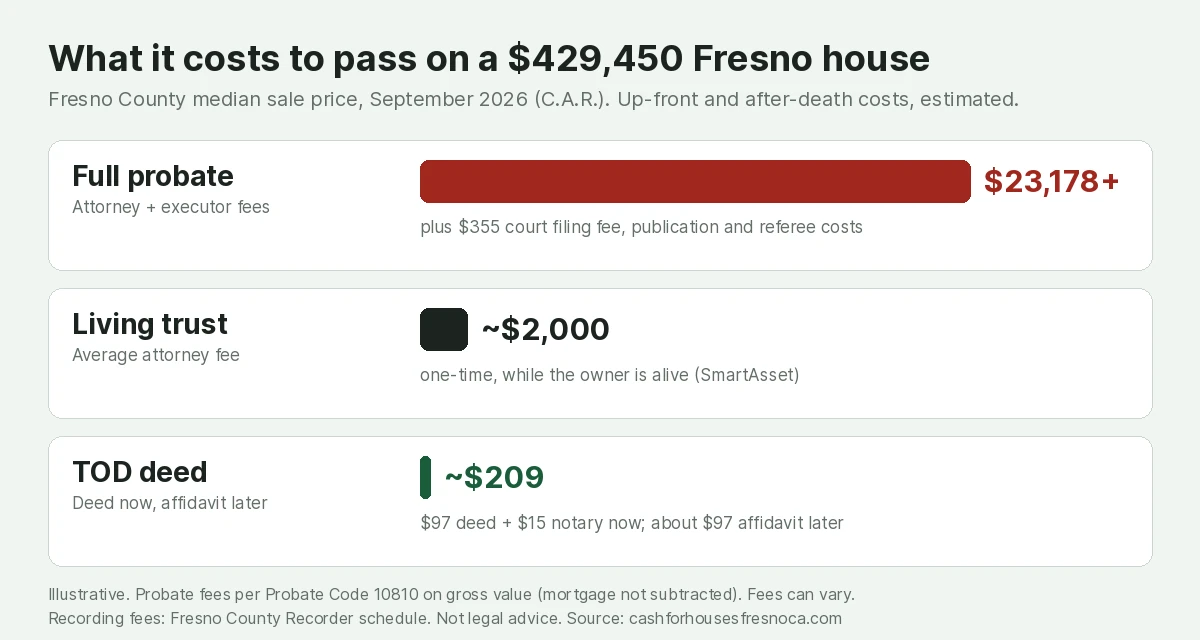
The TOD deed. Fresno County charges $19 for the first page and $3 for each additional page, and a two-page TOD deed records for about $97 once the $75 SB2 housing fee is added, according to SimplyTrust's Fresno County guide (opens in a new tab). Add $15 for the notary. After your death, your beneficiary records a short affidavit with a death certificate, which costs about the same. Call the Fresno County Recorder (opens in a new tab) to confirm current fees before you go.
A living trust. SmartAsset says an average California attorney may charge about $2,000 (opens in a new tab) for a living trust. You get more for that money (more on that below), but it's roughly ten times the cost.
Full probate. California sets the executor's and the attorney's fees as a percentage of the estate's gross value, meaning the mortgage isn't subtracted first: 4% of the first $100,000, 3% of the next $100,000 and 2% of the next $800,000, per Probate Code 10810 (opens in a new tab). Each one gets that amount. On top of that, the court's first filing fee is typically $435 (a $355 base fee (opens in a new tab) plus state surcharges), plus publication and appraisal costs. Our guide to how long probate takes in California walks through the full timeline and every cost.
| House value | Executor fee | Attorney fee | Total statutory fees | TOD deed (approx.) |
|---|---|---|---|---|
| $300,000 | $9,000 | $9,000 | $18,000 | ~$209 |
| $429,450 (Fresno County median) | $11,589 | $11,589 | $23,178 | ~$209 |
| $600,000 | $15,000 | $15,000 | $30,000 | ~$209 |
| $800,000 | $19,000 | $19,000 | $38,000 | ~$209 |
One note: for deaths on or after April 1, 2025, a primary residence worth $750,000 or less can often go through a shorter court petition instead of full probate. Our guide to selling an inherited house in Fresno explains that option. It's cheaper than full probate, but it's still a court case. A TOD deed skips the court entirely.
TOD deed vs. living trust, joint tenancy and quitclaim
A TOD deed isn't the only way to keep a house out of probate. Here's how the common options stack up:
| Option | Avoids probate? | Heir gets step-up in basis? | Owner keeps control? | Best for |
|---|---|---|---|---|
| TOD deed | Yes | Yes | Yes, fully | A paid-off or simple home, one or a few heirs, a tight budget |
| Living trust | Yes | Yes | Yes, as trustee | Several properties, minor or special-needs heirs, planning for incapacity |
| Joint tenancy | Only until the last owner dies | Partly (the deceased owner's share) | Shared with co-owner | Spouses or partners |
| Quitclaim to a child now | Yes, but it's a gift today | No, child takes your old basis | No, it's their house | Rarely the right choice for a parent's home |
| Will only | No | Yes | Yes | Homes that qualify for the $750,000 petition, or when other assets need probate anyway |
The biggest thing a living trust does that a TOD deed doesn't: it handles incapacity. If you develop dementia, your successor trustee can manage or sell a trust-owned house. With a TOD deed, nobody can sell for you unless you've signed a durable power of attorney. Trusts also cover bank accounts and other assets in one document, and they can hold the house for a young or vulnerable beneficiary.
The worst option on the list is usually a quitclaim to your kids while you're alive. Our quitclaim deed California guide runs the numbers on a Fresno house: about $75,000 of tax for the child who got it by quitclaim, versus about $0 for the child who inherited it through a trust, will or TOD deed.

Property tax, capital gains and Medi-Cal
Property tax: Prop 19 still applies
Recording the deed doesn't change your property taxes. The change in ownership happens at death, and that's when Prop 19 (opens in a new tab) kicks in. A child can keep the parent's low Prop 13 tax base only if the house becomes the child's principal residence and they file for the homeowners' exemption within one year. The excluded value is capped at the parent's taxable value plus $1,044,586 for transfers from February 16, 2025 through February 15, 2027. If the child keeps it as a rental or leaves it empty, the house is reassessed to market value. Our Prop 19 California guide shows what that does to the bill, plus the claim forms and deadlines.
Capital gains: the step-up is the big win
Because you own the house until you die, your beneficiary gets a basis equal to its value on the date of death, per IRS Publication 551 (opens in a new tab). If Mom bought in 1996 for $95,000 and the house is worth $430,000 when she dies, her son's basis is $430,000. Sell soon for about that, and there's little or no gain to tax. Our capital gains tax California guide walks through the rest of the rules.
Medi-Cal estate recovery
For deaths on or after January 1, 2017, the state's Department of Health Care Services (opens in a new tab) limits estate recovery to the probate estate of members who were 55 or older. A house that passes by TOD deed generally isn't part of the probate estate, which is a big reason elder law attorneys like these deeds. The beneficiary should still notify DHCS of the death, and anyone on Medi-Cal should have an elder law attorney confirm how the rules apply to them.
Limits and risks to know first
- One missed step voids it. No witnesses, no notary, or recorded on day 61, and the house goes through probate as if the deed never existed.
- It doesn't cover incapacity. Pair it with a durable power of attorney, or use a trust.
- The mortgage comes with the house. Your beneficiary takes the property subject to any loan. Federal law (12 U.S.C. 1701j-3 (opens in a new tab)) generally stops a lender from calling a home loan due just because it passed to a relative at death, but someone still has to keep the payments current.
- Your debts can follow it. If your other assets can't cover your bills, a beneficiary can be personally liable for unsecured debts, capped at the house's value minus liens (Probate Code 5674 (opens in a new tab)).
- A beneficiary has to outlive you. If someone you named dies first, their share generally goes to the other named beneficiaries, not to that person's kids. Review the deed after any death in the family.
- Several beneficiaries means co-owners. Three siblings who inherit together all have to agree to sell. If they can't, it can end in a partition lawsuit.
Inherited a house in Fresno and not sure what to do next?
Tell us about the property. You'll get a no-obligation all-cash offer and an honest listing estimate, and we'll work with your title company on the TOD deed paperwork. Close in as little as 7 days once title is clear.
What the beneficiary does after the owner dies
The deed takes effect at death, but the beneficiary has paperwork to finish before the house is truly sellable. The Sacramento County Public Law Library (opens in a new tab) lays out the steps, which apply statewide:
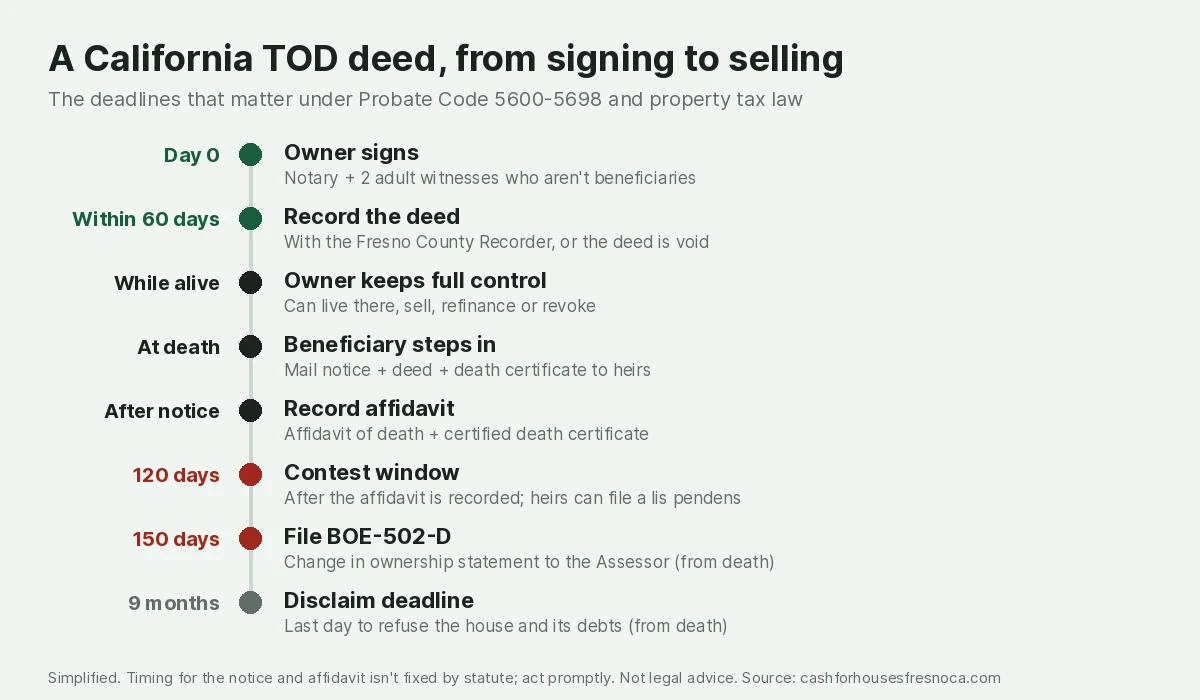
- Get certified death certificates and a copy of the recorded TOD deed.
- Mail notice to the owner's legal heirs. Probate Code 5681 requires the beneficiary to send each heir a notice in the statutory form with copies of the deed and death certificate. Figuring out who counts as an heir can be tricky, so this is a good place for an attorney.
- Record the affidavit. The beneficiary signs an Affidavit of Death of Transferor before a notary, confirming notice was served, and records it with a certified death certificate.
- Wait out the contest window. An heir who thinks the deed is invalid can challenge it. Under Probate Code 5694, a contest backed by a lis pendens recorded within 120 days after the affidavit is recorded can still undo the transfer.
- File with the Assessor within 150 days of death. A Change in Ownership Statement, Death of Real Property Owner (BOE-502-D), is due within 150 days. Neighboring Tulare County (opens in a new tab) notes the penalty for missing it is $100 or 10% of the new taxes, whichever is greater.
- If the owner was on Medi-Cal, notify DHCS. Then contact the mortgage servicer, insurance company and any HOA.
A beneficiary who doesn't want the house, maybe because it's underwater or needs more repairs than it's worth, can file a disclaimer within 9 months of the death.
Selling a house you received by TOD deed
Once the affidavit is recorded, you're the owner of record and you can sell like anyone else. In practice, title companies look closely at TOD deeds. Expect them to ask for the recorded deed, the affidavit, proof that notice went to the heirs, and sometimes for the 120-day window to pass before they insure a sale. If there are several beneficiaries, every one of them signs.
That's often where we come in. We buy inherited houses in Fresno, Clovis, Madera, Visalia and across the Central Valley as-is, including ones that are full of a parent's belongings or need major repairs (here's how to sell a hoarder house if it's packed floor to ceiling). Our escrow officer works through the TOD paperwork with you, and there are no commissions or repair bills. If listing on the open market would net you more, I'll tell you that too. See our inherited house page, compare a cash offer vs. listing, and check seller closing costs in Fresno before you decide. If there was no TOD deed and the estate is in court, our page on selling a house in probate covers that path.
Ready to talk about the house?
Call or text (559) 512-6998 for an all-cash offer and an honest listing estimate on the same property. No repairs, no cleanouts, no commissions.
Call (559) 512-6998Get My All-Cash OfferTransfer on death deed California: FAQ
Does California allow transfer on death deeds?
Yes. California has allowed revocable transfer on death deeds since 2016 under Probate Code sections 5600 to 5698. The current version, with the two-witness rule, applies to deeds signed on or after January 1, 2022, and the law runs through January 1, 2032.
Does a California TOD deed need to be witnessed?
Yes, for deeds signed since January 1, 2022. Two witnesses must be present at the same time and see you sign or hear you acknowledge your signature, and a notary must acknowledge your signature. Witnesses shouldn't be beneficiaries.
How much does a transfer on death deed cost in Fresno County?
Recording a typical two-page TOD deed in Fresno County costs about $97 including the $75 SB2 fee, plus up to $15 for the notary. Your beneficiary later records an affidavit for about the same amount. An attorney to prepare it adds more but is often worth it.
Does a TOD deed avoid probate in California?
Yes, for the house it covers, as long as it was signed, witnessed, notarized and recorded within 60 days, and the owner didn't hold title in joint tenancy or as community property with right of survivorship. Other assets still need their own plan.
Can you sell a house that has a TOD deed on it?
Yes. While you're alive, the deed doesn't limit you at all. You can sell, refinance or revoke it without the beneficiary's permission. After your death, the beneficiary can sell once they've sent notice to the heirs and recorded the affidavit.
Is a TOD deed better than a living trust in California?
It's cheaper and simpler, which makes it a good fit for a single home with one or a few heirs. A living trust costs more but also covers incapacity, other assets and heirs who are minors or need help managing property.
Does a TOD deed trigger property tax reassessment?
Not when it's recorded. At death, the house is reassessed unless an exclusion applies, such as the Prop 19 parent-child exclusion for a child who moves in as their principal residence and files for the homeowners' exemption within one year.
What happens if the beneficiary dies before the owner?
A beneficiary has to outlive the owner. Their share generally passes to the other named beneficiaries. If no beneficiary survives, the house goes through the owner's estate. Review and re-record the deed after a death in the family.
Sources and how to cite this guide
- California Probate Code sections 5620 (opens in a new tab), 5624 (opens in a new tab), 5626 (opens in a new tab), 5628 (opens in a new tab), 5664 (opens in a new tab) and 5674 (opens in a new tab); Government Code 70650 (opens in a new tab) and 8211 (opens in a new tab).
- DeedClaim: 2022 updates to California TOD deed law (opens in a new tab); Nolo: California TOD deeds now require witnessing (opens in a new tab); Sacramento County Public Law Library: transferring title after a TOD deed takes effect (opens in a new tab).
- California State Board of Equalization: Letter to Assessors 2016/006 (opens in a new tab) and Prop 19 exclusion amount for 2025-2027 (opens in a new tab); DHCS: changes to estate recovery (opens in a new tab); IRS Publication 551 (opens in a new tab).
- Costs: Fresno County Recorder fee schedule (opens in a new tab), SimplyTrust Fresno County guide (opens in a new tab), SmartAsset (opens in a new tab), ClearEstate probate fee calculator (opens in a new tab); median price from C.A.R. September 2026 sales report (opens in a new tab).
- Photos: cover photo and teacup photo from rawpixel, portrait from StockSnap, all CC0 public domain. They are not photos of our clients or their homes.
Sharing this data? You're welcome to use the TOD deed vs. probate cost chart, the statutory fee table and the TOD deed timeline. Please credit "Cash For Houses Fresno" and link back to this page.