How long does probate take in California? For most families, 9 to 18 months from the day the petition is filed to the day the heirs get their share. The California courts give that same range on their self-help probate guide (opens in a new tab). A simple estate with a cooperative family can wrap up in about 9 to 12 months. A will contest, a missing heir or a house that has to be sold with court confirmation can push it past two years.
I'm Christian Castro, a licensed California realtor (DRE #02195959) and the owner of Cash For Houses Fresno. Many of the houses I buy are in probate, so I work with executors, administrators and estate attorneys all the time, and the first thing they ask is "how long is this going to take?" This guide answers that with the actual deadlines from the California Probate Code, the statutory fees on every estate size, a real-number cost example for a typical Fresno house and the things that speed probate up or slow it down. It's general information, not legal advice. Every estate is different, so work with a probate attorney.
The short answer
- Typical probate: 9 to 18 months. Simple estates run 9 to 12 months; contested or complex ones run 18 months to 2 years or more. See the month-by-month timeline.
- There's a legal floor. Creditors get 4 months after the court appoints the executor, so even a perfect case rarely closes in less than 6 to 8 months.
- It's expensive. The attorney and the executor are each entitled to a statutory fee: 4% of the first $100,000, 3% of the next $100,000 and 2% of the next $800,000. On a $429,450 Fresno house that's $23,178 combined. See the fee chart.
- You can sell the house during probate. With full authority, the executor can sell after a 15-day notice to heirs. See selling the house.
- Some estates skip probate. Living trusts, joint tenancy, TOD deeds and the new $750,000 primary residence petition can avoid full probate. See shortcuts.
What probate is and when it's required
Probate is the court process that gives someone legal power to handle a person's property after they die, pay their debts and pass what's left to the right people. If there's a will, the court appoints the executor named in it. If there isn't, the court appoints an administrator, usually a close family member. Either way, the person in charge is called the personal representative, and the paper the court hands them is called "letters." Until letters are issued, nobody can sign a deed, sell the house or close the bank accounts.
Not every estate needs probate. Property in a living trust, property held in joint tenancy, accounts with a named beneficiary and real estate with a recorded transfer on death deed pass outside of it. Probate is for what's left in the person's name alone. In practice, that's very often the house: a parent who never set up a trust and owned the family home in their own name.
California also has smaller-estate shortcuts. For deaths on or after April 1, 2025, a primary residence worth up to $750,000 can pass with a single court petition under Probate Code section 13151 (opens in a new tab), and personal property up to $208,850 can transfer by affidavit. We cover those in the shortcuts section, because they change the answer to "how long" more than anything else.
How long probate takes in California: the month-by-month timeline
Most of the probate calendar is set by statute, not by how fast anyone works. Here's what a typical formal probate looks like when the family agrees and the estate is mostly one house.
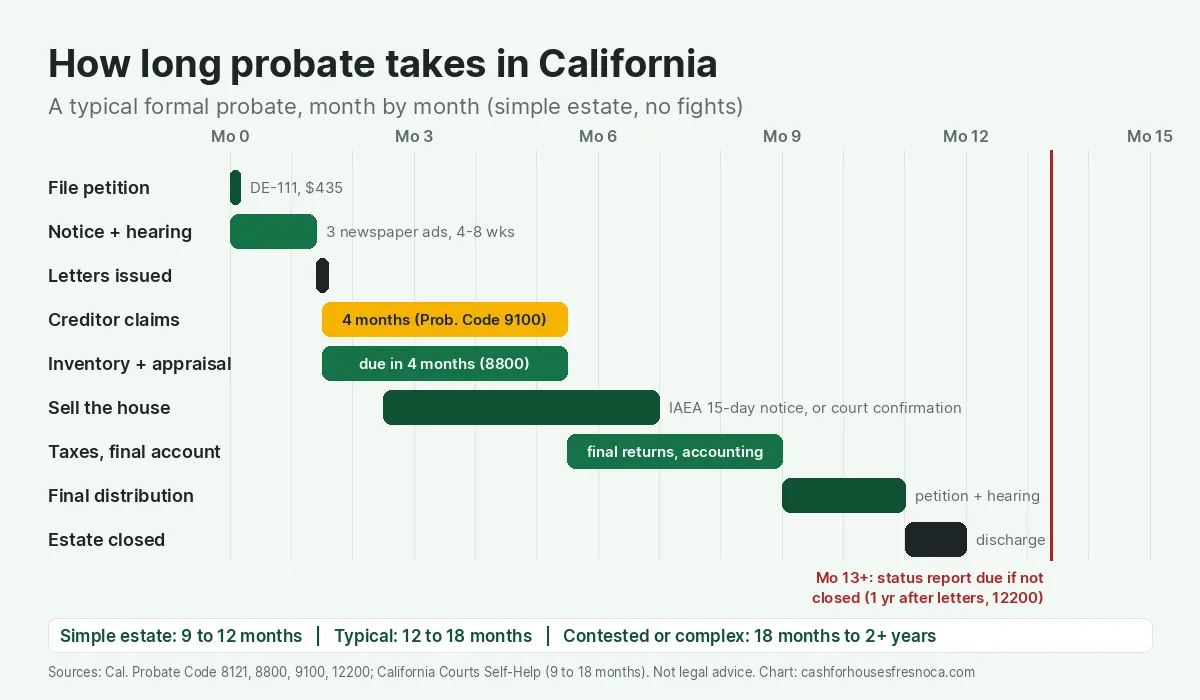
| Stage | Typical time | What sets the clock |
|---|---|---|
| File the petition | Week 1 | Petition for Probate (DE-111), $435 filing fee |
| Notice and first hearing | 4 to 8 weeks | Notice published 3 times, first one at least 15 days before the hearing (Prob. Code 8121) |
| Letters issued | Days to a few weeks after the hearing | Order signed, bond filed (if required), letters issued by the clerk |
| Creditor claim period | 4 months after letters | Claims due by the later of 4 months after letters or 60 days after notice is mailed (Prob. Code 9100) |
| Inventory and appraisal | Within 4 months of letters | Probate referee values the house (Prob. Code 8800) |
| Sell the house (if needed) | 1 to 4 months, overlapping the above | 15-day notice to heirs, or a court confirmation hearing |
| Final taxes and accounting | 1 to 3 months | Final personal and estate income tax returns |
| Petition for final distribution | 1 to 2 months to a hearing | Court approves the accounting, fees and who gets what |
| Distribution and discharge | Weeks after the order | Deeds recorded, funds paid out, receipts filed |
If the estate isn't ready to close within one year after letters are issued (18 months if a federal estate tax return is required), the personal representative must file a petition for final distribution or a status report explaining why, under Probate Code section 12200 (opens in a new tab). That's the law's way of saying a year is the expected pace.
Each step, and how long it takes
1. Filing the petition (week 1)
The process starts when someone files a Petition for Probate (form DE-111) in the county where the person lived, with the original will if there is one. The filing fee is typically $435, per the California Courts self-help guide (opens in a new tab), and you can ask for a fee waiver if you qualify. The clerk sets a hearing date when the petition is filed. Gathering the death certificate, the will and the names and addresses of every heir is usually what takes the time here.
2. Notice and the first hearing (about 4 to 8 weeks)
Before the hearing, notice has to be mailed to the heirs and beneficiaries and published in a local newspaper. Under Probate Code section 8121 (opens in a new tab), the notice runs three times, and the first publication must be at least 15 days before the hearing. If no one objects and the paperwork is clean, the judge appoints the personal representative at that hearing. If a bond is required, it has to be posted before letters issue.
3. Creditor claims (4 months, the fixed floor)
This is the part nobody can shortcut. Under Probate Code section 9100 (opens in a new tab), a creditor has until the later of four months after letters are first issued or 60 days after the personal representative mails them notice. The estate can't make a final distribution until that window closes and valid claims are paid or rejected.
4. Inventory and appraisal (within 4 months)
The personal representative lists every asset, and a court-appointed probate referee appraises the house and other non-cash property. Probate Code section 8800 (opens in a new tab) requires the inventory and appraisal within four months after letters, though the court can allow more time. The referee's value matters later: it becomes the benchmark for any court-confirmed sale and the heirs' stepped-up tax basis.

5. Paying bills, filing taxes and the accounting (1 to 3 months)
Once the creditor period ends, the representative pays approved debts, files the person's final income tax returns and any estate income tax return, and prepares an accounting of every dollar in and out. If all the beneficiaries sign a waiver, a formal accounting isn't required, which can save weeks.
6. Final distribution and closing (1 to 3 months)
The representative files a petition for final distribution, gives notice and goes to one more hearing. The judge approves the accounting and the fees and orders who gets what. After the house is deeded or the sale proceeds are paid out and the heirs sign receipts, the representative is discharged and the estate is closed.
Probate in Fresno County: what to expect locally
Fresno County probate cases are filed with the Probate Clerk at the B.F. Sisk Courthouse, 1130 O Street, Third Floor, in downtown Fresno. According to the Fresno Superior Court's probate page (opens in a new tab), the clerk's office is open Monday through Thursday from 8 a.m. to 3 p.m. and Friday from 8 a.m. to noon, and the clerk assigns your hearing date when the petition is filed.
Two local details trip people up. First, probate examiners review every filing before the hearing and post "examiner notes" listing problems on the court's public portal. Those deficiencies have to be fixed by filing a declaration or an amended document; the court says emails and faxes to examiners don't count. An uncorrected note usually means the matter gets continued, which can cost you a month or more. Second, if you want to appear by Zoom, you have to file a remote appearance request (form RA-010) at least five court days before the hearing.
For newspaper notice, Fresno petitioners commonly publish in a local legal-notice paper such as The Business Journal, which regularly runs Fresno County probate notices. Budget a few hundred dollars for the three runs. Other Valley counties work the same way under the same Probate Code, so the timeline is similar whether the house is in Fresno, Madera, Tulare or Kings County, even though local calendars vary.
What makes probate take longer
The 9 to 12 month estimate assumes everything goes right. These are the usual reasons it doesn't:
- A will contest or a family fight. Objections turn hearings into litigation. This is the biggest reason probate runs past two years.
- Missing or hard-to-find heirs. Every heir has to get notice. Tracking down an estranged sibling or a cousin abroad adds weeks or months.
- Examiner deficiencies and continuances. A missing form or a notice mistake pushes the hearing out, usually by several weeks each time.
- Selling the house with court confirmation. Without full authority, the sale needs its own hearing and can draw overbidders. See below.
- Disputed creditor claims. A rejected claim can turn into a lawsuit the estate has to resolve before it closes.
- A federal estate tax return. Very large estates get 18 months instead of 12 under section 12200, and they usually need it.
- Property in another state. A house outside California may need a second, "ancillary" probate there.
- A house nobody can deal with. A vacant house full of belongings, with deferred repairs or a tenant who won't leave, can stall the whole estate. Our guide on how to sell a hoarder house covers the cleanout problem.
How much probate costs in California
California is one of the few states that sets probate fees by formula. Under Probate Code section 10810 (opens in a new tab), the estate attorney's "statutory fee" is 4% of the first $100,000 of the estate, 3% of the next $100,000, 2% of the next $800,000 and 1% of the next $9 million. The personal representative is entitled to the same amount under section 10800, though family executors often waive it.
The catch is what the percentage is applied to. The fee is based on the gross value in the inventory, "without reference to encumbrances." A $429,450 house with a $300,000 mortgage still produces fees on $429,450, not on the $129,450 of equity. That's why probate can take a big bite out of a modest estate.
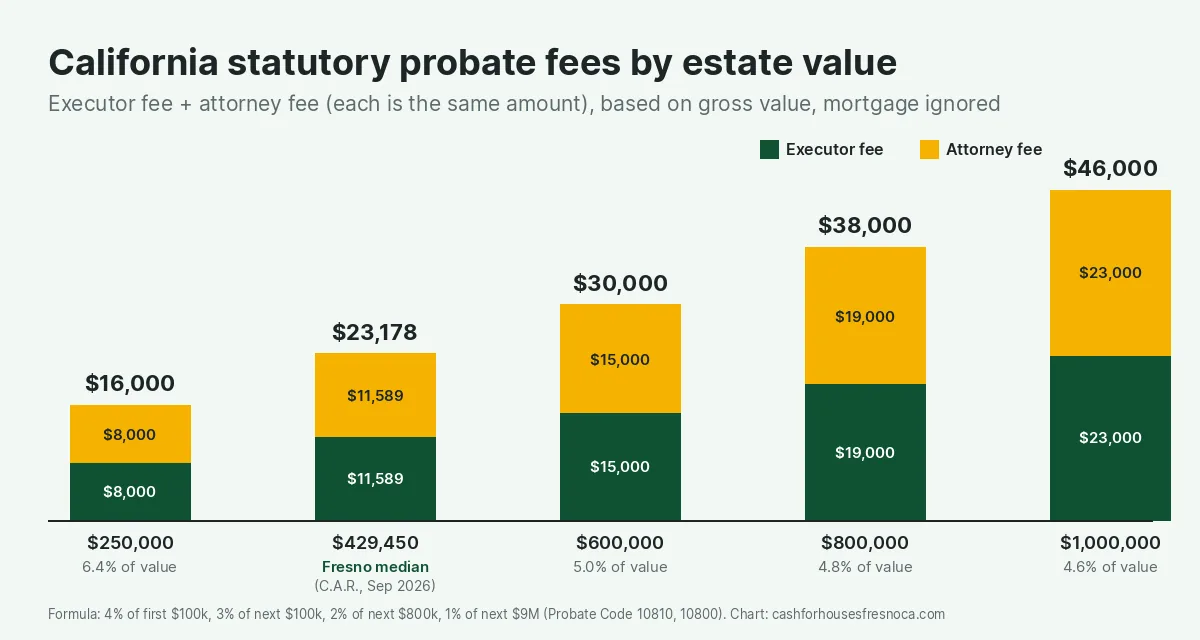
| Gross estate value | Attorney fee | Executor fee | Combined |
|---|---|---|---|
| $250,000 | $8,000 | $8,000 | $16,000 |
| $429,450 (Fresno median) | $11,589 | $11,589 | $23,178 |
| $600,000 | $15,000 | $15,000 | $30,000 |
| $800,000 | $19,000 | $19,000 | $38,000 |
| $1,000,000 | $23,000 | $23,000 | $46,000 |
On top of the statutory fees, expect:
- Court filing fee: typically $435 to open the case: a $355 base fee under Government Code 70650 (opens in a new tab) plus state surcharges.
- Probate referee: one-tenth of one percent of the value appraised (Prob. Code 8961 (opens in a new tab)), at least $75 and normally no more than $10,000 (section 8963).
- Newspaper publication: roughly $150 to $500 depending on the paper.
- Bond premium: only if the will doesn't waive it and the heirs don't agree to waive it. It renews every year the case stays open.
- Extraordinary fees: the court can approve extra pay for unusual work, such as selling real estate, litigation or tax issues.
- Holding costs: property tax, insurance, utilities and upkeep keep running on the house the whole time.
Fresno example: probate on a $429,450 house
Here's what probate looks like on a typical Fresno estate: one house at the September 2026 Fresno County median of $429,450, per the California Association of Realtors (opens in a new tab), no other assets, and a will that waives the bond.
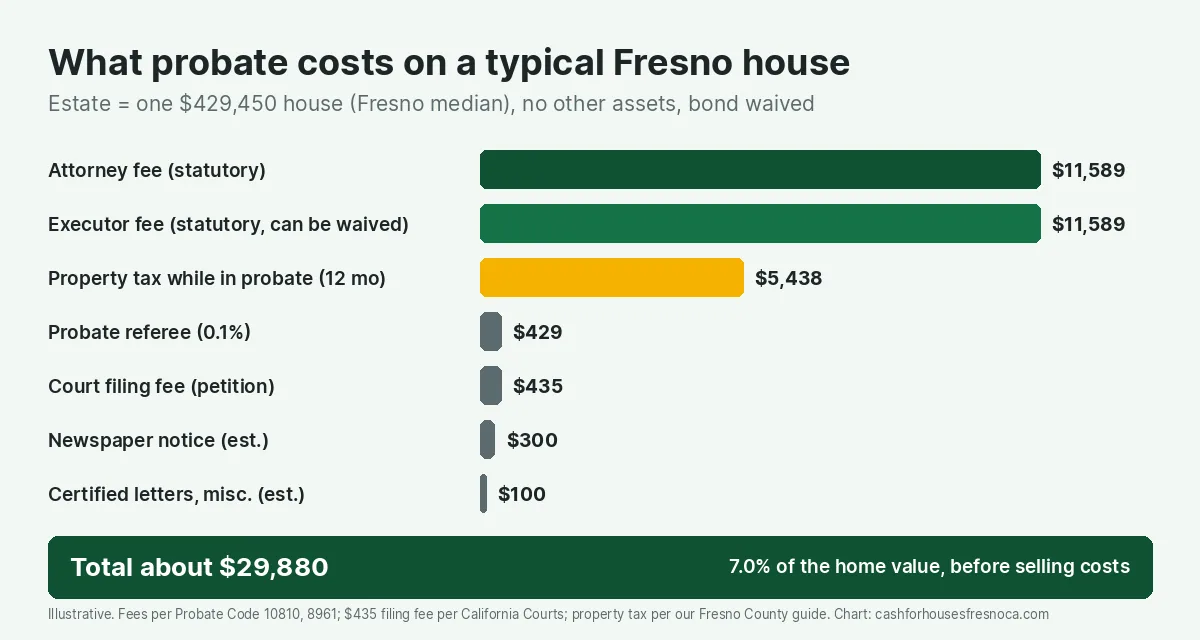
That's about $29,880, or 7% of the home's value, before a single selling cost. The property tax line uses the roughly $5,438 a year our Fresno County property tax guide estimates on a $430,000 home. If the executor is a family member who waives their fee, the total drops to about $18,291. If the house is then listed, add commissions and the other seller closing costs in Fresno. Every extra month in probate adds roughly $450 of property tax alone, plus insurance and utilities.
The good news on taxes: heirs generally get a stepped-up basis equal to the house's value at death, so selling soon after probate usually means little or no capital gains tax. Our guide to capital gains tax in California walks through how that works.
Settling an estate with a house in it?
Call or text Christian at (559) 512-6998. You'll get an all-cash offer that stays in place through the probate process and an honest listing estimate, so the executor and heirs can compare both.
Call (559) 512-6998Get My All-Cash OfferSelling a house during probate
You don't have to wait for probate to finish to sell the house. The sale happens during probate, and the money goes into the estate until distribution. How it works depends on the authority the court gave the personal representative under the Independent Administration of Estates Act (IAEA):
- Full authority: the representative can sell without a court hearing. They send heirs a Notice of Proposed Action and wait 15 days for objections. If no one objects, escrow can close on a normal timeline.
- Limited authority (or no IAEA authority): the sale must be confirmed by the court. The offer must be at least 90% of the referee's appraised value, and other buyers can show up at the hearing and overbid. The minimum overbid is 10% of the first $10,000 of the accepted price plus 5% of the rest, as Stimmel Law explains (opens in a new tab). Getting a hearing date and closing afterward usually adds weeks.
Court confirmation is one reason many buyers with loans skip probate homes. They can't hold a rate lock and an appraisal while a judge's calendar plays out, and they might get overbid at the hearing. Cash buyers don't have that problem. When we buy a probate house, our offer stays in place through the notice period or the confirmation hearing, we buy the house as-is with the belongings still in it, and we close through a local escrow company on the date the estate needs. See our page on selling a house in probate in California for how that works, or read our guide on selling an inherited house in Fresno if probate is already behind you.
To be upfront: if the house is in good condition, the heirs aren't in a hurry and the court has granted full authority, listing it may bring a higher price. Our comparison of a cash offer vs. listing shows the trade-off with real numbers, and our guide to how much cash buyers pay shows how an offer is calculated.
Get a cash offer on a probate or inherited house
Tell us about the property. We'll send the executor a no-obligation all-cash offer that holds through the probate process. No repairs, no cleanout, and close in as little as 7 days once the court allows.
How to make probate go faster
- Ask for full IAEA authority in the petition. It lets the representative sell the house and handle most decisions without extra hearings.
- Get bond waivers. If the will doesn't waive the bond, have every heir sign a waiver so letters issue right after the hearing.
- Find every heir up front. Addresses for everyone entitled to notice, before you file, prevent a continuance.
- Read the examiner notes and fix them early. In Fresno County, check the portal a week or two before each hearing and file corrections in time.
- Mail creditor notices right away. The 60-day clock in section 9100 only starts when known creditors get notice.
- Get the beneficiaries to waive the formal accounting. It's allowed when everyone agrees in writing and can save weeks at the end.
- Sell the house early. Selling during the creditor period means the house isn't the thing holding up the final petition, and it stops the holding costs.
- Keep the family talking. Nothing slows probate like a dispute. A short meeting with numbers on the table beats months of objections.
Shortcuts that skip full probate
Before assuming full probate, check whether a faster path applies:
- Living trust: the successor trustee can usually sell or transfer the house within weeks, with no court case. See our living trust in California guide for costs and how to fund one.
- Joint tenancy or community property with right of survivorship: the survivor records an affidavit of death and owns the house.
- Transfer on death deed: the beneficiary records an affidavit after death. See our transfer on death deed California guide.
- Spousal property petition: property going to a surviving spouse or domestic partner can often pass by a short petition instead of full probate.
- Primary residence petition up to $750,000: for deaths on or after April 1, 2025, Probate Code section 13151 lets heirs transfer a primary residence worth up to $750,000 with one petition, which can be filed 40 days after death. With Fresno's median price around $429,450, most family homes here now qualify.
- Small estate affidavit: personal property up to $208,850 for deaths after April 1, 2025 can transfer without court after 40 days.
If you're planning ahead rather than settling an estate, those same tools are how you keep your own house out of probate. A quitclaim to a child during life is usually not the best one because of the tax cost; our guide to the quitclaim deed in California explains why.
Need to sell a house in probate in Fresno or the Valley?
Call or text (559) 512-6998. We buy probate and inherited houses as-is across Fresno, Clovis, Madera, Visalia and the Central Valley, and we work directly with the executor and the estate's attorney.
Call (559) 512-6998Get My All-Cash OfferHow long does probate take in California: FAQ
How long does probate take in California?
Usually 9 to 18 months. A simple estate with no disputes can close in about 9 to 12 months. Will contests, missing heirs, court-confirmed sales or estate tax issues can stretch it past two years.
What is the shortest time probate can take in California?
Rarely less than 6 to 8 months. The first hearing usually takes 4 to 8 weeks to get, and creditors then have 4 months after letters are issued to file claims. The estate can't make a final distribution until that window closes.
Why do you have to wait 4 months in probate?
California gives creditors until the later of 4 months after letters are first issued or 60 days after notice is mailed to them to file a claim (Probate Code 9100). The estate has to wait out that period so debts are paid before heirs are.
How much does probate cost in California?
The attorney and the executor are each entitled to a statutory fee of 4% of the first $100,000, 3% of the next $100,000 and 2% of the next $800,000 of the gross estate. On a $429,450 house that's $11,589 each, or $23,178 combined, plus about $1,000 to $1,500 in court, referee and publication costs.
Can an executor sell a house before probate is closed?
Yes. With full authority under the Independent Administration of Estates Act, the executor can sell after giving heirs a 15-day Notice of Proposed Action. With limited authority, the sale needs court confirmation and can be overbid at the hearing.
How long after probate closes do heirs get their money?
Usually within a few weeks of the order for final distribution. The personal representative pays out the funds or records the deeds, collects signed receipts from the heirs and files them with the court.
Does a house worth less than $750,000 have to go through probate?
Not necessarily. For deaths on or after April 1, 2025, a primary residence worth up to $750,000 can pass to heirs through a single court petition under Probate Code 13151 instead of a full probate.
Where is probate filed in Fresno County?
With the Probate Clerk at the B.F. Sisk Courthouse, 1130 O Street, Third Floor, Fresno. The clerk sets a hearing date when the petition is filed.
Sources
- California Courts Self-Help Guide: If you need formal probate (opens in a new tab) (9 to 18 months, $435 filing fee).
- California Probate Code sections 8121 (opens in a new tab) (publication), 8800 (opens in a new tab) (inventory), 8961 (opens in a new tab) and 8963 (opens in a new tab) (referee commission), 9100 (opens in a new tab) (creditor claims), 10810 (opens in a new tab) (statutory fees), 12200 (opens in a new tab) (one-year deadline) and 13151 (opens in a new tab) (primary residence petition).
- Superior Court of California, County of Fresno: Probate division (opens in a new tab).
- Stimmel Law: sale of real property in probate (opens in a new tab); Sacramento County Public Law Library: small estate limits (opens in a new tab); Bay Legal: executor bonds (opens in a new tab); median price from the C.A.R. September 2026 sales report (opens in a new tab).
Information in this guide is current as of October 2026. You're welcome to share the charts with a link back to this page.