Can you sell a house with a lien on it? Yes. Selling a house with a lien is normal in California. Your mortgage is a lien, and millions of homes sell with one every year. Tax liens, judgment liens, contractor liens and HOA liens work much the same way: escrow finds them, gets a payoff number, and pays them out of your sale proceeds so the buyer gets clean title. The real questions are how much each lien takes from you, and whether you can shrink or remove it before closing.
I'm Christian Castro, a licensed California realtor (DRE #02195959) and the owner of Cash For Houses Fresno. A lot of the houses I buy come with something extra on title: two years of back property taxes, a credit card judgment from a decade ago, a roofer who recorded a lien after a dispute, or an IRS notice the owner forgot about. This guide covers selling a house with a lien step by step: the common types, how long each one lasts, how escrow pays them, what you can negotiate, and a worked Fresno example. It's general information, not legal or tax advice.
The short answer
- You can sell a house with a lien. Liens get paid from your proceeds at closing, in order, before you get your check. See how it works.
- The lien follows the house, not the sale. A judgment lien stays attached to the property even after a transfer (CCP 697.390), so buyers and title companies insist it be paid or released.
- Some liens expire or die early. A mechanic's lien is void if the contractor doesn't sue within 90 days of recording it. Judgment liens last 10 years unless renewed. See the chart.
- Many liens can be negotiated. Old judgment creditors and contractors often take less to get paid now. In our Fresno example, negotiating two liens adds about $13,100 to the seller's check.
- If liens are bigger than your equity, you'll need lienholders to agree to take less, or bring cash to closing. See when liens exceed equity.
What a lien is and how to find one on your house
A lien is a legal claim against your property that secures a debt. It doesn't give the creditor the house, but it ties the debt to it. Until the lien is paid or released, the title isn't clear, and almost no buyer, lender or title insurer will close on a house with an open lien they can't account for.
Liens come in two flavors:
- Voluntary liens are ones you agreed to: your mortgage, a second mortgage, a HELOC, or a solar or energy-efficiency loan secured by the house.
- Involuntary liens are placed on the house without your consent: unpaid property taxes, court judgments, IRS and state tax liens, contractor liens, HOA liens, child support liens and city code enforcement liens.
Most liens are recorded with the county recorder where the house sits. In Fresno County that's the Fresno County Recorder's office. You can search the public index by name, but the easiest way to see everything at once is to order a preliminary title report from a title company. It lists every recorded lien, the amount on the recorded document, and who holds it. Sellers are often surprised. An abstract of judgment recorded years ago can sit quietly on title until the day you try to sell.

How selling a house with a lien works
Selling a house with a lien follows the same path as selling a house with a mortgage, which is the lien everyone already has. Here's the flow in California:
- Title searches the property and the sellers' names. The prelim shows recorded liens against the house. A final name search near closing catches liens that attach to you personally, like an abstract of support judgment.
- Escrow requests a payoff demand from each lienholder. A demand is a written statement of the exact amount needed to release the lien on a given date, including interest, penalties and fees.
- At closing, escrow pays each lienholder from the buyer's funds, in order of priority, before anything goes to you.
- Each lienholder records a release. For a mortgage that's a reconveyance. For a judgment it's an acknowledgment of satisfaction. For a tax lien it's a release from the agency.
- You get what's left. Your net proceeds are the sale price minus closing costs and every payoff.
The part sellers miss: it doesn't matter who buys the house. Whether you list with an agent or sell to a cash buyer, the liens get paid out of the same pot. What changes is how fast escrow can work through the demands, and how much room you have to negotiate. For how payoffs show up on your settlement statement, see the payoffs section of our Fresno seller closing cost guide.
7 common liens and how each one gets paid when you sell
1. Mortgages, HELOCs and second loans
Your lender sends a payoff statement, escrow wires the balance, and the trustee records a reconveyance under Civil Code 2941. This is the routine case. Our guide to selling a house with a mortgage walks through the deadlines and what you keep.
2. Property tax liens
Property taxes are a lien on the house automatically. In California, taxes still unpaid after June 30 make the property "tax-defaulted." From there, penalties build at 1.5% a month (18% a year) on top of the 10% late penalties, a small administrative charge per year and a $15 redemption fee, as the Contra Costa County Tax Collector explains (opens in a new tab) for the statewide rules. After five years in default, the county gets the power to sell the house at a tax sale. Escrow pays the full redemption amount at closing. If you're behind, our Fresno County property tax guide covers due dates and what a tax sale really costs you.
3. Judgment liens
When someone sues you and wins, they can record an abstract of judgment with the county recorder. Under CCP 697.310 (opens in a new tab), that creates a lien on any real property you own in that county, and it lasts 10 years from the date the judgment was entered. It can be renewed for another 10. Two more rules matter:
- Interest keeps running. Most California money judgments grow at 10% a year. Since January 1, 2023, judgments for medical debt under $200,000 and personal debt under $50,000 accrue at 5% instead (CCP 685.010 (opens in a new tab)). A $15,000 judgment from 2019 at 10% is well over $25,000 today.
- The lien survives a transfer. If you sell or deed the house away without paying it, the property stays subject to the lien (CCP 697.390). That's why title won't insure past it.
The homestead exemption can protect part of your equity from a judgment lien on the home you live in. In Fresno County that protection is in the hundreds of thousands of dollars. See our guide to the homestead exemption in California before you pay a judgment creditor in full.
4. Mechanic's liens
Contractors, subcontractors and suppliers who weren't paid for work on your house can record a mechanic's lien. California is strict about their deadlines, which is good news for sellers:
- The lien must be recorded within 90 days after the work was completed, or within 60 days (direct contractors) or 30 days (subs and suppliers) after you record a notice of completion (Civil Code 8412).
- The contractor must file a lawsuit to foreclose the lien within 90 days of recording it, or the lien is void (Civil Code 8460).
- If you dispute the amount, you can record a release bond for 125% of the claim (opens in a new tab) (Civil Code 8424), which moves the lien off the house and onto the bond so the sale can close.
A lien that's past its 90-day lawsuit deadline still sits on the record until it's released. If the contractor won't sign a release, you can petition the court to release the property under Civil Code 8480. Title companies see this often and will tell you what they need.
5. IRS and California tax liens
Unpaid federal taxes create a lien on everything you own, and the IRS records a Notice of Federal Tax Lien to make it public. To sell, you'll either pay the IRS from escrow or apply for a certificate of discharge on Form 14135, which removes the lien from that one property, usually in exchange for the proceeds. IRS Publication 783 says to apply "at least 45 days before the transaction date," so start early (Taxpayer Advocate Service overview (opens in a new tab)).
The Franchise Tax Board's state tax liens last at least 10 years and can be extended. According to the FTB (opens in a new tab), your escrow or title company requests a payoff through its eDemand system, and the FTB releases the lien once it's paid. EDD payroll tax liens work the same way. If both the IRS and the state have liens and there isn't enough to pay everyone, talk to a tax professional before you open escrow.
6. HOA liens
If you fall behind on HOA dues, the association can record an assessment lien. Under Civil Code 5720 (opens in a new tab), it can't foreclose until you owe at least $1,800 in assessments or they're more than 12 months delinquent. Short of that, the lien just sits there growing late charges and collection costs. Escrow orders an HOA demand and pays it at closing, along with the transfer and document fees the HOA charges on every sale.
7. Child support, PACE and code enforcement liens
- Child support liens attach to the parent, not one property, so they often surface late, in the final name search. Escrow requests a demand from the state Department of Child Support Services, and the lien is released or reduced once the arrears are paid.
- PACE liens (HERO, Ygrene and similar energy loans) are paid through your property tax bill and take priority over the mortgage. FHA stopped insuring mortgages on homes with PACE obligations in 2018 (HUD Mortgagee Letter 2017-18 (opens in a new tab)), so most financed buyers will need it paid off. You must disclose it either way.
- Code enforcement liens cover unpaid city fines and cleanup costs. Our guide to selling a house with code violations covers Fresno's 2026 fine schedule.
Found a lien you didn't know about?
Call or text (559) 512-6998. I'll help you sort out what's on title and give you an all-cash offer that accounts for every payoff, with no repairs and no commissions.
Call (559) 512-6998Get My All-Cash OfferHow long liens last in California
Timing matters because an old lien can be cheaper, or even free, to clear. Here's how long the most common liens stay enforceable if nobody pays, releases or renews them:
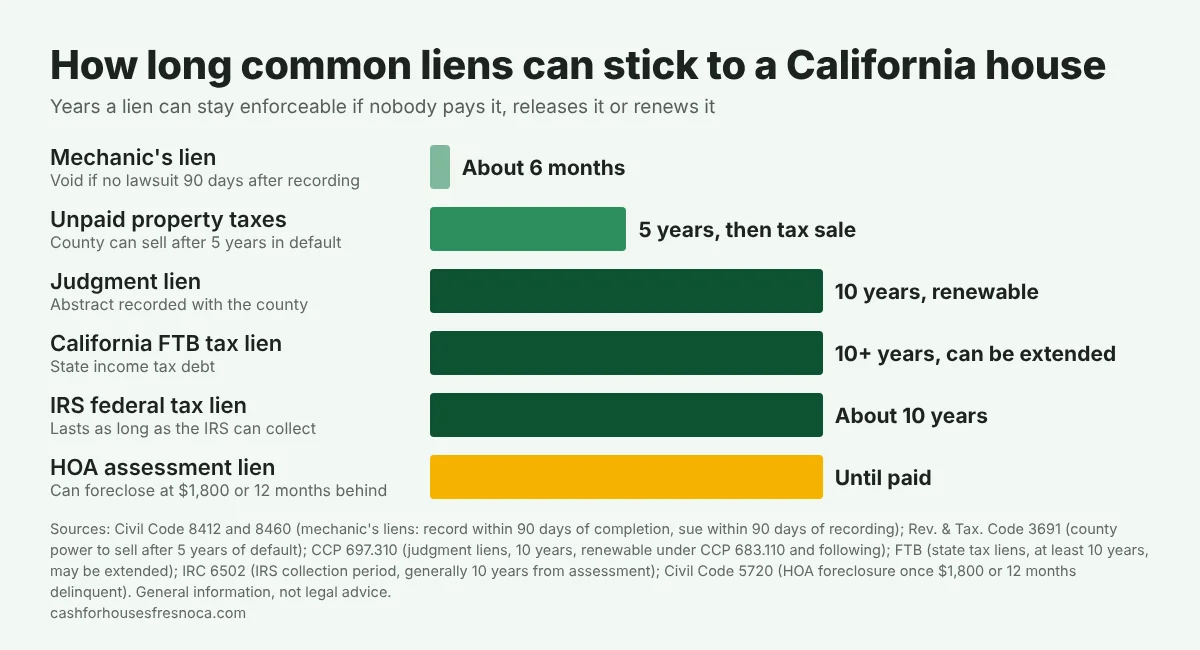
Two cautions. First, an "expired" lien usually still shows on title until someone records a release or a court orders one, so don't assume a buyer's title company will ignore it. Second, creditors renew judgments all the time. Check the recorder's index for a renewal before you count on a 10-year clock.
Fresno example: selling a house with three liens
Here's what selling a house with a lien (or three) can look like in real numbers. Say a Fresno homeowner sells at $429,450, the Fresno County median in the C.A.R. September 2026 sales report (opens in a new tab). They owe $210,000 on the mortgage, are two years behind on a $3,600 property tax bill, have an old credit card judgment that has grown to $24,000 with interest, and a roofer recorded a $12,500 mechanic's lien after a dispute.
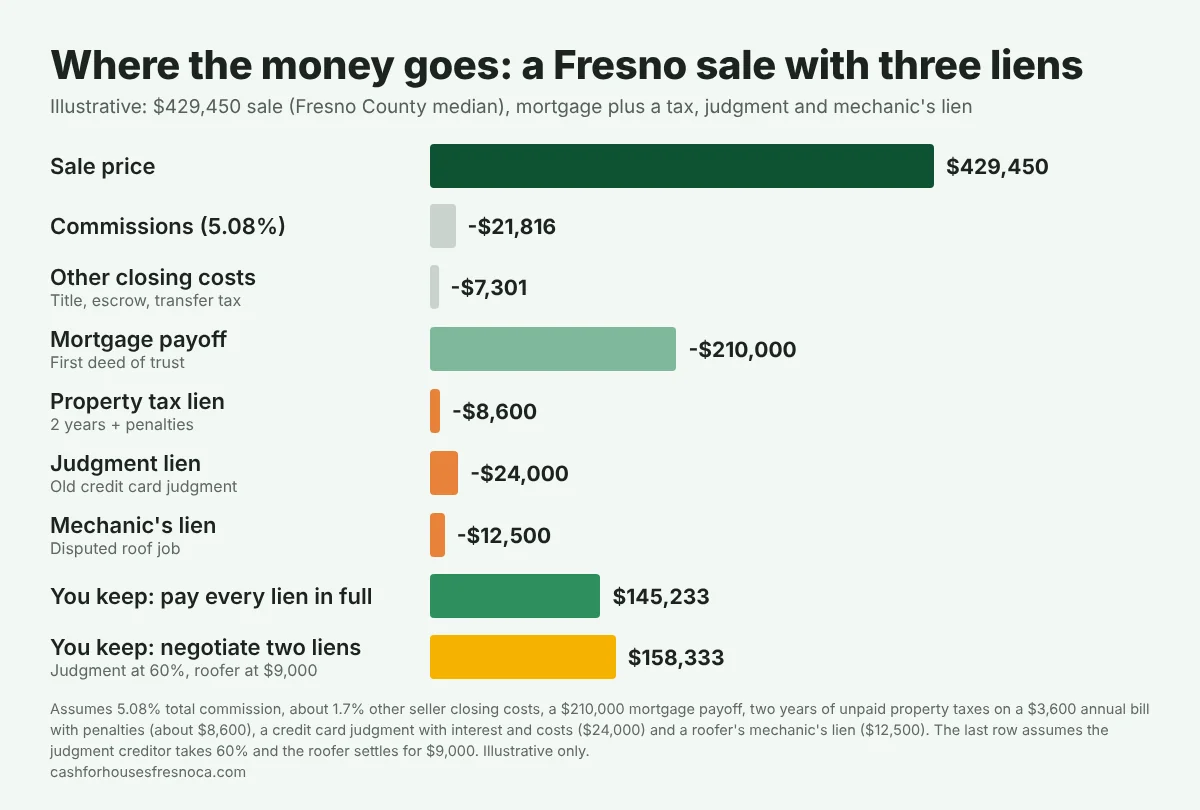
| Item | Pay every lien in full | Negotiate two liens |
|---|---|---|
| Sale price | $429,450 | $429,450 |
| Commissions (5.08%) | -$21,816 | -$21,816 |
| Other closing costs (~1.7%) | -$7,301 | -$7,301 |
| Mortgage payoff | -$210,000 | -$210,000 |
| Property tax redemption | -$8,600 | -$8,600 |
| Judgment lien | -$24,000 | -$14,400 (60%) |
| Mechanic's lien | -$12,500 | -$9,000 |
| You keep | $145,233 | $158,333 |
The commission rate comes from Clever's August 2026 data, as used in our breakdown of how much it costs to sell a house. The tax payoff is illustrative: two unpaid years plus 10% penalties and about a year of the 1.5% monthly redemption penalty. Property taxes can't be negotiated, but the judgment and the contractor's claim often can. That's a $13,100 swing from a few phone calls, which is why I tell sellers to get demands early and never just sign off on the first number.
How to reduce or remove a lien before you sell

- Check that every lien is valid. Is the judgment against you, or someone with a similar name? Was the mechanic's lien recorded on time, and did the contractor sue within 90 days? Is the judgment past 10 years with no renewal? An invalid lien can often be removed with a letter, a release or a court order.
- Ask for a reduced payoff. Judgment creditors and debt buyers often settle old judgments for a fraction of the balance when they know the money is sitting in escrow. Get any deal in writing, with the creditor's promise to record a full release at closing.
- Use the homestead exemption. If it's your home, part of your equity may be off limits to judgment creditors. See our homestead exemption guide.
- Bond around a disputed mechanic's lien. A 125% release bond lets you close now and fight about the amount later.
- Apply for an IRS discharge. Form 14135 can free the house from a federal tax lien even when the proceeds won't cover the whole tax debt.
- Get a lawyer for the hard ones. Competing tax liens, a lien from a divorce, or a creditor who won't respond are worth an hour with a real estate attorney.
One thing not to do: deed the house to a relative to "get it out of your name." The lien stays attached to the property, and the transfer can create new problems with the creditor and with taxes. Our quitclaim deed guide explains why.
When liens are bigger than your equity
If the mortgage plus every other lien adds up to more than the house will sell for, the sale can't close on its own. You have three options:
- Bring cash to closing to cover the gap.
- Negotiate the junior liens down. A judgment creditor or HOA behind a big mortgage knows it might get nothing at a foreclosure, so a partial payoff now often looks good to them.
- Do a short sale, where the mortgage lender agrees to accept less than it's owed. Every other lienholder has to sign off too.
If you're also behind on the mortgage, the clock matters. See our page on how to stop foreclosure in Fresno for the timeline and your options.
How to sell a house with a lien in 6 steps
- Order a preliminary title report before you list or accept an offer, so nothing surprises you in escrow.
- List every lien with its holder, the recorded amount and the recording date.
- Check deadlines and validity: 90 days for mechanic's liens, 10 years for judgments, renewals on the recorder's index.
- Request payoff demands from each lienholder, and apply for an IRS discharge at least 45 days out if you need one.
- Negotiate what you can and get every reduced payoff and release promise in writing.
- Run your net. Subtract closing costs and every payoff from the price, then decide whether listing or a cash sale leaves you better off. Our cash offer vs listing guide helps with that.
When selling a house with a lien for cash makes sense
To be honest about it: a lien doesn't make a cash sale the right answer by itself. If the house is in good shape, the liens are small and you have time, listing it will usually net you more, and the liens get paid the same way. A cash sale tends to make sense when:
- The clock is running. A tax sale, an HOA foreclosure or a mortgage default is getting close, and you need to close in days, not months.
- There's not much equity left. When the liens eat most of the proceeds, spending $30,000 on repairs and commissions to list can wipe out what's left.
- The house needs work too. Liens often come with a house that has deferred repairs, mold or a lifetime of belongings inside.
- It's inherited or in probate. The deceased owner's debts and liens have to be sorted out before heirs see a dime. See our pages on selling an inherited house and probate sales.
- A financed buyer already backed out because of a PACE lien or a title problem that took too long to clear.
When you sell to us, we buy the house as-is and work with escrow on every demand. We pay the closing costs, charge no commissions and can close in as little as 7 days or on the date you pick. We'll also tell you straight if listing would put more in your pocket.
Get an all-cash offer on a house with liens
Tell us about the property and what's on title. We'll send a no-obligation all-cash offer, coordinate the lien payoffs with escrow, and you can close in as little as 7 days.
We buy houses with liens in Fresno, Clovis, Madera, Visalia, Hanford and across the Central Valley. You can read more about me and how we work, or contact us any time.
Ready to clear the title and move on?
Call or text (559) 512-6998 for an all-cash offer. We handle the payoffs with escrow, pay the closing costs, and you can close in as little as 7 days.
Call (559) 512-6998Get My All-Cash OfferFAQ: selling a house with a lien
Can you sell a house with a lien on it in California?
Yes. Liens are paid from your sale proceeds at closing. Escrow requests a payoff demand from each lienholder, pays them before you're paid, and each lienholder records a release so the buyer gets clear title.
Who pays the lien when a house is sold?
The seller does, out of the sale proceeds. The buyer's money comes into escrow, and escrow pays the liens before releasing what's left to the seller. If the liens are larger than the proceeds, the seller has to bring cash, negotiate the liens down or do a short sale.
Can a buyer take over a lien on a house?
Rarely. A judgment lien stays attached to the property after a sale under CCP 697.390, but buyers and title insurers almost never accept that. Some PACE assessments can transfer to a buyer, but most lenders won't allow it, and FHA won't insure a loan on a house with one.
How long does a judgment lien last in California?
Ten years from the date the judgment was entered, under CCP 697.310. The creditor can renew the judgment for another 10 years. Interest is usually 10% a year, or 5% for medical debt under $200,000 and personal debt under $50,000 entered since 2023.
How long does a mechanic's lien last in California?
Not long. The contractor must record it within 90 days after the work is done (or sooner if you recorded a notice of completion) and file a lawsuit to foreclose within 90 days of recording. If they don't sue in time, the lien is void, and you can ask the court to release it under Civil Code 8480.
Can I sell my house with an IRS tax lien?
Yes. You can pay the IRS from escrow, or apply for a certificate of discharge with Form 14135. IRS Publication 783 says to apply at least 45 days before closing. The IRS usually requires the net proceeds in exchange for discharging the lien from that property.
Can liens be negotiated when selling a house?
Often. Property tax liens can't be, but judgment creditors, contractors, HOAs and debt buyers frequently accept less when they know the money is in escrow. Get every agreement in writing, including a promise to record a full release.
How do I find out if there is a lien on my house?
Order a preliminary title report from a title company. It lists every recorded lien against the property. You can also search the Fresno County Recorder's index by name, and check your property tax status with the Fresno County Tax Collector.
Do you buy houses with liens in Fresno?
Yes. We buy houses with tax liens, judgment liens, mechanic's liens, HOA liens and other title problems across Fresno and the Central Valley. Call or text (559) 512-6998 for an all-cash offer. We pay closing costs and there are no commissions.
Sources and how to cite this guide
- California statutes: CCP 697.310 (opens in a new tab) (judgment liens); CCP 685.010 (opens in a new tab) (judgment interest); CCP 697.390 summary (opens in a new tab) (liens survive transfer); Civil Code 8412 and 8460 summary (opens in a new tab) (mechanic's lien deadlines); Civil Code 8424 (opens in a new tab) (release bonds); Civil Code 5720 (opens in a new tab) (HOA foreclosure limits).
- Taxes: county tax collector guide to default and power to sell (opens in a new tab); Franchise Tax Board liens (opens in a new tab); IRS lien discharge (opens in a new tab) and Publication 783 (Rev. 12-2022).
- Other liens: child support lien demands in escrow (opens in a new tab); HUD Mortgagee Letter 2017-18 (opens in a new tab) (PACE).
- Data: C.A.R. September 2026 sales report (opens in a new tab) (Fresno County median price).
- Photos: chain-link fence from PxHere, closed book and person by the lake from StockSnap, all CC0 public domain. None show our clients or their homes.
Sharing this data? You're welcome to use the lien duration chart and the Fresno payoff example. Please credit "Cash For Houses Fresno" and link back to this page.