Can you sell a house with mold? Yes. Selling a house with mold is legal in California and it happens every week. What you can't do is hide it. If you know about mold, you have to disclose it, and from there you get to choose: fix it before you list, disclose it and list as-is, or sell to a cash buyer who takes the problem off your hands.
I'm Christian Castro, a licensed California realtor (DRE #02195959) and the owner of Cash For Houses Fresno. Mold comes up on a lot of the houses I walk through, usually from a slow leak nobody noticed: under a sink, behind a shower, in the attic after a winter storm, or in the crawl space of an older raised-floor home. This guide walks through selling a house with mold step by step: what California requires you to disclose, what cleanup really costs, how mold affects buyers and lenders, and an honest side-by-side of all three ways to sell. It's general information, not legal advice.
The short answer
- You can sell a house with mold. You don't have to fix it first. You do have to tell buyers about mold you know about.
- Mold is listed on California's disclosure form. The Transfer Disclosure Statement asks about environmental hazards and names mold by word. "As-is" doesn't cancel that. See what to disclose.
- Most mold jobs aren't huge. The national average for professional remediation is about $2,254. Hidden mold behind a tub or in the ductwork can run $8,000 to $10,000. See what it costs.
- Fix the leak, not just the mold. Mold always follows water. A buyer's inspector will look for the source.
- Small problem? Fixing usually pays. In our Fresno example, fixing and listing nets about $378,250 versus about $285,000 from a cash sale. Cash makes sense when the damage is big, unknown or you can't fund the work.
Can you sell a house with mold?
Yes. There's no law in California that stops you from selling a house with mold, and there's no rule that you have to remediate it first. Plenty of houses sell every year with a moldy bathroom, a damp crawl space or water-stained drywall.
What changes is how the sale goes. Mold scares buyers more than almost any other defect, even when the actual problem is small. People have heard the phrase "toxic black mold" and they picture the worst. So the real question isn't whether you can sell, it's how much the mold will cost you in price, time and stress, and which route keeps that cost lowest.
Three things decide that:
- How much mold there is and where. A few square feet of surface mold on bathroom grout is a weekend job. Mold inside walls, in the attic or in the HVAC system is a contractor job.
- Whether the water source is fixed. Mold with an active leak behind it will come back. Buyers and inspectors know that.
- Your time and budget. Remediation, repairs and the months of holding the house all cost money before you see a dollar from the sale.
Do you have to disclose mold in California?
If you know about it, yes. This is the most important part of selling a house with mold, and it's where sellers get into trouble.
California requires sellers of one-to-four-unit homes to fill out a Real Estate Transfer Disclosure Statement (TDS). The form's wording is set by law in Civil Code section 1102.6 (opens in a new tab). Section II.C, item 1 asks whether you're aware of "substances, materials, or products which may be an environmental hazard such as, but not limited to, asbestos, formaldehyde, radon gas, lead-based paint, mold, fuel or chemical storage tanks, and contaminated soil or water on the subject property." Mold is named right there in the list.
Other TDS questions catch the cause, too: "flooding, drainage or grading problems" and "room additions, structural modifications, or other alterations or repairs not in compliance with building codes." If you've had a roof leak, a slab leak or a flooded laundry room, a buyer will expect to read about it. If unpermitted repairs are part of the story, see our guide to selling a house with code violations.
A few rules that trip people up:
- "As-is" doesn't erase the disclosure. Civil Code section 1102(c) says any waiver of the disclosure requirements "is void as against public policy." You can sell as-is, meaning you won't make repairs, but you still have to say what you know.
- Disclose past mold, too. If mold was cleaned up, say so and hand over the paperwork: the remediation invoice, what was removed, and any clearance test. A documented, fixed problem reads very differently to a buyer than a vague "had some mold once."
- Don't paint over it. Covering mold or a water stain right before listing is the classic way a small problem turns into a fraud claim. California courts have held for decades (going back to Lingsch v. Savage in 1963) that a seller who knows of a material defect a buyer can't easily see has to disclose it.
- You don't have to go looking. The duty covers what you know or should reasonably know. You aren't required to tear open walls or order air testing just to sell.
You'll also hear about California's Toxic Mold Protection Act of 2001. It told the state health department to set permissible exposure limits for indoor mold and tied some disclosure duties to those limits. The department's 2005 report concluded that "sound, science-based PELs for indoor molds cannot be established at this time," and none have been set. So in practice, the TDS is what governs a home sale. When in doubt, disclose. A disclosed problem is a price conversation. A hidden one can become a lawsuit.
Not sure how bad the mold is?
Call or text (559) 512-6998. I'll walk the house with you, give you an honest read on whether fixing it makes sense, and make an all-cash offer for it as-is. No obligation either way.
Call (559) 512-6998Get My All-Cash OfferWhere mold hides in Fresno homes
Fresno is dry most of the year, so people are surprised when mold shows up. But mold doesn't need a humid climate. It needs water that sits. The EPA puts it simply: "The key to mold control is moisture control," and it recommends drying water-damaged areas within 24 to 48 hours to keep mold from growing (EPA, A Brief Guide to Mold, Moisture and Your Home (opens in a new tab)).

Here's where I see it most in Fresno-area houses:
- Bathrooms. Showers with failed grout or caulk, no exhaust fan, or a slow leak at the tub drain or toilet wax ring. The visible spot on the ceiling is often the smallest part of it.
- Under sinks and behind appliances. Dishwasher supply lines, fridge ice-maker lines and washing machine hoses leak for months before anyone looks.
- Attics. Roof leaks during winter rains, especially on older roofs that have baked through 100-degree summers.
- Crawl spaces. Many older Fresno homes sit on raised foundations. Poor drainage, a leaking drain line or blocked vents can keep the soil and wood underneath damp.
- Evaporative (swamp) coolers. A cooler that overflows or leaks onto the roof or into the duct can wet the ceiling and ductwork.
- HVAC systems. Clogged condensate lines and dirty coils. Mold in ductwork is one of the more expensive fixes.
- Vacant and inherited houses. A house that sat empty with a small leak, the power off or the windows shut can go from fine to moldy in one season. If you're dealing with an inherited house, check under every sink before anything else.
Mold often shows up alongside other problems. A hoarder house can hide leaks under years of stuff, and a fire-damaged house usually has water damage from the fire hoses too.
What mold remediation costs
Most mold jobs are smaller than sellers fear. According to Angi and HomeAdvisor data compiled by Bob Vila (opens in a new tab), professional mold remediation typically costs $1,125 to $3,439, with a national average of about $2,254. Larger areas run about $10 to $25 per square foot. Where the mold is matters more than anything:
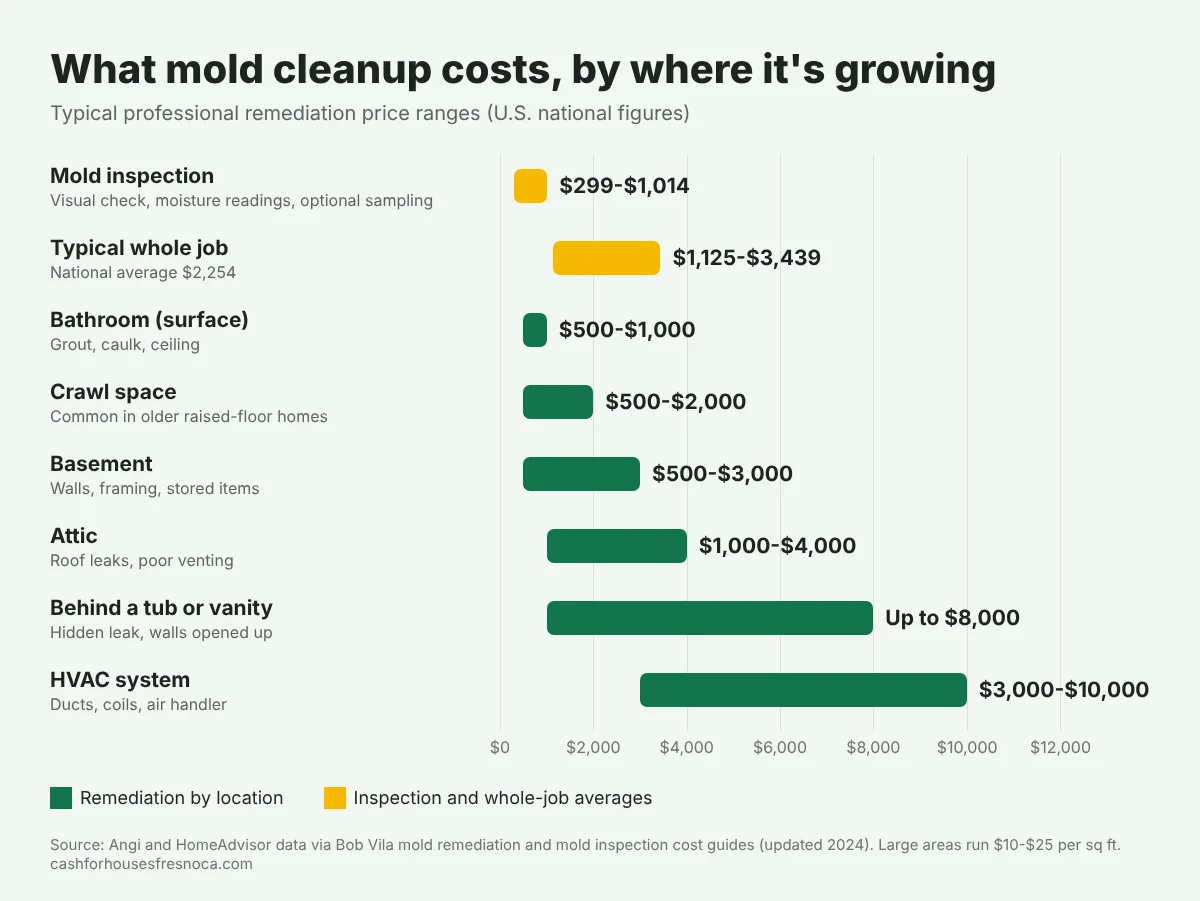
A few things to know before you call anyone:
- Small spots you can often handle yourself. The EPA says that if the moldy area is less than about 10 square feet, "in most cases, you can handle the job yourself." Wear gloves, goggles and an N95, scrub hard surfaces with detergent and water, and throw out soaked drywall or carpet.
- Testing usually isn't needed. The EPA also says that "if visible mold growth is present, sampling is unnecessary." Air tests are most useful for finding hidden mold or proving a cleanup worked (a clearance test), which is worth having when you sell.
- The leak repair is a separate bill. Remediation removes the mold. A plumber, roofer or HVAC tech fixes the cause, and then drywall, paint and flooring put the room back together. On a hidden bathroom leak, the repair can cost more than the mold removal.
- Use separate companies if you can. Having one company test and a different one remediate avoids the obvious conflict of interest.

How to sell a house with mold in 7 steps
- Stop the water first. Find and fix the leak, or at least shut off the line. Mold with an active water source keeps spreading while you decide.
- Figure out how big it is. Measure what you can see. Under 10 square feet of surface mold is usually a DIY or small-contractor job. Bigger than that, inside walls, in the attic or in the ducts, call a mold inspector ($299 to $1,014).
- Get two quotes. One for remediation and one for the repairs after it. Now you know what fixing it really costs.
- Gather your paperwork. Leak repair invoices, insurance claims, past remediation reports and any clearance tests. These go with your disclosures.
- Run the numbers on all three routes. Fix and list, list as-is, or sell for cash. Use the comparison below and our guide to how much it costs to sell a house for the rest of the costs.
- Disclose clearly. On the TDS and the seller questionnaire, say where the mold was, what caused it, what was done and when. Attach the documents.
- Price for the condition. If you sell as-is, price it as a house that needs work. Overpricing a mold house just means it sits, buyers assume the worst, and you cut the price later anyway.
How mold affects buyers, inspections and loans
Even when you disclose up front, expect the mold to come up again during escrow:
- The inspection. A buyer's home inspector will note visible mold, water stains, high moisture readings and the likely source. Many buyers then hire a mold inspector of their own. Expect a repair request or a credit request.
- The appraisal. Appraisers note visible mold and water damage. On FHA and VA loans, which have minimum property standards for health and safety, a lender may require the problem fixed before it will fund. That can push a sale toward cash buyers or conventional loans.
- The buyer's nerves. Mold is an emotional defect. Some buyers walk away no matter what the report says, which is why mold houses can fall out of escrow and come back on the market. Each relist costs you time and makes the next buyer more suspicious.
- Insurance. Many homeowners policies limit or exclude mold unless it came from a sudden, covered water event. If your leak was sudden, such as a burst pipe, read your policy and talk to your agent before you sell.
Concessions are already common in this market. Redfin found that 44.7% of U.S. home sales in the three months ending August 2026 included a seller concession, and that was before any mold showed up in an inspection report. For more on how repairs and credits eat into your proceeds, see our breakdown of seller closing costs in Fresno.
3 ways to sell a house with mold, compared
Here's an honest side-by-side on a typical Fresno house. Say it would be worth $429,450 in good shape (the Fresno County median in the C.A.R. September 2026 sales report (opens in a new tab)), and it has a hidden leak behind the tub plus mold in the crawl space. Remediation and repairs come to about $16,000.
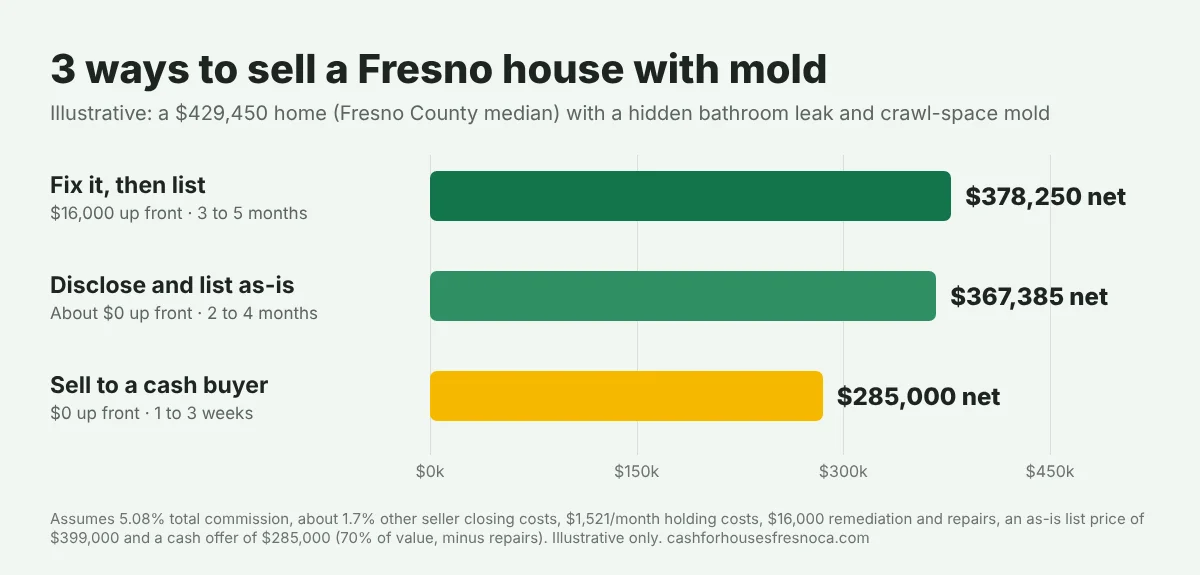
| Item | Fix it, then list | Disclose and list as-is | Sell to a cash buyer |
|---|---|---|---|
| Sale price | $429,450 | $399,000 (illustrative) | $285,000 |
| Commissions (5.08%) | -$21,816 | -$20,269 | $0 |
| Other closing costs (~1.7%) | -$7,301 | -$6,783 | $0 (buyer pays) |
| Remediation and repairs | -$16,000 | $0 | $0 |
| Holding costs ($1,521/mo) | -$6,084 (4 mo) | -$4,563 (3 mo) | $0 |
| Estimated net | $378,250 | $367,385 | $285,000 |
| Cash you need up front | About $16,000 | About $0 | $0 |
| Time to close | 3 to 5 months | 2 to 4 months | 1 to 3 weeks |
| Risk of a deal falling apart | Low once fixed | Higher | Low |
The cash number uses the common investor formula (about 70% of the fixed-up value, minus repairs) explained in our guide to how much cash buyers pay for houses. Commission rates come from Clever's August 2026 data, and the $1,521 a month in holding costs (property tax, insurance, utilities and mortgage interest) comes from our cost-to-sell breakdown.
The honest takeaway: if the mold is small, the source is clear and you can pay for the work, fixing it and listing will usually net you the most. In this example that's about $93,000 more than the cash sale. The math flips when the job is bigger or less certain. If the "$16,000" turns into $40,000 once the walls are open, or the house needs a roof, plumbing and mold work all at once, the gap closes fast. For more on that trade-off, see cash offer vs listing.
Want both numbers on your house?
Call or text (559) 512-6998. You'll get an all-cash offer for the house exactly as it is, mold and all, plus my honest estimate of what it would sell for fixed and listed. No repairs, no commissions, no pressure.
Call (559) 512-6998Get My All-Cash OfferWhen selling a house with mold for cash makes sense
A cash sale gives up some price in exchange for certainty and speed. It tends to be the right call when:
- The mold is widespread or the scope is unknown. Mold in several rooms, in the walls or in the ductwork, or a leak nobody has found yet.
- There's more wrong than mold. An old roof, a slab leak, outdated plumbing or foundation issues stacked on top of the mold.
- You don't have the cash or the time. You can't front $15,000 to $40,000, or you can't manage contractors for months.
- It's an inherited, vacant or rental house. You live out of town, the estate is in probate, or a tenant left the place damaged.
- You've already had a buyer walk. A deal that fell apart over mold is a good sign the next one might too.
When you sell to us, we buy the house as-is, mold included. You still fill out your disclosures, but there's no repair request, no lender to satisfy and no second inspection that blows up escrow. We pay the closing costs, there are no commissions, and you can close in as little as 7 days or on the date you pick.
Get an all-cash offer on a house with mold
Tell us about the house. We'll send a no-obligation all-cash offer for it exactly as it is, mold and all, and you can close in as little as 7 days.
We buy houses with mold in Fresno, Clovis, Madera, Visalia and across the Central Valley. You can read more about me and how we work, or contact us any time.
Ready to be done with the mold?
Call or text (559) 512-6998 for an all-cash offer on your house as it is. No cleanup, no repairs, no showings, and you can close in as little as 7 days.
Call (559) 512-6998Get My All-Cash OfferFAQ: selling a house with mold
Can you sell a house with mold in California?
Yes. There's no law that stops you from selling a house with mold or requires you to remove it first. You do have to disclose mold you know about on the Transfer Disclosure Statement, which names mold as an environmental hazard.
Do I have to disclose mold that was already cleaned up?
You should. Disclose where it was, what caused it and what was done, and attach the remediation invoice and any clearance test. A documented, fixed problem reassures buyers. Leaving it out invites a claim later if they find signs of it.
Does selling as-is mean I don't have to disclose mold?
No. "As-is" means you won't make repairs. California Civil Code 1102(c) makes any waiver of the seller disclosure requirements void, so you still have to disclose known mold and water damage on an as-is sale.
How much does mold lower a home's value?
There's no fixed percentage. It depends on how much mold there is, where it is, whether the source is fixed and how nervous buyers are. Buyers usually knock off at least the cost of remediation and repairs, plus a cushion for risk. Small, documented, fixed mold problems often have little lasting effect on price.
How much does mold remediation cost?
Nationally, most professional jobs run about $1,125 to $3,439, averaging about $2,254, per Angi and HomeAdvisor data. A bathroom surface job can be $500 to $1,000, while mold behind a tub can reach $8,000 and an HVAC system $3,000 to $10,000.
Should I test for mold before selling?
Usually not if you can see it. The EPA says sampling is unnecessary when mold is visible. Testing is worth it to find hidden mold you suspect, or as a clearance test after cleanup to show buyers the job worked.
Can I clean up mold myself before selling?
For small areas, yes. The EPA says areas under about 10 square feet can usually be handled by a homeowner with gloves, goggles and an N95 mask. Fix the water source first, scrub hard surfaces and throw out soaked drywall or carpet. Bigger jobs need a professional.
Will a buyer's lender approve a house with mold?
Sometimes not until it's fixed. Appraisers note visible mold and water damage, and FHA and VA loans have health and safety standards that can require repairs before funding. Cash buyers don't have that hurdle.
Do you buy houses with mold in Fresno?
Yes. We buy houses with mold, water damage and other repairs as-is across Fresno, Clovis, Madera, Visalia and the Central Valley. Call or text (559) 512-6998 for an all-cash offer. We pay closing costs and there are no commissions.