Can you sell a house with code violations? Yes. In California you can sell a house with code violations, open citations or unpermitted work without fixing anything first. What you can't do is keep it quiet. Known violations go on your disclosures, an open case can follow the property, and the buyer's lender may balk. Once you know the rules, you get to pick the route that costs you the least.
I'm Christian Castro, a licensed California realtor (DRE #02195959) and the owner of Cash For Houses Fresno. Code problems are some of the most common issues I see on Fresno houses: a garage turned into a bedroom in the 1990s, a patio cover a past owner built on a weekend, a water heater with no permit, or a letter from Code Enforcement about junk in the yard. This guide covers how to sell a house with code violations step by step: what counts as a violation, what you have to disclose, what Fresno's fines really cost in 2026, what it takes to legalize unpermitted work, and an honest comparison of all three ways to sell. It's general information, not legal advice.
The short answer
- You can sell a house with code violations. No California law makes you fix them before a sale. You do have to disclose what you know.
- The disclosure form asks directly. California's Transfer Disclosure Statement asks about work done without permits, work not up to code, zoning violations and "any notices of abatement or citations." See what to disclose.
- Selling doesn't erase an open case. Under state law a sale doesn't make a code enforcement action moot, and you may have to record a notice naming the buyer within 5 days. See open cases.
- Fresno fines escalate. In 2026 a general citation runs up to $250, then $500, then $1,000. Vacant building violations reach $10,000. See the chart.
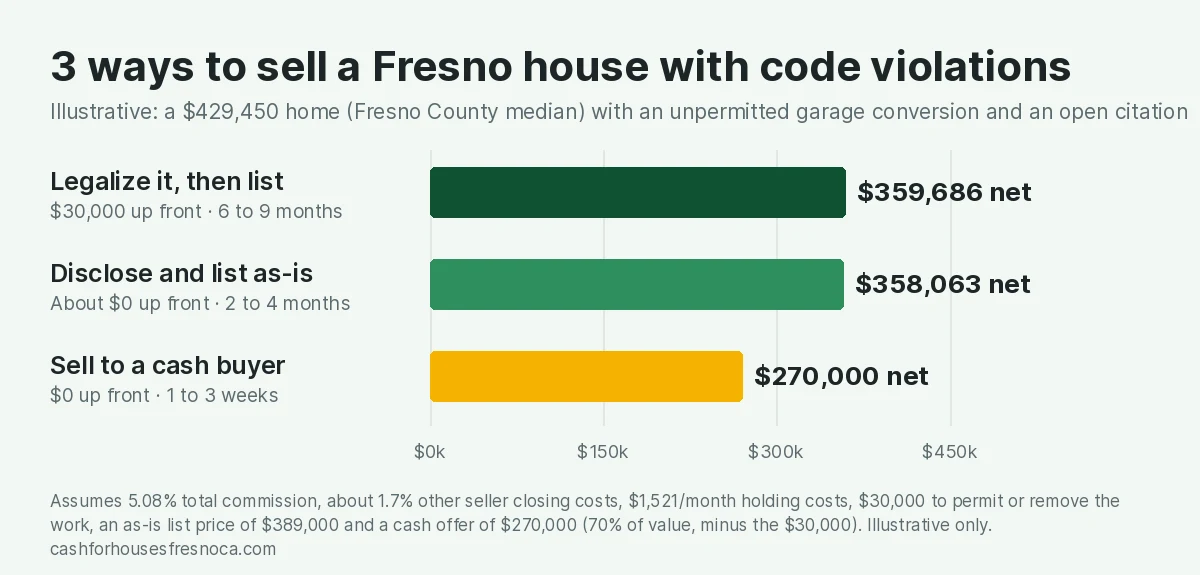
- Legalizing can be cheap or brutal. Permitting existing unpermitted space runs from about $20,000 to $200,000 or more. In our Fresno example, legalizing and listing nets about $359,686, listing as-is about $358,063, and a cash sale about $270,000.
Can you sell a house with code violations?
Yes. Houses with code violations sell in California every day. There's no statewide rule that says you must clear every violation, close every permit or pass a city inspection before you transfer title.
What a violation changes is who will buy the house and at what price. Three things decide how much it costs you:
- What kind of violation it is. Overgrown weeds or a junk car is a weekend fix. An unpermitted bedroom, illegal wiring or a converted garage is a contractor and permit job. A substandard-housing order is serious.
- Whether the city already knows. Unpermitted work nobody has reported is a disclosure issue. An open case with citations is a disclosure issue and a running bill.
- How the buyer is paying. Lenders and appraisers look hard at unpermitted space and safety problems. Cash buyers don't have a lender to satisfy.
Common code violations on Fresno houses
"Code violation" covers a lot of ground. On the houses I walk through around Fresno, Clovis and the Central Valley, these come up most:
- Garage conversions. The big one. A garage turned into a bedroom, den or rental unit without permits, often decades ago.
- Room additions and patio enclosures. Extra square footage that isn't on the county assessor's record or the city's permit history.
- Electrical, plumbing and water heater work. A new panel, added circuits or a swapped water heater with no permit, missing strapping or bad venting.
- Safety items. Missing smoke or carbon monoxide detectors, bedrooms without a proper exit window, and unsafe stairs or railings.
- Property maintenance. Junk and rubbish, inoperable vehicles, overgrown vegetation, a pool that's gone green, or a vacant house that isn't secured.
- Zoning issues. An extra unit in the back, a structure too close to the property line, or a home business the zoning doesn't allow.

Not all of these carry the same weight. A buyer will shrug at a missing smoke detector and walk away from an unpermitted bedroom with a sketchy subpanel. If you're not sure which you have, a pre-listing home inspection and a look at your permit history (below) will tell you.
What California requires you to disclose
This is the part that matters most. Sellers of one-to-four-unit homes in California fill out the Real Estate Transfer Disclosure Statement (TDS), whose wording is set in Civil Code section 1102.6. Section II.C asks you to answer yes or no to items including (full form text (opens in a new tab)):
- Item 4: "Room additions, structural modifications, or other alterations or repairs made without necessary permits"
- Item 5: "Room additions, structural modifications, or other alterations or repairs not in compliance with building codes"
- Item 10: "Any zoning violations, nonconforming uses, violations of 'setback' requirements"
- Item 15: "Any notices of abatement or citations against the property"
So the form asks about code violations by name. If you know about them, check "yes" and explain. A few rules sellers get wrong:
- "As-is" doesn't cancel the duty. Civil Code section 1102(c) makes any waiver of the disclosure rules "void as against public policy." You can refuse to make repairs. You can't refuse to disclose.
- Disclose past and closed cases too. A violation you fixed with a final permit sign-off is easy to explain. Attach the paperwork. A buyer who finds an old citation you left off will assume the worst.
- Bought it recently and fixed it up? Since July 1, 2024, Civil Code section 1102.6h requires sellers who resell within 18 months of buying to list additions and alterations done by a contractor and say whether permits were pulled. That rule targets flips.
- You don't have to go digging, but don't look away. The duty covers what you know. If you suspect a problem, a permit history check is cheap and protects you.
Disclosure is also good strategy. A buyer who learns about the unpermitted bedroom from your TDS prices it in on day one. A buyer who learns about it from their inspector on day twelve asks for a big credit or cancels. For a full list of California seller forms, see the disclosure section of our guide to selling a house by owner.
Selling with an open code enforcement case
An open case is different from an unpermitted patio nobody has reported. If the city has issued a notice of violation or citations, a few state laws kick in:
- The case doesn't end at the sale. Health and Safety Code section 17991 (opens in a new tab) says a sale or transfer "shall not render moot" an enforcement action against the owner of record. Fines and costs from your time as owner can still come to you.
- You may have to record a notice naming the buyer. If you sell between the notice of violation and the fix, the same section requires you to record a "Notice of Conveyance of Substandard Property" with the county recorder within 5 days and give the enforcement agency the buyer's information.
- The case may already be on title. Under Health and Safety Code section 17985, an agency that starts an enforcement action records a notice of pendency with the county recorder, and a notice of final disposition when it's resolved. A title search will find it, and so will the buyer.
- Unpaid fines and abatement costs can become liens. When a city does cleanup work itself and the owner doesn't pay, the cost can be recorded against the property. Those get paid out of your proceeds at closing, the same as the mortgage. Our closing cost guide explains how payoffs work, and our guide to selling a house with a lien covers every other kind.
Here's what that looks like in real life. A 2026 agenda for Fresno's Building Standards Appeals Board describes a case where a large backyard structure was built without plans or permits. The city opened the case after a complaint in May 2025, gave several months of extensions while a permit application sat incomplete, then issued a $250 citation that November and a $500 one in December. That's how most cases go: notice, deadline, extension, then fines that step up until the work is done or removed.
If you have an open case, call the inspector before you list. Ask what it would take to close it, whether an extension is possible during escrow, and whether there are any unpaid fines or liens. Get the answers in writing and give them to your buyer.
What code violations cost in Fresno
Under state law, a city can fine up to $130, then $700, then $1,300 for repeat infractions of its building and safety code within a year (Government Code section 36900 (opens in a new tab)). Administrative citations, which most cities use for code enforcement, follow their own schedule. Fresno's current one is in the City of Fresno Master Fee Schedule (opens in a new tab), with fees effective July 1, 2026:
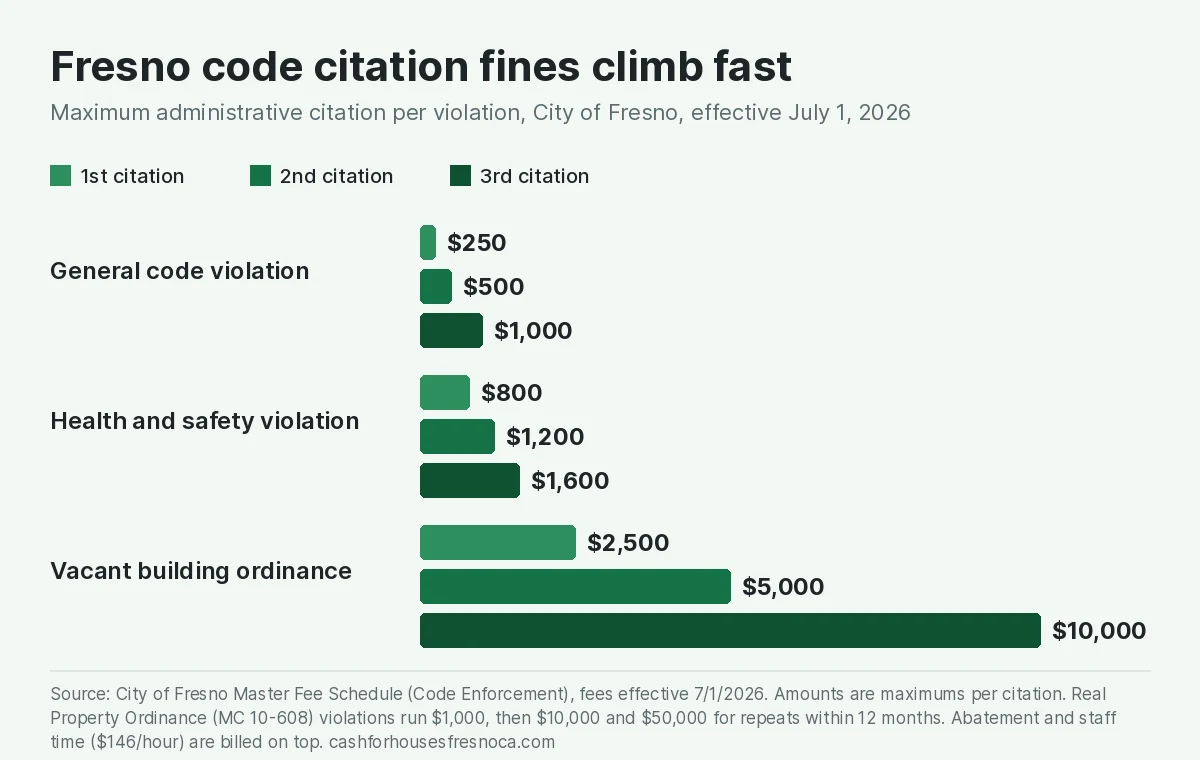
A few more line items from the same schedule worth knowing:
- Real Property Ordinance violations (Fresno Municipal Code 10-608) carry a $1,000 citation, then $10,000 and $50,000 for repeats within a rolling 12 months, plus abatement and enforcement costs.
- Unregistered vacant properties are charged $250 a month. That matters for inherited houses that sit empty while an estate is settled.
- Staff time adds up. Notices of violation and public nuisance enforcement are billed at $146 an hour, and releasing a recorded lien costs a $60 county filing fee plus a $146 city processing fee.
- Missing smoke or CO detectors can draw a $200 citation per violation.
The fines alone rarely sink a sale. The real cost is the deadline. Once citations start, you're on the city's clock, not yours, and every month the house sits unsold you also pay property tax, insurance and utilities. That's where a lot of Fresno sellers decide to sell.
Unpermitted work: legalize, remove or disclose
For unpermitted additions and conversions, you have three options before a sale:
- Legalize it. Apply for a permit for the existing work. Expect to need as-built plans, possibly an engineer, and inspections that may require opening walls so the inspector can see wiring, plumbing and framing. California has no statewide "retroactive permit" law; it all runs through the local building department. In the city of Fresno that's the FAASTER online permitting portal. In unincorporated Fresno County it's the county's Citizens Portal.
- Remove it. Take the work back to its permitted condition, for example by turning a converted garage back into a garage. Sometimes that's cheaper than legalizing, but you lose the space.
- Disclose it and sell as-is. Tell buyers exactly what was done without permits and price the house for it. The buyer takes on the decision to legalize or remove.
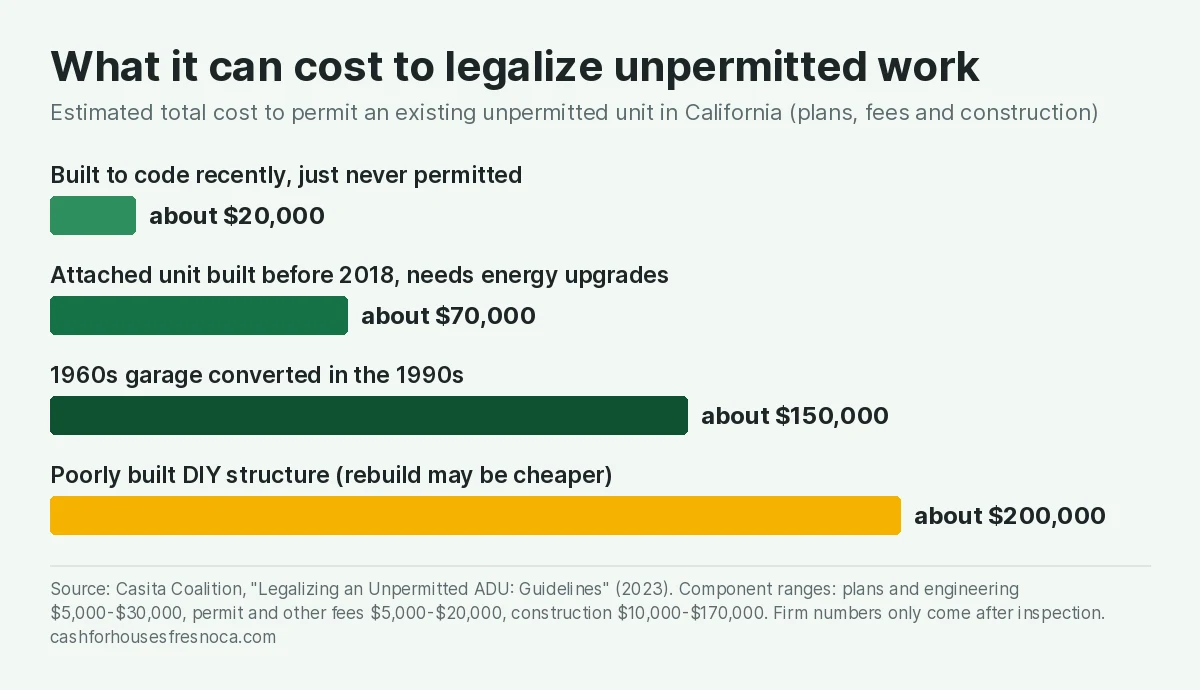
The Casita Coalition, a California housing nonprofit, breaks the cost into three buckets: plans and engineering ($5,000 to $30,000), permit and other fees ($5,000 to $20,000) and construction ($10,000 to $170,000). It warns that the total "could come in anywhere from $20,000 - $200,000 or more," and that nobody can give you a firm number until the inspections are done. The pre-application phase alone takes about 8 weeks, and construction can run from one month to more than a year.
Two pieces of good news for California sellers:
- Older unpermitted ADUs got easier to legalize. Since January 1, 2025, AB 2533 (Government Code section 66332) says a city can't deny a permit for an unpermitted ADU or junior ADU built before January 1, 2020 just because it doesn't meet current building or zoning standards. It can deny only if the unit is substandard under Health and Safety Code section 17920.3, and impact fees generally don't apply. A city summary of AB 2533 (opens in a new tab) lists the proof you'll need, like dated photos, assessor records or old escrow papers.
- Older wiring and plumbing isn't automatically a violation. State law exempts older systems that are still in good and safe condition, so you don't have to bring a 1960s house up to 2026 code just to sell it.

How unpermitted work affects the buyer's loan
Appraisers have to deal with unpermitted space too. Fannie Mae's Selling Guide (opens in a new tab) says that when additions were made without permits, "the appraiser must comment on the quality and appearance of the work and its impact, if any, on the market value." In practice, an unpermitted bedroom often gets valued for less than permitted space, or not counted as living area at all. FHA and VA loans add minimum property standards for safety, so a converted garage with no exit window or an open electrical hazard can stall funding until it's fixed. That shrinks your buyer pool to conventional buyers with big down payments, and cash buyers.
Not sure what the city has on your house?
Call or text (559) 512-6998. I'll help you figure out what's on record and give you an all-cash offer for the house exactly as it is, violations and all. No repairs, no permits, no pressure.
Call (559) 512-6998Get My All-Cash OfferHow to sell a house with code violations in 7 steps
- Find out what's on record. Pull the permit history from the city or county, and ask Code Enforcement whether there are open cases, citations or liens. Order a preliminary title report early.
- Compare it with what's actually there. Walk the house with your permit list. Every bedroom, bathroom, addition, patio cover and big system change should match a permit.
- Fix the cheap, safe things. Smoke and CO detectors, water heater strapping, junk removal and weeds. These cost little and remove easy objections.
- Price the big items. Get a contractor or designer to estimate legalizing or removing the larger work. Now you know what "fix it first" really costs.
- Run the numbers on all three routes. Legalize and list, list as-is, or sell for cash. Use the comparison below and our breakdown of how much it costs to sell a house.
- Disclose in writing. On the TDS and the seller questionnaire, say what was done, when, whether it was permitted, and any city contact or case number. Attach letters and invoices.
- Price for the condition. An as-is house priced like a fully permitted one sits, and the price cuts come anyway.
3 ways to sell a house with code violations, compared
Here's an honest side-by-side on a typical Fresno house. Say it would be worth $429,450 fully permitted (the Fresno County median in the C.A.R. September 2026 sales report (opens in a new tab)). It has a garage converted into a bedroom without permits and an open citation. A designer and contractor estimate about $30,000 to permit the conversion or put the garage back.
| Item | Legalize it, then list | Disclose and list as-is | Sell to a cash buyer |
|---|---|---|---|
| Sale price | $429,450 | $389,000 (illustrative) | $270,000 |
| Commissions (5.08%) | -$21,816 | -$19,761 | $0 |
| Other closing costs (~1.7%) | -$7,301 | -$6,613 | $0 (buyer pays) |
| Permits, plans and construction | -$30,000 | $0 | $0 |
| Holding costs ($1,521/mo) | -$10,647 (7 mo) | -$4,563 (3 mo) | $0 |
| Estimated net | $359,686 | $358,063 | $270,000 |
| Cash you need up front | About $30,000 | About $0 | $0 |
| Time to close | 6 to 9 months | 2 to 4 months | 1 to 3 weeks |
| Risk of a deal falling apart | Low once permitted | Higher (appraisal, loan) | Low |
The cash number uses the common investor formula (about 70% of the fixed-up value, minus repairs) explained in our guide to how much cash buyers pay for houses. Commission rates come from Clever's August 2026 data, and the $1,521 a month in holding costs (property tax, insurance, utilities and mortgage interest) comes from our cost-to-sell breakdown. Seven months of holding covers about two months of pre-application, a few months of permits and work, and a normal listing period.
The honest takeaway: if the permit job is small, the scope is known and you have the cash and time, legalizing or listing as-is will usually net you more than a cash sale, here about $88,000 more. Notice how close the first two are, though. Legalizing only pays when it's cheap and predictable. If the inspector opens the walls and $30,000 becomes $70,000 or $150,000 (well within the Casita Coalition's ranges), or citations keep stacking up while you wait, the math flips fast. For the bigger picture, see cash offer vs listing.
When selling a house with code violations for cash makes sense
A cash sale trades some price for speed and certainty. It tends to be the right call when:
- The scope is unknown or big. Several unpermitted rooms, a garage conversion with its own kitchen, or electrical work nobody can vouch for.
- The city's clock is running. You have an open case, a compliance deadline or citations that keep stepping up.
- There's more wrong than permits. An old roof, mold, fire damage or a hoarder cleanout on top of the violations.
- It's inherited, vacant or a rental. The estate is in probate, the house is empty and racking up vacant-property fees, or you're a tired landlord whose tenant added "improvements."
- A buyer's loan already fell through. If an appraiser or lender flagged the unpermitted space once, the next financed buyer will likely hit the same wall.
When you sell to us, we buy the house as-is, violations, open permits and all. You still give your disclosures, but there's no appraisal to fail, no lender demanding repairs and no permit job to manage. We handle the city afterward, pay the closing costs and charge no commissions, and you can close in as little as 7 days or on the date you choose.
Get an all-cash offer on a house with code violations
Tell us about the house. We'll send a no-obligation all-cash offer for it exactly as it is, unpermitted work and open citations included, and you can close in as little as 7 days.
We buy houses with code violations in Fresno, Clovis, Madera, Visalia and across the Central Valley. You can read more about me and how we work, or contact us any time.
Ready to be done with the city letters?
Call or text (559) 512-6998 for an all-cash offer on your house as it is. No permits, no repairs, no showings, and you can close in as little as 7 days.
Call (559) 512-6998Get My All-Cash OfferFAQ: selling a house with code violations
Can you sell a house with code violations in California?
Yes. California doesn't require you to fix code violations or close permits before selling. You do have to disclose violations you know about. The Transfer Disclosure Statement asks about unpermitted work, work not up to code, zoning violations and any notices of abatement or citations.
Do I have to disclose unpermitted work when I sell?
If you know about it, yes. Item 4 of the TDS asks about room additions, structural changes or repairs made without necessary permits. Selling as-is doesn't change that, because Civil Code 1102(c) makes waivers of the disclosure rules void.
What happens to an open code enforcement case when I sell?
The case doesn't go away. Health and Safety Code 17991 says a sale doesn't make an enforcement action moot. If you sell between the notice of violation and the fix, you may have to record a Notice of Conveyance of Substandard Property within 5 days and give the agency the buyer's information.
Do code violations show up on a title report?
Often. Agencies record a notice when they start certain enforcement actions, and unpaid fines or abatement costs can be recorded as liens. A preliminary title report will show them, and liens are usually paid from your proceeds at closing.
How much are code violation fines in Fresno?
Under the City of Fresno fee schedule effective July 1, 2026, general citations run up to $250, $500 and $1,000. Health and safety citations run up to $800, $1,200 and $1,600. Vacant building violations reach $2,500, $5,000 and $10,000, and staff time is billed at $146 an hour.
How much does it cost to legalize unpermitted work?
It varies widely. The Casita Coalition estimates about $20,000 for a unit built to code that was just never permitted, and $150,000 to $200,000 or more for an old or poorly built conversion. Plans, fees and construction are the three big costs.
Can a buyer get a mortgage on a house with unpermitted work?
Sometimes. Appraisers must comment on unpermitted additions and may value them for less or exclude them from living area. FHA and VA loans have safety standards that can require repairs before funding. Conventional buyers with strong down payments and cash buyers have the fewest problems.
Is it cheaper to remove unpermitted work than to permit it?
Sometimes. Turning a converted garage back into a garage can cost less than legalizing it, but you lose the living space and its value. Get a quote for both before you decide, and compare them with selling as-is.
Do you buy houses with code violations in Fresno?
Yes. We buy houses with code violations, unpermitted additions, open citations and other problems as-is across Fresno, Clovis, Madera, Visalia and the Central Valley. Call or text (559) 512-6998 for an all-cash offer. We pay closing costs and there are no commissions.