How do you evict a tenant in California? You serve the right written notice, wait for it to run out, file an unlawful detainer lawsuit, have the tenant served, win a judgment, and then have the sheriff enforce it. You can't skip any of those steps, change the locks yourself or shut off the utilities. In Fresno, a typical nonpayment eviction takes about 8 weeks if the tenant doesn't fight it and about 11 if they do.
I'm Christian Castro, a licensed California realtor (DRE #02195959) and the owner of Cash For Houses Fresno. I'm not an attorney, and this isn't legal advice. I work with a lot of Central Valley landlords who are in the middle of a tenant problem, and most of them want the same thing: a clear picture of how to evict a tenant in California, how long it takes and what it costs before they decide what to do. That's what this guide is. It covers the legal reasons you need, every notice type, the court steps with the rules that changed in 2025, Fresno-specific costs and contacts, and the mistakes that send landlords back to square one.
The short answer
- You need a legal reason. For most tenants who've lived there 12 months or more, it has to be a "just cause" listed in state law. See legal reasons.
- Start with the right written notice: 3 days for unpaid rent or a fixable violation, 30, 60 or 90 days to end a month-to-month tenancy. See step 1.
- Tenants now get 10 court days to answer the lawsuit, up from 5, since January 1, 2025. See step 4.
- Only the sheriff can remove a tenant. In Fresno County, lockouts are scheduled about 2 to 3 weeks out after the sheriff gets the writ. See step 6.
- A nonpayment eviction can cost $7,800 to $12,000+ once lost rent is counted. See the Fresno cost example.
Legal reasons to evict a tenant in California
Most California rentals fall under the Tenant Protection Act (Civil Code 1946.2 (opens in a new tab)). Once a tenant has lived there 12 months, the landlord needs a "just cause" from the law's list to end the tenancy. The California Courts self-help center (opens in a new tab) splits them in two:
| At-fault just causes | No-fault just causes |
|---|---|
| Not paying rent | Owner or close family member moving in |
| Breaking a lease term after a chance to fix it | Taking the unit off the rental market |
| Nuisance, serious damage or illegal activity | Substantial remodel or demolition |
| Refusing lawful entry, subletting against the lease | Complying with a law or government order |
No-fault evictions come with relocation assistance equal to one month's rent (or waiving the last month's rent), and since SB 567 took effect April 1, 2024, owner move-ins and remodels have tighter rules: the owner has to move in within 90 days and stay at least 12 months, and remodel notices need permits and a description of the work.
Some single-family homes and condos are exempt from just cause, but only if they aren't owned by a corporation or REIT and the lease includes the exemption notice the law spells out. Tenants who've been there less than 12 months aren't covered by just cause either. Either way, you still need the right notice and a court case.
You can't evict for a discriminatory reason, or to retaliate against a tenant who complained about repairs or code problems, reported you to a government agency, or organized with other tenants (Civil Code 1942.5 (opens in a new tab)).
What you can never do
California law is blunt about "self-help" evictions. A landlord can't change the locks, remove doors or windows, take the tenant's belongings, or shut off water, power or gas to force someone out. Under Civil Code 789.3 (opens in a new tab), a landlord who does is liable for the tenant's damages plus up to $100 for each day of the violation. The courts' own guidance says it plainly: the landlord "must go through the court process." Even after you win, only the sheriff carries out the lockout.
Step 1: Serve the right notice
Every California eviction starts with a written notice. The type depends on the reason:
| Notice | When it's used | How long |
|---|---|---|
| 3-day notice to pay rent or quit | Unpaid rent (rent only, no late fees, utilities or damages) | 3 days, not counting Saturdays, Sundays or court holidays |
| 3-day notice to perform covenants or quit | A lease violation the tenant can fix | 3 days, not counting weekends or court holidays |
| 3-day notice to quit | Serious problems that can't be fixed (nuisance, illegal use, serious damage) | 3 days, counting weekends and holidays |
| 30-day notice | Ending a month-to-month tenancy under 1 year | 30 days |
| 60-day notice | Ending a month-to-month tenancy of 1 year or more | 60 days |
| 90-day notice | Section 8 (subsidized) tenants | 90 days |
Under the Tenant Protection Act, a notice ending a long-term tenancy also has to state the just cause, and for no-fault reasons it has to say whether you're paying relocation assistance or waiving the last month's rent. If the problem is a fixable lease violation, the tenant generally has to get a notice to correct it before you can move to a notice to quit.
Two details trip up a lot of landlords. First, a 3-day notice to pay rent can only demand rent, and it has to be the right amount. Asking for late fees or a wrong number can void the notice. Second, the notice has to be served properly: handed to the tenant, left with an adult at the home or work and mailed, or, if nobody's there, posted on the door and mailed. Keep a dated record of how and when you served it. The court's landlord eviction guide (opens in a new tab) has step-by-step instructions and sample notices.
Step 2: File an unlawful detainer
If the notice period ends and the tenant hasn't paid, fixed the problem or moved, you can file an unlawful detainer, California's name for an eviction lawsuit. According to the California Courts (opens in a new tab), you'll need:
- Summons (form SUM-130)
- Complaint (form UD-100), with a copy of the notice and the lease attached
- Civil Case Cover Sheet (form CM-010)
- Any local forms your court requires
The filing fee is usually $240 to $450, depending on how much back rent you ask for, with fee waivers available if you qualify. In Fresno County, unlawful detainers are handled at the Fresno Superior Court (opens in a new tab), 1130 O Street, Fresno, CA 93721. The court's page links to free self-help clinics for both landlords and tenants.
Step 3: Serve the tenant
You can't hand the papers over yourself. Someone 18 or older who isn't a party to the case, a registered process server, or the sheriff has to serve the tenant. The Fresno County Sheriff's Civil Unit (opens in a new tab) charges $50 to serve a summons and complaint in an unlawful detainer with a Prejudgment Claim of Right to Possession. Serving that claim form along with the papers matters: it makes any unknown adult occupants come forward now, instead of surfacing at the lockout and stopping it.

Step 4: The tenant's 10 court days
Here's the biggest recent change. Starting January 1, 2025, AB 2347 gave tenants 10 court days to file a written answer, up from 5. Court days don't count weekends or court holidays, so 10 court days is about two calendar weeks. If the tenant was served some other way than in person, the deadline can be longer. The law's coverage in LAist (opens in a new tab) notes it also shortened the time for certain motions, so cases that do get challenged move along faster.
The Fresno court's own page puts it simply for tenants: they have ten days to respond in writing, and if they don't, "the court may enter a default judgment" for the landlord.
Step 5: Default judgment or trial
If the tenant doesn't answer, you ask the court for a default judgment for possession (and, usually, the unpaid rent). That's the fastest path.
If the tenant answers, either side can ask for a trial date. Eviction cases get priority, and the law generally sets trial within 20 days of the request (Code of Civil Procedure 1170.5 (opens in a new tab)). Bring the lease, the notice, your proof of service, the rent ledger and photos. Defenses tenants raise most often are a defective notice, the wrong rent amount, repair problems (habitability) and retaliation. A jury demand or a continuance can add weeks.
In the City of Fresno, tenants facing an eviction they believe is unlawful can apply to the Eviction Protection Program (opens in a new tab), run through the City Attorney's Office, which can connect them with a lawyer at no charge. In fiscal year 2025 the program took 330 intake calls and referred 146 to outside counsel, Fresnoland reported (opens in a new tab). If your tenant has a lawyer, it's a good idea for you to have one too.
Step 6: The writ and the sheriff lockout
Once you have a judgment, the court issues a Writ of Execution for Possession of Real Property. You deliver it to the sheriff with the fee. According to the Fresno County Sheriff (opens in a new tab):
- You'll need the signed, court-sealed writ, a completed SER-001 form and the fee. The sheriff's fee schedule lists $180 for an eviction ($105 posting plus $75 for the notice of restoration).
- Lockouts are scheduled first come, first served, typically about 2 to 3 weeks out.
- Deputies post a notice to vacate. The court says the tenant then has five days to move.
- On lockout day, you or your agent must be there early with working keys or a locksmith. Don't go onto the property or contact the occupants before the deputies arrive, or the eviction can be cancelled.
- The Civil Unit won't postpone a lockout. Only a court order can stop it.
After the lockout, any belongings left behind don't become yours. California law requires the landlord to store them for a period and give the former tenant a chance to reclaim them before they can be sold or thrown out. Follow those rules carefully.
How long an eviction takes in California
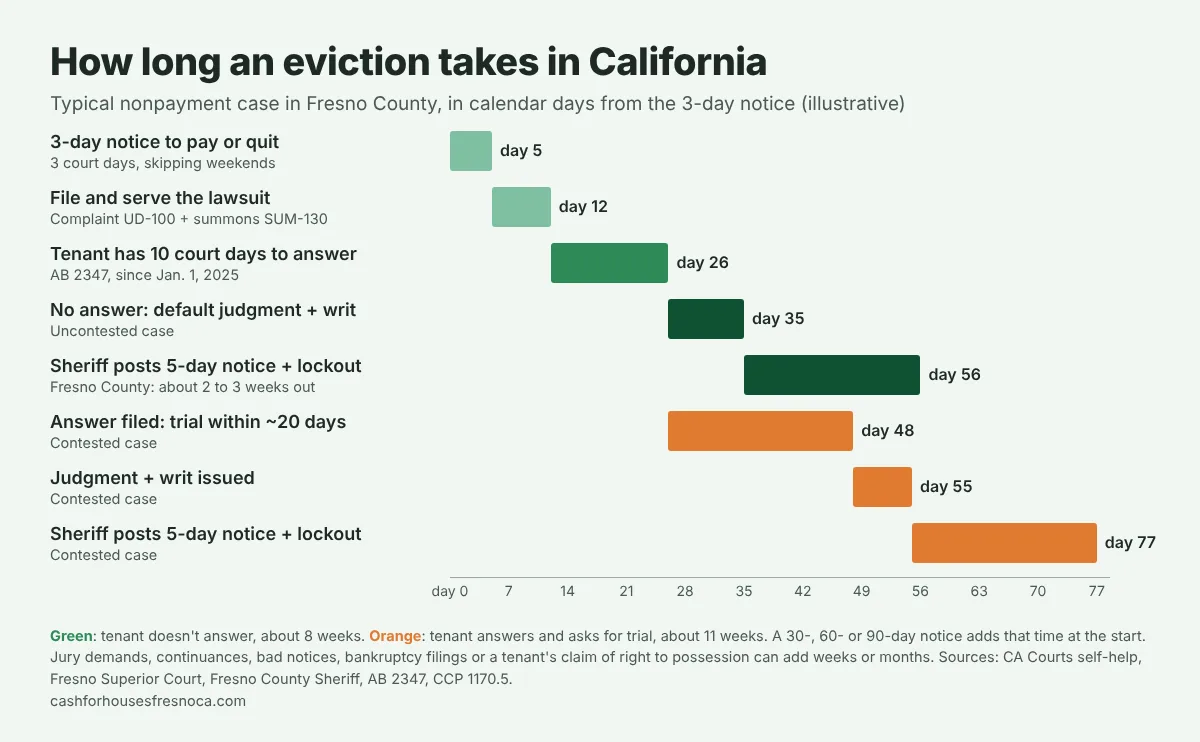
The court's self-help center says evictions take "30 to 45 days or more" from the time the tenant is served. Add the notice period before that and the sheriff's scheduling after, and a nonpayment case in Fresno takes about 8 weeks when the tenant doesn't answer and about 11 weeks when they do. If you're ending a month-to-month tenancy, add the 30, 60 or 90 days of notice at the start. Bad notices, jury trials, continuances, bankruptcy filings and unknown occupants can each add weeks or months.
What an eviction costs in Fresno
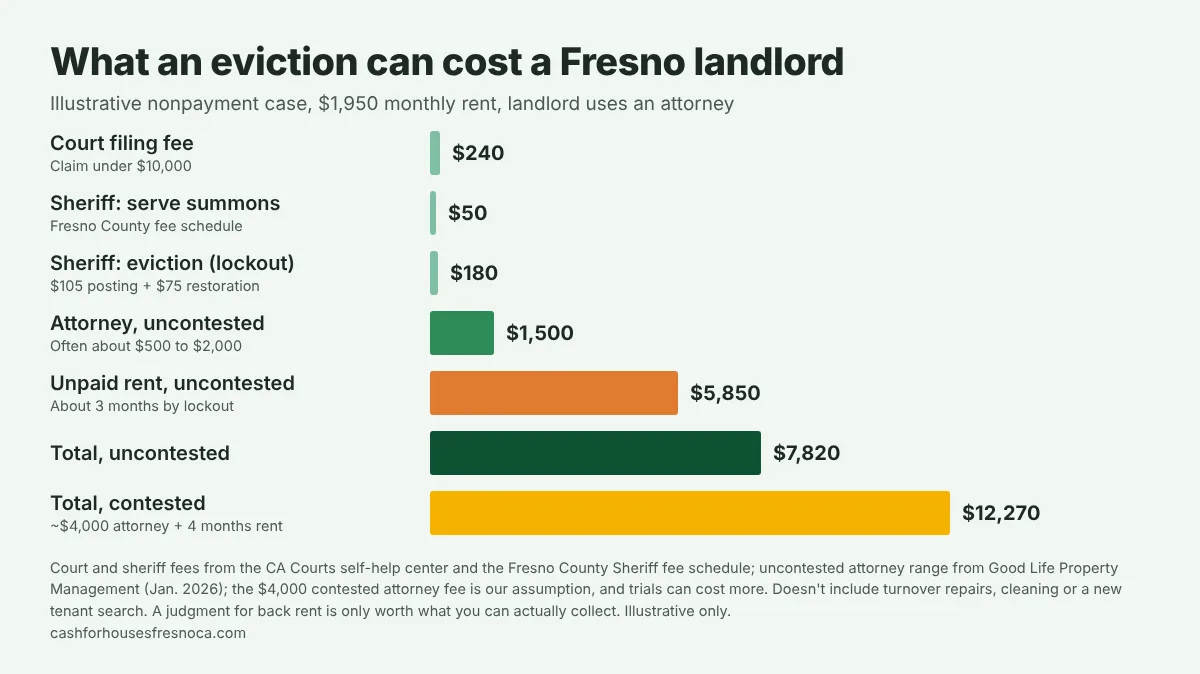
The court and sheriff fees are the small part. Filing runs $240 to $450, the sheriff charges $50 to serve and $180 for the lockout, and an attorney for an uncontested case often costs about $500 to $2,000, according to Good Life Property Management (opens in a new tab), which puts a typical total at $3,000 to $4,000 before lost rent. The big number is rent you don't collect. A tenant who stops paying on the 1st and is locked out about eight weeks later has usually missed three months. At $1,950 a month, that's $5,850.
A judgment for back rent helps only if you can collect it, and many landlords never do. Then there's the turnover after: cleaning, repairs and finding a new tenant. That's before you count your time, or the stress.
Stuck with a non-paying tenant?
You don't have to finish the eviction to sell. Call or text (559) 512-6998. We buy Fresno rentals with the tenant still in place, as-is, for all cash, and can close in as little as 7 days.
Call (559) 512-6998Get My All-Cash OfferMistakes that restart the clock
- Demanding the wrong amount on a 3-day notice, or adding late fees or utilities.
- Counting the days wrong. The 3-day pay-or-quit and perform-covenants notices skip weekends and court holidays.
- Skipping the just cause or the relocation statement on a notice to a tenant covered by the Tenant Protection Act.
- Taking rent after the notice without understanding how it affects the case. Accepting rent can waive the notice. Ask your attorney first.
- Retaliating, or looking like it, by serving a notice right after a repair complaint or a call to code enforcement.
- Not naming or serving every adult occupant, which can let an unnamed occupant stop the lockout.
- Self-help: changing the locks, removing belongings or shutting off utilities.
Alternatives to eviction
An eviction is sometimes necessary. But it's slow and expensive, so it's worth knowing the other doors:
- A payment plan for a tenant who's behind for a reason that's ending, like a job gap. Put it in writing.
- Cash for keys: a voluntary written agreement where you pay the tenant to move out by a set date. It's often faster and cheaper than court. Our guide to selling a house with tenants covers how to structure one.
- A mediated move-out through the court's self-help clinic or a local mediation program.
- Selling the house with the tenant in place. An investor buyer takes over the lease and the tenant situation, and you skip the court process entirely. If you're done being a landlord, see how we help tired landlords in Fresno, and our page on how we buy houses with tenants.
Selling a rental has its own tax questions. Our guides to capital gains tax in California and the 1031 exchange in California cover depreciation recapture and how to defer the tax if you're buying another property. And if the tenant left the house in rough shape, see our guides to selling a house with code violations and selling a hoarder house.
Get an all-cash offer on your rental, tenant and all
Tell us about the property and the tenant situation. We buy as-is with the tenant in place, pay the closing costs, and you can close in as little as 7 days.
We buy rentals with problem tenants in Fresno, Clovis, Madera, Visalia, Tulare, Hanford and across the Central Valley. You can read more about me and how we work, or contact us any time.
FAQ: how to evict a tenant in California
How do I evict a tenant in California?
Serve the correct written notice, wait for it to expire, file an unlawful detainer (summons SUM-130, complaint UD-100 and cover sheet CM-010), have the tenant served, then get a default judgment or win at trial. The court issues a writ of possession, and the sheriff posts a 5-day notice and carries out the lockout.
How long does it take to evict a tenant in California?
The courts say 30 to 45 days or more from the time the tenant is served. Counting the notice period and sheriff scheduling, a nonpayment case in Fresno typically takes about 8 weeks if the tenant doesn't respond and about 11 weeks if they do. Ending a month-to-month tenancy adds 30, 60 or 90 days of notice.
How many days does a tenant have to respond to an eviction in California?
Since January 1, 2025, a tenant served in person has 10 court days to file a written answer, up from 5. Weekends and court holidays don't count. Other service methods can add time.
Can I evict a tenant without a reason in California?
Not if the tenant is covered by the Tenant Protection Act and has lived there 12 months or more. You need a just cause from the law's list, and no-fault causes require one month's rent in relocation assistance. Exempt single-family homes with the required lease notice, and tenants under 12 months, can be given a 30- or 60-day notice without a stated cause, but still need a court case if they don't leave.
How much does it cost to evict a tenant in California?
Court filing fees are usually $240 to $450, and in Fresno County the sheriff charges $50 to serve the papers and $180 for the lockout. Attorney fees often run about $500 to $2,000 for an uncontested case and more at trial. Lost rent is usually the largest cost, often several thousand dollars.
Can I change the locks on a tenant who won't pay?
No. Changing locks, removing belongings or shutting off utilities to force a tenant out is an illegal self-help eviction under Civil Code 789.3, with damages and penalties of up to $100 a day. Only the sheriff can remove a tenant, after a court judgment.
Can I sell a house while evicting a tenant?
Yes. You can sell before, during or after an eviction. Many landlords sell to an investor who takes over the tenant situation, which skips the rest of the court process. The tenant's lease and protections carry over to the new owner.
Do you buy houses with non-paying tenants in Fresno?
Yes. We buy rentals with non-paying or problem tenants across Fresno and the Central Valley, as-is. Call or text (559) 512-6998 for an all-cash offer. We pay the closing costs, charge no commissions and handle the tenant after closing.
Sources and how to cite this guide
- California Courts: eviction guide for landlords (opens in a new tab); types of eviction notices (opens in a new tab); forms and filing fees (opens in a new tab); Fresno Superior Court unlawful detainer page (opens in a new tab).
- California law: Civil Code 1946.2 (opens in a new tab) (just cause); Civil Code 789.3 (opens in a new tab) (self-help); Civil Code 1942.5 (opens in a new tab) (retaliation); CCP 1170.5 (opens in a new tab) (trial timing); AB 2347 (10 court days, effective Jan. 1, 2025), via LAist (opens in a new tab); SB 567 via the California Apartment Association (opens in a new tab).
- Fresno: Fresno County Sheriff eviction instructions (opens in a new tab) and fee schedule (opens in a new tab); City of Fresno Eviction Protection Program (opens in a new tab); Fresnoland on EPP funding (opens in a new tab).
- Costs: Good Life Property Management, California eviction costs (opens in a new tab) (updated Jan. 2026).
- Photos: modern hallway (rawpixel, CC0); man in hat, Saint Louis Art Museum collection, public domain (CC0). Neither shows our clients or their homes.
Sharing this data? You're welcome to use the eviction timeline and the Fresno cost chart. Please credit "Cash For Houses Fresno" and link back to this page.