
Can you sell a house with foundation issues? Yes. Selling a house with foundation issues is legal and common in California, as long as you disclose what you know. What changes is who can buy it and for how much. Many financed buyers can't close until the problem is fixed, and cash buyers will price in the repair plus the risk. Your job is to figure out which path leaves the most money in your pocket: fix it first, list it as-is, or sell it for cash.
I'm Christian Castro, a licensed California realtor (DRE #02195959) and the owner of Cash For Houses Fresno. I've walked a lot of Central Valley houses with doors that won't latch, a crack running across the garage slab, or a "structural" line on the buyer's inspection report that killed the last escrow. This guide covers selling a house with foundation issues step by step: how to tell what kind of problem you have, what California makes you disclose, what repairs cost, how buyers' loans are affected, and a worked Fresno example. It's general information, not legal or engineering advice.
The short answer
- You can sell a house with foundation issues, but you have to disclose them on California's Transfer Disclosure Statement, even if you sell as-is. See what to disclose.
- Most repairs are smaller than sellers fear. The average foundation repair runs about $5,165, though major jobs reach $20,000 to $100,000. See the cost chart.
- Financing is the real hurdle. FHA and VA appraisers flag structural problems, and the loan usually can't close until they're fixed. See buyer financing.
- Get an engineer's report before you decide. A few hundred to $1,500 turns "foundation problem" into a specific scope and price, which stops buyers from guessing high.
- Fixing first usually nets the most when you have the time and cash. In our Fresno example, repairing then listing beats a cash sale by about $86,000, but it takes months and $25,000 up front.
Signs of foundation problems, and which ones actually matter
Almost every house older than a few years has some cracking. Concrete shrinks as it cures, and wood framing moves with heat and moisture. The question isn't "is there a crack?" but "is the foundation still moving, and is it hurting the structure?" Here's how inspectors and engineers usually sort it:
Usually cosmetic:
- Thin, hairline cracks in a slab or stem wall that haven't grown in years
- Small vertical cracks in drywall at the corners of doors and windows
- Minor cracks in a garage floor or driveway
Worth a structural engineer:
- Cracks wider than about 1/4 inch, cracks that are offset (one side higher than the other) or stair-step cracks in block or brick
- Floors that slope enough to roll a marble, or that feel bouncy
- Doors and windows that stick, swing open on their own, or have gaps at the top corner
- Walls pulling away from the ceiling, the chimney or the trim
- Water pooling against the foundation, a damp crawl space, or rotted floor joists and sill plates
In the Central Valley, I see two kinds of houses most often. Older homes on raised foundations, with a crawl space and a perimeter footing, tend to have rotted sills, settled piers or inadequate bolting. Newer homes on concrete slabs tend to have slab cracks and settlement at one corner, usually tied to drainage. They're fixed in very different ways, which is why a specific diagnosis matters more than the word "foundation."
Foundation issues in Fresno: what the soil reports say
Fresno isn't known for the dramatic foundation failures you hear about in parts of Texas, but the soil isn't trouble-free either. A geologic hazards study prepared for the City of Fresno's General Plan update found that the area's clayey soils "are considered to be slightly to moderately expansive", meaning they swell when wet and shrink when dry, with lab samples showing a low to high expansion potential (Krazan & Associates, Fresno General Plan EIR, Appendix F (opens in a new tab)). The same report notes that subsidence from groundwater pumping is a significant concern in western Fresno County, where the ground has dropped more than 20 feet, but that the Fresno planning area itself "is not known to be subject to such subsidence hazards."
In practice, that means most foundation problems I see in Fresno, Clovis and the surrounding towns come from water: sprinklers or downspouts soaking the soil next to the house, a slab leak, poor grading, or a crawl space that stays damp. That's actually good news for sellers. Drainage fixes and a few piers cost far less than a full replacement.
What California sellers must disclose about foundation issues
California is a disclosure state. Most sellers of one-to-four unit homes must give the buyer a Real Estate Transfer Disclosure Statement (TDS) under Civil Code 1102.6. Two parts of the form deal with foundations directly (full TDS text (opens in a new tab)):
- Section II.B asks whether you're aware of significant defects or malfunctions in a list of components, and "Foundation" is one of the boxes, along with "Other Structural Components."
- Section II.C, item 7 asks about "any settling from any cause, or slippage, sliding, or other soil problems." Item 8 asks about "flooding, drainage or grading problems," and item 9 about major damage from earthquake, flood or landslide.
A few rules trip sellers up:
- "As-is" doesn't remove the duty to disclose. You can refuse to make repairs, but you still have to fill out the TDS honestly. Our sell as-is page covers what that does and doesn't mean.
- Past repairs count. If the foundation was repaired, disclose it, and hand over the engineer's report, permits and any transferable warranty. A documented repair with a warranty actually reassures buyers.
- Reports you've received count. If a prior buyer's inspector or an engineer wrote up the foundation, you know about it now. Leaving it off the form is how sellers end up sued after closing.
- Unpermitted fixes are their own issue. Structural work done without a permit can show up as a code problem later. See our guide to selling a house with code violations.
My advice: over-disclose. Buyers who walk in knowing about a foundation issue negotiate. Buyers who discover it after closing call a lawyer.
Got a structural report that scared off your buyer?
Call or text (559) 512-6998. I'll look at the house and the report and give you an all-cash, as-is offer, with no repairs and no commissions.
Call (559) 512-6998Get My All-Cash OfferWhat foundation repairs cost
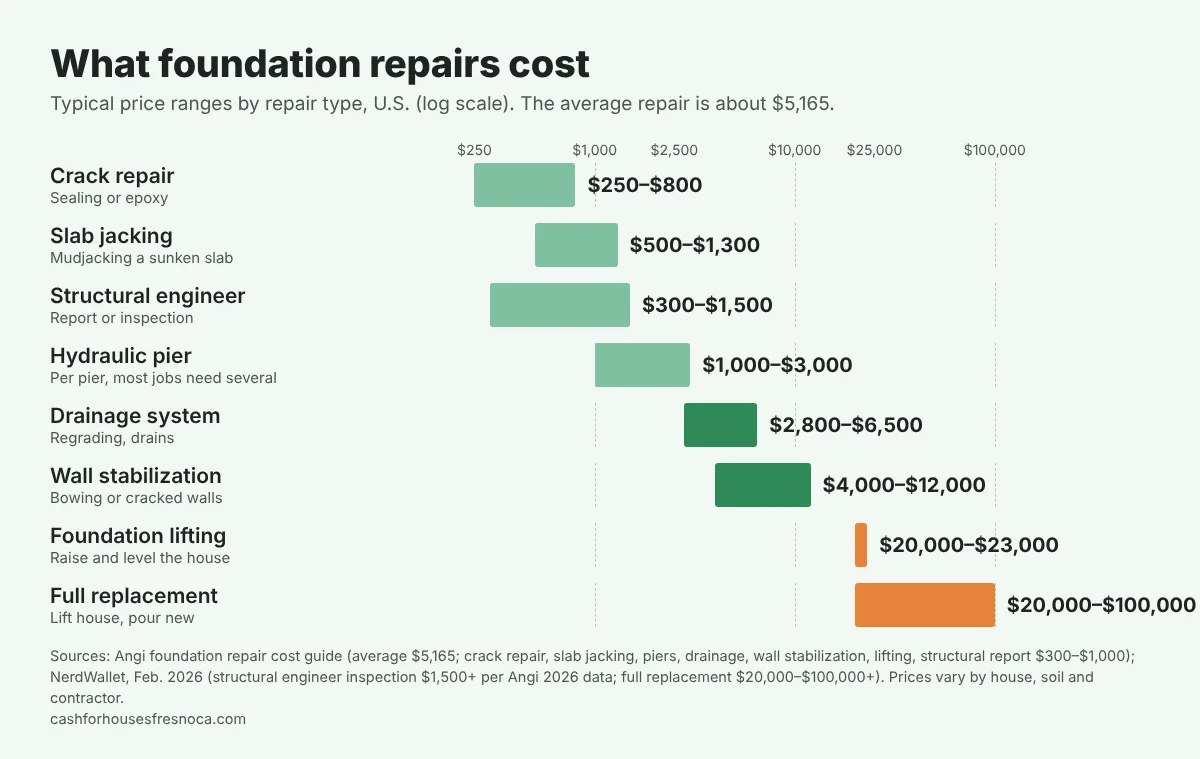
Foundation repair prices span a huge range, which is exactly why buyers tend to assume the worst. According to Angi (opens in a new tab), the average foundation repair costs about $5,165, with most homeowners paying between $2,220 and $8,112. NerdWallet's 2026 guide (opens in a new tab) puts major jobs, like extensive piering, large drainage projects or lifting the house, at $15,000 to $100,000 or more, and a full foundation replacement at $20,000 to $100,000.
A few things move the number:
- How many piers. Angi lists hydraulic piers at $1,000 to $3,000 each, and stabilizing one corner of a slab can take several. A whole-house job takes many more.
- Raised foundation vs slab. Crawl-space repairs (new sill plates, posts, bolting) are often cheaper and easier to access than lifting a slab.
- Drainage. If water caused the movement, the repair isn't done until the water is fixed. Budget for regrading, gutters, drains or a slab leak repair.
- Engineering and permits. A structural engineer's inspection runs about $1,500 or more by Angi's 2026 figures, as reported by NerdWallet, and a soil report $500 to $3,000. Structural work also needs a building permit.
Get at least two bids from foundation contractors, and ideally one plan from an independent engineer who isn't selling the repair. That gives you a real number to put in front of buyers. For how repair costs fit with everything else that comes out of a sale, see our breakdown of how much it costs to sell a house.
How foundation issues affect buyer financing
This is where selling a house with foundation issues gets hard. The problem usually isn't the buyer, it's the buyer's loan.
- FHA and VA loans require the house to meet minimum property standards, including structural soundness. If the appraiser sees major foundation problems, sloping floors or water pooling at the foundation, the appraisal usually comes back "subject to" repairs, meaning the work has to be done before the loan can fund (Redfin's FHA appraisal guide (opens in a new tab)). Most sellers don't want to pay for a $20,000 repair on a house that's still in escrow.
- Conventional loans are more flexible, but the lender can still require an engineer's letter, and the appraiser will knock value off for an obvious defect.
- Homeowners insurance can be harder to get on a house with active structural movement, and no insurance means no loan.
The result: a house with a known foundation issue often attracts fewer, more cautious buyers, and a bigger share of them are investors or cash buyers. That's not a reason to panic. It's a reason to decide up front whether you'll fix the issue, offer a credit, or market the house to buyers who can close as-is.

Your 3 options for selling a house with foundation issues
1. Repair the foundation, then list
Best for sellers with time, cash for the repair and a house that's otherwise in good shape. You hire an engineer, pull a permit, have the work done and hand buyers a clean report and a transferable warranty. The house can then go to any buyer, including FHA and VA. The risks are the up-front cost, delays, and the chance the contractor finds more than expected once they start digging.
2. List it as-is, with the report and a bid
Best when the repair is moderate and you'd rather not manage a construction project. Order the engineer's report and a contractor bid before you list, put them in the disclosure packet, and price the house with the repair in mind. Buyers will still deduct more than the bid, often a lot more, because they're taking on the risk and the hassle. Expect most offers to come from cash or conventional buyers, and expect a longer time on the market. Our timeline of how long it takes to sell a house shows what's normal in Fresno.
3. Sell to a cash buyer as-is
Best when the repair is large or unknown, the house needs other work too, or you need to close quickly. A cash buyer takes the house without inspection contingencies or loan approval, and you skip the repair and the commission. You'll get less than a fixed-up sale. Our guide to how much cash buyers pay for houses shows how those offers are built.
Fresno example: fix it, list it as-is, or sell for cash
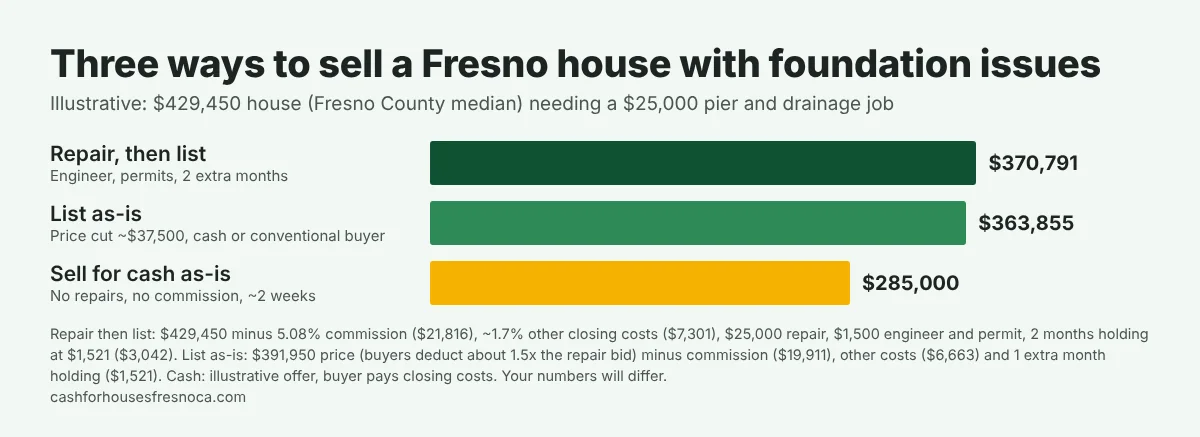
Here's what selling a house with foundation issues can look like in real numbers. Say a Fresno home would sell for $429,450 in good condition, the Fresno County median in the C.A.R. September 2026 sales report (opens in a new tab). An engineer finds one corner of the slab has settled from poor drainage, and the best bid for piers plus drainage work is $25,000.
| Item | Repair, then list | List as-is | Cash sale as-is |
|---|---|---|---|
| Sale price | $429,450 | $391,950 | $285,000 |
| Commissions (5.08%) | -$21,816 | -$19,911 | $0 |
| Other closing costs (~1.7%) | -$7,301 | -$6,663 | Paid by buyer |
| Foundation repair | -$25,000 | $0 | $0 |
| Engineer and permit | -$1,500 | $0 | $0 |
| Extra holding costs | -$3,042 (2 months) | -$1,521 (1 month) | $0 |
| You keep | $370,791 | $363,855 | $285,000 |
| Typical timeline | 3 to 5 months | 2 to 4 months | As little as 7 days |
The commission rate is Clever's August 2026 figure and the $1,521 a month holding cost comes from our breakdown of the full cost of selling a house. The as-is price assumes buyers knock off about 1.5 times the repair bid, which is a common reaction to a structural problem, and that you find a cash or conventional buyer rather than FHA.
The honest takeaway: if you can fund the repair and wait, fixing first nets the most. Listing as-is is close behind if the problem is well documented. A cash sale costs real money here. It wins when the repair is bigger or unknown, when you'd need to borrow to fund it, when the house needs other work, or when months of carrying costs and uncertainty aren't an option. Our cash offer vs listing guide walks through that decision in more detail.
How to sell a house with foundation issues in 6 steps
- Get a structural engineer's evaluation, not just a contractor's sales visit. You want the cause, the scope and a repair plan in writing.
- Get two or three repair bids based on that plan, including drainage work.
- Gather your paperwork: past reports, permits, receipts and any repair warranty.
- Fill out the TDS honestly, checking "Foundation" and item 7 if they apply, and attach the reports.
- Run the numbers for all three paths with your real bid and price, like the table above.
- Choose your buyer pool. If you're not repairing, tell your agent to target cash and conventional buyers, or get a cash offer to compare against.
If the foundation problem came from a fire, a burst pipe or a long-term leak, there may be insurance money or other issues in play. See our guides to selling a fire-damaged house and selling a house with mold, which often goes hand in hand with a damp crawl space.
When selling a house with foundation issues for cash makes sense
A foundation problem alone doesn't make a cash sale the right answer. If the fix is a few thousand dollars, do it and list. A cash sale tends to make sense when:
- The repair is big or unclear, like a lift, a replacement, or a bid that keeps growing.
- A financed buyer already fell out of escrow after the inspection or appraisal, and you don't want to repeat it.
- The house needs other work too: roof, plumbing, a full cleanout, or unpermitted additions.
- It's inherited or a rental and nobody wants to manage a construction project. See our pages on selling an inherited house and selling a rental property.
- You need to close fast because of a move, a divorce or a foreclosure date.
When you sell to us, we buy the house as-is, foundation and all. You don't pay for an engineer or repairs, we pay the closing costs, there are no commissions, and you can close in as little as 7 days or on the date you pick. If listing would put more in your pocket, I'll tell you.
Get an all-cash offer on a house with foundation issues
Tell us about the property and what the inspection found. We'll send a no-obligation all-cash offer, and you can close in as little as 7 days with no repairs.
We buy houses with foundation problems in Fresno, Clovis, Madera, Visalia, Hanford and across the Central Valley. You can read more about me and how we work, or contact us any time.
Ready to sell without fixing the foundation?
Call or text (559) 512-6998 for an all-cash, as-is offer. No repairs, no commissions, and you can close in as little as 7 days.
Call (559) 512-6998Get My All-Cash OfferFAQ: selling a house with foundation issues
Can you sell a house with foundation issues in California?
Yes. It's legal to sell a house with foundation problems in California as long as you disclose what you know on the Transfer Disclosure Statement. You don't have to repair it, but the problem will affect your price and which buyers can get a loan.
Do I have to disclose foundation problems when selling my house?
Yes. The California TDS asks about defects in the foundation (Section II.B) and about "any settling from any cause, or slippage, sliding, or other soil problems" (Section II.C, item 7). Past repairs and reports you've received should be disclosed too. Selling as-is doesn't remove this duty.
How much does a foundation problem lower a home's value?
There's no fixed percentage. Buyers usually subtract the repair bid plus a cushion for risk and hassle, often well over the bid itself. A documented repair plan from an engineer keeps that cushion smaller. In our Fresno example, a $25,000 repair led to a $37,500 price cut on an as-is listing.
Will an FHA loan go through on a house with foundation issues?
Often not until it's fixed. FHA appraisers check for structural soundness, and major foundation problems usually lead to an appraisal "subject to" repairs, which must be completed before closing. VA loans work similarly. Cash and some conventional buyers are more flexible.
Should I fix the foundation before selling?
If you have the money and time and the house is otherwise in good shape, fixing first usually nets the most because it opens the house to every buyer. If the repair is large, uncertain, or you'd have to borrow for it, listing as-is with a report or selling for cash may be the better trade.
How much does foundation repair cost?
Angi puts the average at about $5,165, with most repairs between $2,220 and $8,112. Hydraulic piers run $1,000 to $3,000 each, and major jobs like lifting or replacing a foundation can cost $20,000 to $100,000 or more.
Are foundation problems common in Fresno?
Fresno's clayey soils are described as slightly to moderately expansive in the City's General Plan geology study, and the city area isn't considered a subsidence zone. Most local problems we see come from water: poor drainage, sprinklers against the house, slab leaks or damp crawl spaces.
Do you buy houses with foundation problems in Fresno?
Yes. We buy houses with foundation issues, cracked slabs, settled piers and structural damage across Fresno and the Central Valley. Call or text (559) 512-6998 for an all-cash offer. We pay closing costs and there are no commissions.
Sources and how to cite this guide
- Disclosure law: Civil Code 1102.6, Real Estate Transfer Disclosure Statement (opens in a new tab) (Section II.B and II.C items 7 to 9).
- Repair costs: Angi foundation repair cost guide (opens in a new tab); NerdWallet, Foundation Repair Cost in 2026 (opens in a new tab) (updated Feb. 25, 2026).
- Fresno soils: Krazan & Associates, Geologic Hazards Investigation, Fresno General Plan Update (2012), EIR Appendix F (opens in a new tab).
- Financing: Redfin, What won't pass an FHA inspection (opens in a new tab).
- Data: C.A.R. September 2026 sales report (opens in a new tab) (Fresno County median price).
- Photos: concrete building from PxHere (CC0); Cliff Palace and the Parthenon (Rhomaides Frères, c. 1880) via rawpixel, public domain (CC0). None show our clients or their homes.
Sharing this data? You're welcome to use the repair cost chart and the Fresno comparison. Please credit "Cash For Houses Fresno" and link back to this page.