Can you sell a house with a reverse mortgage? Yes. Selling a house with a reverse mortgage works much like selling with a regular mortgage: escrow gets a payoff from the loan servicer, pays it from the sale, and you or the estate keep whatever is left. The differences are that the balance has been growing instead of shrinking, and that heirs face their own deadlines and a special rule that caps what they ever have to pay.
I'm Christian Castro, a licensed California realtor (DRE #02195959) and the owner of Cash For Houses Fresno. I get calls from two kinds of people about reverse mortgages: older homeowners who want to move to be near family or into assisted living, and adult children who just got a "due and payable" letter after a parent passed away. This guide covers selling a house with a reverse mortgage for both. It explains how the loan comes due, what the payoff includes, the heirs' timeline, the 95% rule, and a worked Fresno example. It's general information, not legal, tax or financial advice.
The short answer
- You can sell a house with a reverse mortgage any time. The loan is paid off from the sale, and there's no prepayment penalty on an FHA-insured HECM. See selling while you're alive.
- The loan comes due when the last borrower dies, sells or moves out, including a stay of more than 12 straight months in a care facility. See when it comes due.
- Heirs never owe more than the house is worth. A HECM is non-recourse. If the loan is bigger than the value, heirs can sell for at least 95% of the appraised value and the lender takes the proceeds as payment in full. See the 95% rule.
- Heirs have to move fast. HUD expects the loan settled within 30 days of the borrower's death, with extensions if the family is actively selling. See the heirs' timeline.
- The balance keeps growing while you sell, by roughly $1,500 a month on a $260,000 loan in our Fresno example, so delays cost real money.
How a reverse mortgage works, and why the balance grows
A reverse mortgage lets a homeowner 62 or older borrow against their equity without making monthly payments. Almost all of them are Home Equity Conversion Mortgages (HECMs), insured by the Federal Housing Administration. For FHA case numbers assigned in 2026, the most a HECM can be based on is a home value of $1,249,125, according to HUD's 2026 loan limit announcement (opens in a new tab).
Because nothing is repaid each month, the balance goes up instead of down. Every month the loan adds interest plus FHA's annual mortgage insurance premium, which HUD set at 0.5% of the balance a year, on top of a 2% up-front premium (HUD Mortgagee Letter 2017-12 (opens in a new tab)). Those charges compound, so the balance can double in about 10 years at today's kinds of rates.
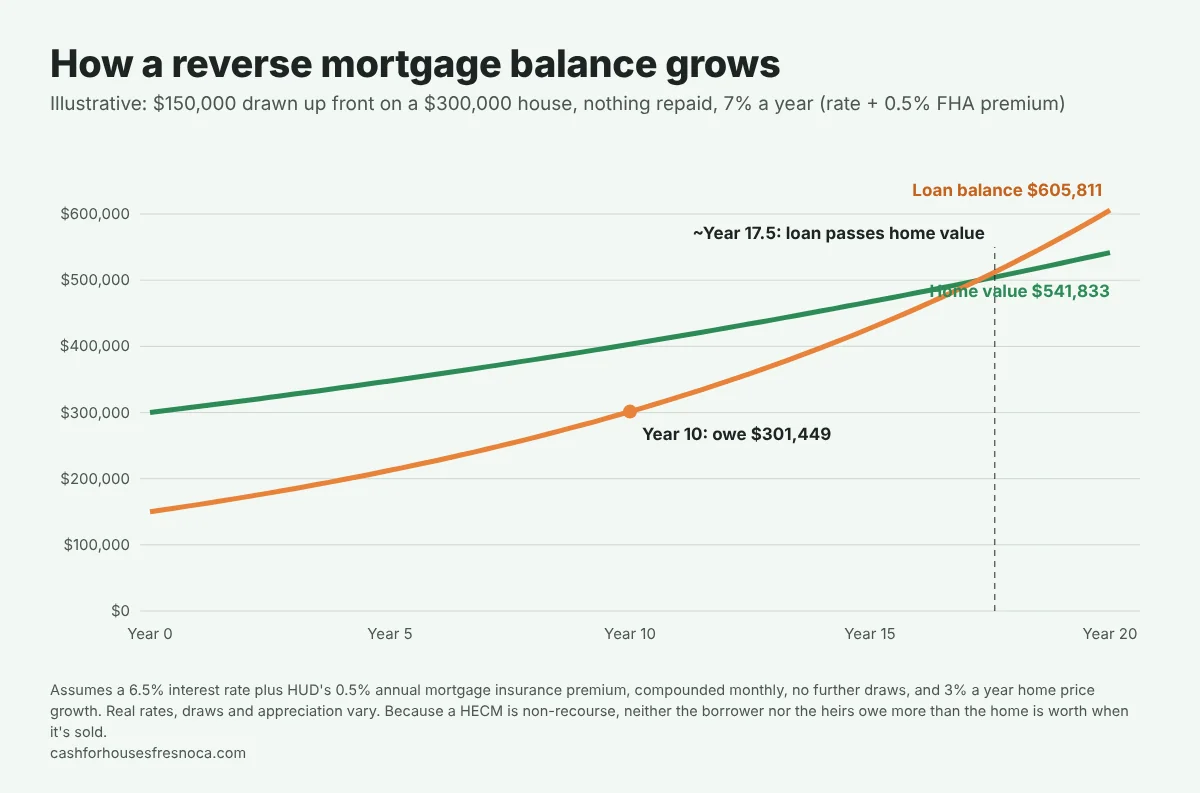
That growth is the whole story when it's time to sell. A borrower who took $150,000 out of a $300,000 house might find, 15 or 20 years later, that the loan has eaten most or all of the equity. That's not a scam or a mistake. It's how the loan is designed. But it's why the first thing to do before selling a house with a reverse mortgage is get an exact payoff number.
When a reverse mortgage comes due
According to the Consumer Financial Protection Bureau (opens in a new tab), a HECM must be repaid when:
- The last surviving borrower or eligible non-borrowing spouse dies.
- The home is sold.
- The last borrower no longer lives there as a principal residence, meaning where they live most of the year.
- The borrower is away for more than 12 consecutive months in a health care facility and no co-borrower lives in the home.
The loan can also be called early if the borrower stops paying property taxes or homeowners insurance, or lets the house fall into disrepair. If you're behind on property taxes on a reverse-mortgaged house, deal with it now. See our Fresno County property tax guide for deadlines and payment plans.
An eligible non-borrowing spouse, a spouse who wasn't on the loan but meets HUD's rules, can usually stay in the home after the borrower dies as long as they keep up the taxes, insurance and upkeep. The loan stops paying out, but it isn't due until they die or move out.
Selling a house with a reverse mortgage while you're alive
If you have a reverse mortgage and want to downsize, move closer to family or move into assisted living, you can sell whenever you like. Here's how it works:
- Request a payoff statement from your servicer (the company you get statements from, not necessarily the lender who made the loan). It shows the balance as of a date, with a daily amount for each day after.
- Price the house and run your net. Subtract the payoff, commissions and closing costs from the expected price. What's left is yours.
- Open escrow. Escrow orders the final payoff demand and pays the servicer at closing, exactly like a regular mortgage. Our guide to selling a house with a mortgage walks through how payoffs work at the closing table.
- Get your proceeds. Whatever remains after the payoff and costs goes to you. FHA-insured HECMs carry no prepayment penalty.
Two cautions for living borrowers. First, if you move out (say, into memory care) before the house is sold, the 12-month clock and the "principal residence" rule matter. Talk to your servicer before you move so a vacancy doesn't trigger a due-and-payable notice before you're ready. Second, if you'll need the cash for care, a fast sale that stops the interest and the holding costs can be worth more than squeezing out the top price over six months.
Selling a house with a reverse mortgage after the owner dies
This is the more common situation, and the one that catches families off guard. When the last borrower dies, the servicer sends a due and payable notice to the estate. According to HUD's guide for heirs (opens in a new tab), the estate or heirs have a few options:
- Keep the house by paying off the loan, usually with a new mortgage, savings or life insurance. HUD lets heirs pay the lesser of the full balance or 95% of the current appraised value.
- Sell the house and use the proceeds to pay off the loan. Anything left belongs to the estate.
- Hand the house back with a deed in lieu of foreclosure if there's no equity and nobody wants to deal with a sale.
Meanwhile, HUD's guide is clear that property taxes and insurance remain the estate's responsibility until title is transferred. That includes the insurance on a vacant house, which many regular policies exclude after 30 to 60 days.
Who can sign depends on how the house was held. If it was in a living trust, the successor trustee can sell. If there was a transfer on death deed, the named beneficiary can. Otherwise the estate usually needs probate before anyone can sign a deed, which can blow through the lender's deadlines. Our guide to how long probate takes in California explains the timeline, and lenders generally grant extensions when they can see probate is underway. For help with the property side, see our pages on selling an inherited house and selling a probate house.
The heirs' timeline: 30 days, extensions and foreclosure
HUD's guide says the loan "must be satisfied within 30 days of the date of the borrower's death." In practice, servicers rarely foreclose that fast if the family stays in touch. The same guide says the lender "may approve 90-day extensions with satisfactory documentation" showing the heirs are actively trying to sell or pay off the loan.
Industry guides such as MyHECM (opens in a new tab) describe the usual pattern as about six months to sell, plus up to two 90-day extensions, for up to a year in total. Those extensions aren't automatic. Here's what keeps them coming:
- Call the servicer as soon as possible, and send the death certificate.
- Tell them in writing whether the family plans to keep, sell or hand back the house.
- Send proof of progress: a listing agreement, a purchase contract, an escrow number or a probate filing.
- Keep the property taxes, insurance and utilities paid, and keep the house secure.
If nobody responds, the servicer will start foreclosure. Federal rules for HECMs require the lender to begin foreclosure within six months of the loan coming due unless HUD approves more time, and they let the estate deliver a deed in lieu within nine months (24 CFR 206.125 (opens in a new tab)). A foreclosure doesn't put heirs on the hook for any deficiency, but it wipes out any equity the family could have kept, so it's the worst outcome when the house is worth more than the loan.

Got a due and payable letter on a parent's house?
Call or text (559) 512-6998. I'll help you understand the payoff and deadlines, and give you an all-cash offer that can close in as little as 7 days, as-is.
Call (559) 512-6998Get My All-Cash OfferThe 95% rule: when you owe more than the house is worth
Because a HECM is non-recourse, nobody owes more than the house is worth when it's sold. FHA's insurance fund covers the shortfall, which is what the up-front and annual premiums pay for.
For heirs, HUD puts it in plain terms: the estate or heirs "may sell the home for at least 95-percent of the current appraised value," and the lender will accept the net proceeds to satisfy the loan, even if the balance is higher. The same 95% figure applies if an heir wants to keep the house.
Here's what that means with Fresno numbers. Say the house appraises at $429,450 but the loan has grown to $470,000:
| Item | Underwater reverse mortgage |
|---|---|
| Appraised value | $429,450 |
| Reverse mortgage balance | $470,000 |
| Minimum sale price (95% of appraisal) | $407,978 |
| Who gets the sale proceeds | The lender, as payment in full |
| Heirs keep | $0 |
| Heirs owe | $0 |
The practical lessons: when the loan is underwater, don't spend your own money on repairs or cleanup, because none of it comes back to you. Either sell quickly at or above the 95% line, or offer a deed in lieu and walk away. If an heir wants to keep the house, they can buy it for 95% of appraised value rather than the full loan balance. Ask the servicer for the appraisal they ordered, or order your own if you think theirs is high.
Some reverse mortgages aren't HECMs. Private "jumbo" or proprietary reverse mortgages are used on higher-value homes and follow their own loan documents. Most are also non-recourse, but check the note and deed of trust rather than assuming HUD's rules apply.
Fresno example: what heirs keep after selling a house with a reverse mortgage
Now the more common case, where there's still equity. Say a Fresno home is worth $429,450, the Fresno County median in the C.A.R. September 2026 sales report (opens in a new tab), and the reverse mortgage balance is $260,000 when the owner passes away.
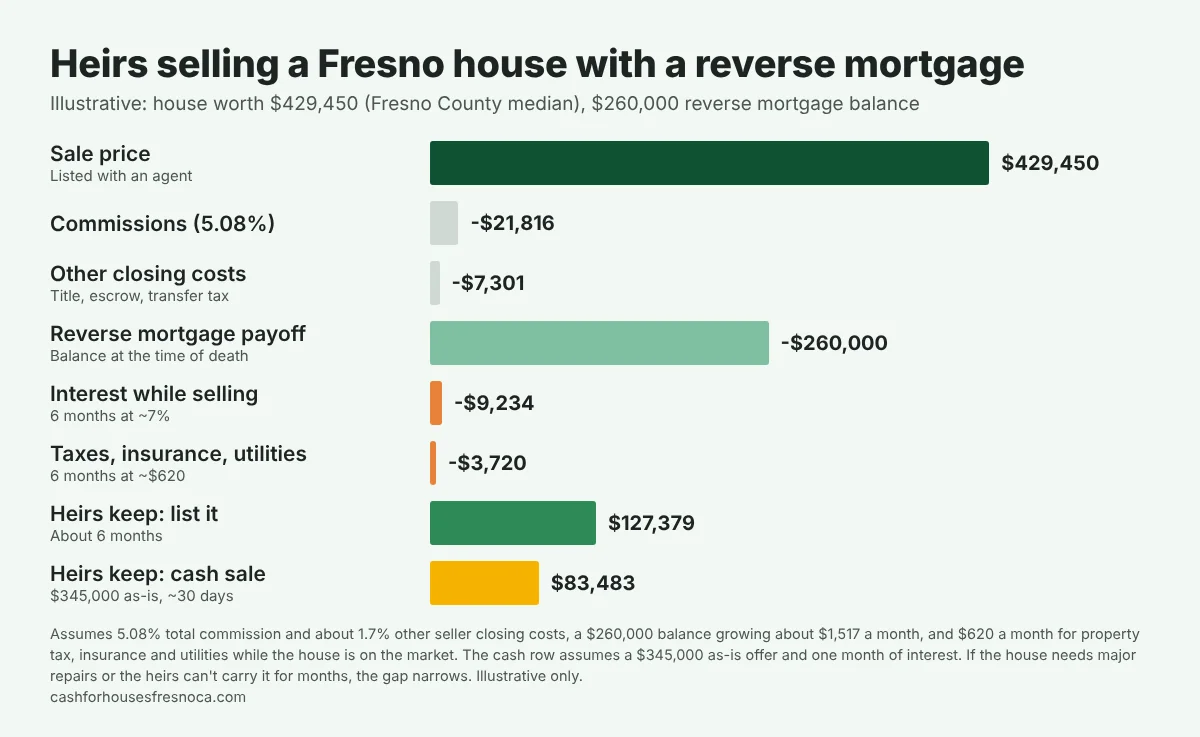
| Item | List with an agent | Cash sale as-is |
|---|---|---|
| Sale price | $429,450 | $345,000 |
| Commissions (5.08%) | -$21,816 | $0 |
| Other closing costs (~1.7%) | -$7,301 | Paid by buyer |
| Reverse mortgage balance | -$260,000 | -$260,000 |
| Interest and FHA premium while selling | -$9,234 (6 months) | -$1,517 (1 month) |
| Taxes, insurance, utilities | -$3,720 (6 months) | Included |
| Heirs keep | $127,379 | $83,483 |
The commission rate is Clever's August 2026 figure, as used in our breakdown of how much it costs to sell a house. The balance grows about $1,517 a month at an assumed 7% (interest plus the FHA premium), and we assume $620 a month for property tax, insurance and utilities on a vacant house.
The honest read: if the house is in good shape and the family can handle a six-month sale, listing usually leaves more for the heirs. The gap shrinks fast when the house needs a new roof, a cleanout or foundation work, when probate drags out and the interest keeps running, or when the heirs live out of state and can't manage a vacant house. That's when a quick as-is sale starts to make sense. Heirs also usually get a stepped-up tax basis on an inherited house, so a sale soon after death often brings little or no capital gains tax. See our guide to capital gains tax in California. If someone in the family wants to keep the house instead, read our Prop 19 guide first, because the property tax may be reassessed.
How to sell a house with a reverse mortgage in 7 steps
- Call the servicer right away, whether you're the owner planning a move or an heir. Heirs should send a death certificate and ask for the due date.
- Get the payoff statement and the per-day interest amount.
- Find out the value. Get an agent's opinion or an appraisal, and ask the servicer for any appraisal it orders.
- Decide: keep, sell or deed back. If the balance is above 95% of the value, there's no equity to protect, and a deed in lieu may be simplest.
- Get authority to sign. The owner signs while alive. After death, that's the successor trustee, the TOD beneficiary, or the court-appointed administrator in probate.
- Send proof of progress to the servicer and ask for extensions in writing before each deadline.
- Close through escrow, which pays the servicer, records the reconveyance and sends the rest to you or the estate.
For the full seller-side cost picture, see our guide to seller closing costs in Fresno.
When selling a house with a reverse mortgage for cash makes sense
A reverse mortgage alone isn't a reason to sell for cash. A cash sale tends to make sense when:
- The servicer's deadline is close and a listing won't close in time.
- The house needs work. Reverse mortgage homes are often older homes where the owner aged in place, with deferred repairs and a lifetime of belongings. See our guide to selling a hoarder house.
- The equity is thin. Every month of interest and holding costs comes straight out of what's left.
- The heirs are out of town or disagree, and nobody wants to manage a vacant house for months.
- The owner is moving to care and needs the money and the certainty of a closing date.
When you sell to us, we buy the house as-is, with whatever's still inside. We work with escrow and the servicer on the payoff, pay the closing costs, charge no commissions and can close in as little as 7 days or on the date you pick. If listing would put more in your family's pocket, I'll tell you that too.
Get an all-cash offer on a house with a reverse mortgage
Tell us about the property and the servicer's deadline. We'll send a no-obligation all-cash offer, coordinate the payoff with escrow, and you can close in as little as 7 days.
We buy houses with reverse mortgages in Fresno, Clovis, Madera, Visalia, Hanford and across the Central Valley. You can read more about me and how we work, or contact us any time.
Need to settle a reverse mortgage fast?
Call or text (559) 512-6998 for an all-cash, as-is offer. We handle the payoff with escrow, pay the closing costs, and you can close in as little as 7 days.
Call (559) 512-6998Get My All-Cash OfferFAQ: selling a house with a reverse mortgage
Can you sell a house with a reverse mortgage?
Yes. The owner can sell at any time, and heirs can sell after the owner dies. Escrow pays off the reverse mortgage balance from the sale, and whatever is left goes to the seller or the estate. FHA-insured HECMs have no prepayment penalty.
What happens to a reverse mortgage when the owner dies?
The loan becomes due and payable once the last borrower and any eligible non-borrowing spouse have died. The heirs can pay it off and keep the house, sell the house, or give it back to the lender with a deed in lieu of foreclosure. Property taxes and insurance remain the estate's responsibility until title transfers.
How long do heirs have to sell a house with a reverse mortgage?
HUD says the loan must be satisfied within 30 days of the borrower's death, but lenders may approve 90-day extensions when heirs document that they're actively selling or refinancing. In practice, families who stay in contact often get around six months, and up to about a year with extensions.
Do heirs have to pay back a reverse mortgage if the house is worth less than the loan?
No. A HECM is non-recourse. Heirs can sell the house for at least 95% of its current appraised value and the lender accepts the net proceeds as full payment, even if the balance is higher. FHA insurance covers the difference. Heirs can also hand the house back with a deed in lieu.
What is the 95% rule for reverse mortgages?
It's HUD's rule that heirs can satisfy an FHA-insured reverse mortgage by selling the home, or buying it themselves, for at least 95% of the current appraised value, even when the loan balance is higher.
Can the surviving spouse stay in the house?
If the spouse was a co-borrower, yes, the loan simply continues. If they weren't on the loan but qualify as an eligible non-borrowing spouse under HUD's rules, they can usually stay as long as they keep paying property taxes, insurance and upkeep, though the loan stops paying out.
Can I sell my house with a reverse mortgage and move into assisted living?
Yes. You can sell whenever you want. Be aware that the loan can come due if you live outside the home for more than 12 consecutive months in a health care facility and no co-borrower lives there, so plan the sale with your servicer before or soon after you move.
Do you buy houses with reverse mortgages in Fresno?
Yes. We buy houses with reverse mortgages from owners and heirs across Fresno and the Central Valley, as-is. Call or text (559) 512-6998 for an all-cash offer. We pay closing costs, there are no commissions, and we coordinate the payoff with escrow.
Sources and how to cite this guide
- HUD: Inheriting a Home Secured by an FHA-insured Reverse Mortgage (opens in a new tab) (30 days, 95% rule, 90-day extensions); 2026 FHA and HECM loan limits (opens in a new tab) ($1,249,125); Mortgagee Letter 2017-12 (opens in a new tab) (2% initial, 0.5% annual MIP).
- Regulation: 24 CFR 206.125 (opens in a new tab) (sale, foreclosure timing, deed in lieu).
- Consumer guidance: CFPB, When do I have to pay back a reverse mortgage? (opens in a new tab); MyHECM, reverse mortgage after death (opens in a new tab).
- Data: C.A.R. September 2026 sales report (opens in a new tab) (Fresno County median price).
- Photos: hands on piano keys (rawpixel, CC0); portrait by Paul Strand (1916) and totara tree by Leslie Adkin, both public domain (CC0) via rawpixel. None show our clients or their homes.
Sharing this data? You're welcome to use the balance growth chart and the Fresno heirs example. Please credit "Cash For Houses Fresno" and link back to this page.