Can you sell a house with tenants in it? Yes. In California, selling a house with tenants is legal and common. The lease doesn't end when the house changes hands. The buyer becomes the new landlord, takes over the security deposit and has to honor the lease. What you can't do is treat the sale itself as a reason to make the tenants leave.
I'm Christian Castro, a licensed California realtor (DRE #02195959) and the owner of Cash For Houses Fresno. Rentals are a big part of what we see here: only about half of homes in the city of Fresno are owner-occupied (50.1%, according to the U.S. Census Bureau (opens in a new tab)), so a lot of sellers have a tenant in the house when they decide it's time. This guide covers selling a house with tenants in California: what happens to the lease, the just-cause and notice rules, what to do about showings and the deposit, the tax side, and a Fresno example comparing three ways to sell. It's general information, not legal or tax advice.
The short answer
- The lease survives the sale. A fixed-term lease runs to its end date under the new owner, and a month-to-month tenancy carries over too. See what happens to the lease.
- Selling isn't a "just cause" to end a tenancy under California's Tenant Protection Act once a tenant has been there 12 months, unless the house is exempt. See the Tenant Protection Act.
- Notice rules still apply: 24 hours' written notice for showings, and 30, 60 or 90 days to end a month-to-month tenancy when you're allowed to. See notice periods.
- You have three realistic options: get the house vacant and list it, list it with the tenant in place, or sell to a cash buyer with the lease intact. See the Fresno comparison.
- Vacant usually sells for the most when the tenant leaves on good terms. Selling occupied wins when the tenant won't or can't leave, or when the house needs work.
What happens to the lease when you sell a house with tenants
A sale transfers the house, and the tenancy comes along with it. The buyer "steps into your shoes" as landlord. What that means in practice depends on the kind of tenancy:
- Fixed-term lease (say, a 12-month lease ending next June): the buyer has to honor it until it ends, at the same rent and terms. Neither you nor the buyer can end it early just because the house sold. If the tenant agrees to leave early, put it in writing.
- Month-to-month tenancy: it also continues. Ending it takes proper written notice, and for most long-term tenants, a just cause under state law (more on that below).
- No written lease: a tenant who pays rent without a written lease is usually month-to-month. Their rights don't disappear because the paperwork is missing.
That's why "selling a house with tenants" really means one of two things: selling to someone who's happy to keep the tenant (usually an investor), or finding a lawful way to get the house vacant first. Both are legal. What isn't legal is pressuring a tenant out, changing the locks, or cutting off utilities to empty the house. California treats those as illegal self-help evictions, with penalties of up to $100 a day (Civil Code 789.3 (opens in a new tab)). If a tenant has stopped paying or broken the lease, the legal route is a court eviction. Our guide to how to evict a tenant in California walks through it step by step.
The Tenant Protection Act: just cause, relocation and rent caps
Most California rentals are covered by the Tenant Protection Act of 2019 (often called AB 1482). It does three things that matter when you're selling a house with tenants.
1. Just cause after 12 months
Once a tenant has lawfully lived there for 12 months, Civil Code 1946.2 (opens in a new tab) says the landlord needs a "just cause" listed in the law to end the tenancy. The California Courts self-help center (opens in a new tab) sums up the two kinds:
- At-fault: not paying rent, breaking the lease, illegal activity, serious damage.
- No-fault: the owner or a close family member moving in, taking the unit off the rental market, a substantial remodel or demolition, or complying with a government order.
"I'm selling the house" is not on either list. But a no-fault reason can come up as part of a sale. The most common is a buyer who wants to live in the house. Since SB 567 took effect on April 1, 2024, an owner move-in has strict rules: the owner or qualifying relative has to move in within 90 days after the tenant leaves and live there for at least 12 months, according to the California Apartment Association (opens in a new tab). A buyer can't use it as a pretext to empty the house and flip it.
2. Relocation money for no-fault endings
When a tenancy ends for a no-fault reason, the landlord has to pay relocation assistance equal to one month's rent, or waive the last month's rent instead. The notice has to say which one. Getting this wrong can sink the whole termination.
3. A cap on rent increases
Covered units can't go up more than 5% plus inflation, or 10%, whichever is lower, in any 12 months. Fresno isn't one of the big metro areas with its own index, so it uses the statewide CPI; industry trackers such as Steadily (opens in a new tab) put that cap at 8.6% for increases taking effect on or after August 1, 2026. This matters for a sale because a buyer who's pricing the house as a rental can't assume they'll raise a below-market rent to market overnight.
Who's exempt
A single-family home or condo can be exempt from both the just-cause and rent-cap rules if it isn't owned by a REIT, a corporation or an LLC with a corporate member, and the lease includes the specific written exemption notice the law requires. The California Attorney General's guide (opens in a new tab) is clear that the notice is what makes the exemption work. No notice, no exemption. Units built within the last 15 years are also exempt from the rent cap. Check your lease before you assume anything. Fresno doesn't have its own rent control or just-cause ordinance on top of the state law, but the state rules apply here in full.
Notice periods when selling a house with tenants
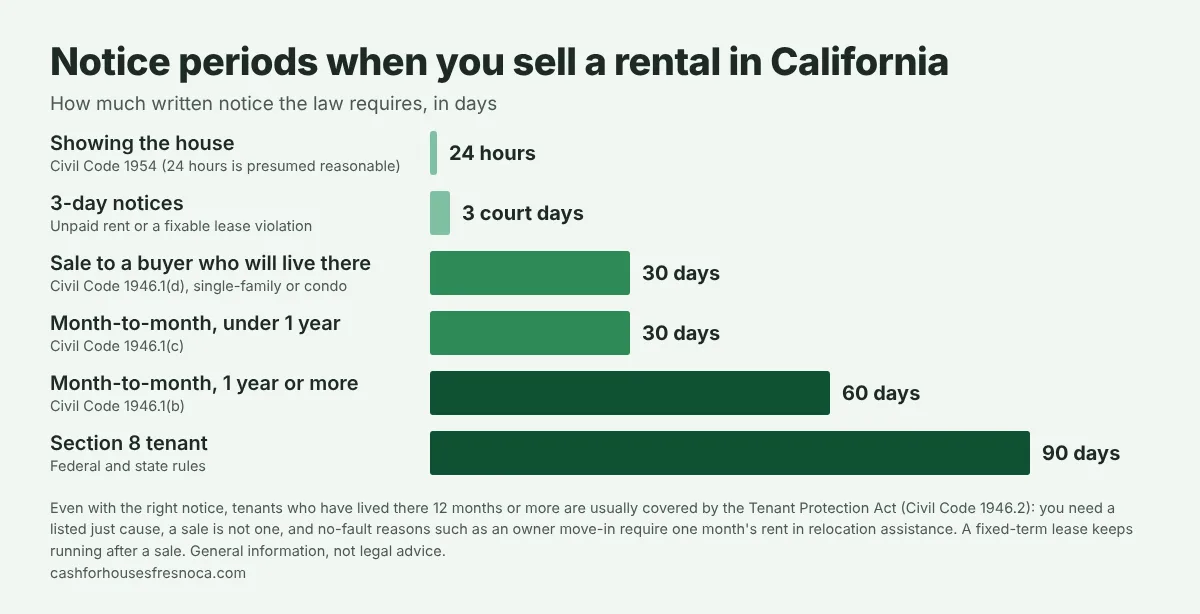
Under Civil Code 1946.1 (opens in a new tab), ending a month-to-month tenancy takes 60 days' written notice if the tenant has lived there a year or more, and 30 days if less than a year. Section 8 tenants get 90 days.
There's one sale-specific rule that a lot of landlords have heard about: subdivision (d) allows a 30-day notice instead of 60 when all of these are true:
- The house (or condo) can be sold separately from any other unit.
- You've signed a contract to sell it to a buyer, and escrow is open.
- The buyer is one or more people, not a company, and in good faith intends to live there for at least a full year after the tenancy ends.
- The notice goes out within 120 days of opening escrow, and you haven't already given a notice under this section.
The catch: that rule only shortens the notice period. If the tenant is covered by the Tenant Protection Act, you still need a just cause, which in this case is the buyer's owner move-in, with the relocation payment and SB 567's requirements. For an exempt house, the 30-day sale notice can work on its own. This is exactly the kind of situation where an hour with a landlord-tenant attorney is cheap insurance.
Showings, inspections and appraisals with tenants inside
You can show an occupied house to buyers, but only on the tenant's terms set by law. Civil Code 1954 (opens in a new tab) lets a landlord enter to show the property to prospective buyers during normal business hours after reasonable written notice, and 24 hours is presumed reasonable. Every showing, inspection and appraisal is another notice.
In real life, how a listing goes with tenants inside depends on the tenants. Here's what helps:
- Tell them early and honestly. Explain that the lease stays in place, who will contact them, and how showings will work.
- Bundle the visits. A couple of set showing windows a week beats a dozen one-off entries.
- Offer something for the hassle: a rent credit for each showing, or a cleaning service before photos. It's cheaper than a tenant who stops cooperating.
- Don't post the inside of their home online without permission. Many agents use exterior photos only for an occupied rental.
Lenders add another wrinkle. A buyer using a loan will need an appraisal, and some loan programs want to see the house in decent condition. If the tenant hasn't kept it up, an occupied listing can stall at the appraisal or inspection. That's one reason rentals with long-term tenants often end up selling to investors, who are buying the rent anyway.

The security deposit, prorated rent and estoppel letters
When you sell, the security deposit has to go somewhere. Under Civil Code 1950.5 (opens in a new tab), you either transfer it to the buyer and notify the tenant in writing with the new owner's name, address and phone number, or return it to the tenant less any lawful deductions. In practice escrow handles this: the deposit shows up as a credit to the buyer on the settlement statement. Since July 1, 2024 (AB 12), most landlords can't collect more than one month's rent as a deposit, so if an older lease has a bigger one on file, expect the buyer to ask about it.
Rent is prorated to the closing date. If the tenant has paid November's rent and you close on November 15, you keep about half and the buyer gets credited the rest. If the tenant is behind, you and the buyer negotiate who gets the back rent. Our guide to seller closing costs in Fresno shows where these items land on the closing statement.
Buyers of rentals often ask for a tenant estoppel certificate: a short form, signed by the tenant, confirming the rent, the deposit, the lease dates and that there are no side deals. It protects the buyer from surprises like a promised rent discount you forgot to mention. Ask your tenant early. A tenant who won't sign one is a warning sign for buyers.
Selling a rental with a tenant you'd rather not deal with?
Call or text (559) 512-6998. We buy Fresno rentals with the tenant and lease in place, as-is, for all cash, and can close in as little as 7 days.
Call (559) 512-6998Get My All-Cash OfferFresno example: three ways to sell a rented house
Here's how the numbers can shake out. Say you own a rented house worth $429,450, the Fresno County median in the C.A.R. September 2026 sales report (opens in a new tab), and the tenant pays $1,950 a month.
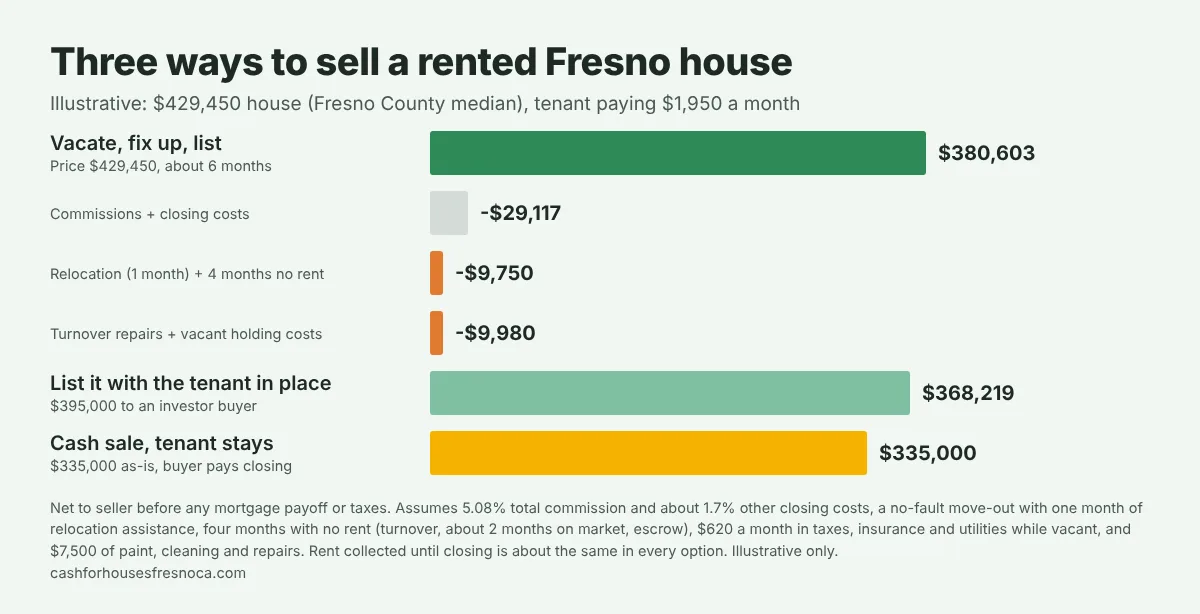
| Item | Vacate, fix up, list | List with tenant in place | Cash sale, tenant stays |
|---|---|---|---|
| Sale price | $429,450 | $395,000 | $335,000 |
| Commissions (5.08%) | -$21,816 | -$20,066 | $0 |
| Other closing costs (~1.7%) | -$7,301 | -$6,715 | Paid by buyer |
| Relocation assistance (1 month) | -$1,950 | $0 | $0 |
| Lost rent (4 months vacant) | -$7,800 | $0 | $0 |
| Taxes, insurance, utilities while vacant | -$2,480 | $0 | $0 |
| Paint, cleaning, turnover repairs | -$7,500 | $0 | $0 |
| Net to you | $380,603 | $368,219 | $335,000 |
| Typical time | About 6 months | 2 to 4 months | As little as 7 days |
The commission rate is Clever's August 2026 figure, as used in our breakdown of how much it costs to sell a house. The four vacant months cover turnover, roughly two months on the market (see how long it takes to sell a house) and escrow. The investor price is an assumption: investors pricing a rental usually pay less than an owner-occupant would, because they're buying the rent, not the house.
The honest read: if your tenant is willing to leave on good terms and the house only needs light work, getting it vacant and listing it usually puts the most in your pocket. The picture changes quickly when:
- The tenant is protected by just cause and there's no lawful reason to end the tenancy.
- The tenant isn't paying, and the alternative is an eviction that can take two to three months and cost thousands.
- The house needs a lot more than $7,500 of work after the tenant leaves. Long-term rentals often have code violations or deferred repairs.
- You live out of town, or you're done being a landlord and don't want to manage a vacancy, a remodel and a listing.
Cash for keys: paying a tenant to move
"Cash for keys" is a voluntary agreement where you pay the tenant to move out by a set date. It's legal in California when it's truly voluntary, and it's often faster and cheaper than an eviction. A few rules of thumb:
- Put it in writing: the amount, the move-out date, the condition you expect, what happens to the deposit, and that the payment is made when the keys are handed over.
- Make it worth their while. Moving costs real money. Offers often start around the deposit back plus one to two months' rent, but the right number depends on the tenant and the local rental market. In Fresno, the median gross rent was $1,421 in the Census Bureau's 2020-2024 estimates, and a single-family house usually rents for more.
- Don't pressure or threaten. The tenant can say no. If the offer comes with threats of eviction you can't actually bring, it can turn into a harassment or retaliation claim.
- Get advice on the release language. A short attorney review of the agreement is worth it.
Taxes when you sell a rental
A rental doesn't get the home-sale exclusion of $250,000 (single) or $500,000 (married) unless you also lived in it as your main home for two of the last five years. Past depreciation is "recaptured" and taxed federally at up to 25%, and California taxes the whole gain as regular income. Our guide to capital gains tax in California runs a Fresno rental example.
If you want to keep investing, a 1031 exchange can defer the tax by rolling the proceeds into another rental. The deadlines are strict (45 days to identify, 180 to close), so line up a qualified intermediary before you close. A CPA can tell you which route saves more.
Selling a house with tenants in 8 steps
- Pull your paperwork: the lease and any addenda, the rent ledger, the deposit amount, and any notices you've served or received.
- Figure out the tenancy: fixed-term or month-to-month, how long they've lived there, and whether the house is covered by the Tenant Protection Act or properly exempt.
- Decide your route: sell with the tenant in place, wait for the lease to end, or negotiate a move-out.
- Run the numbers for each route, like the Fresno example above, including vacancy, repairs and time.
- Talk to the tenant. Tell them what's happening and what isn't changing. Ask about an estoppel certificate.
- Give written notice for every showing, inspection or appraisal (24 hours is presumed reasonable).
- Open escrow and give the escrow officer the lease, the deposit amount and the rent status so they can prorate and credit correctly.
- After closing, make sure the tenant gets written notice of the new owner and where to pay rent, and that the deposit transfer is documented.
When selling a house with tenants for cash makes sense
Having a tenant isn't by itself a reason to take a lower cash price. A cash sale with the tenant in place tends to make sense when:
- The tenant isn't paying and you'd rather not spend two or three months and several thousand dollars on an eviction.
- The tenant is protected by just cause and has no plans to leave.
- The house needs real work that you don't want to fund or manage.
- You inherited it with tenants and nobody in the family wants to be a landlord. See our guide to selling an inherited house in Fresno.
- You're a tired landlord with one rental or several. See how we help tired landlords in Fresno.
When you sell to us, we buy the house with the tenant and lease in place. One walk-through with proper notice, no repeated showings, no repairs, no commissions, and we pay the closing costs. Escrow credits us the deposit and prorates the rent, and we take over the tenant relationship after closing. You can read more on our page about how we buy houses with tenants in Fresno. And because I'm also a licensed realtor, if listing would clearly net you more, I'll tell you that.
Get an all-cash offer on your rental, tenants and all
Tell us about the property and the lease. You don't need to tell your tenant to get an offer. We'll send a no-obligation all-cash offer, and you can close in as little as 7 days.
We buy tenant-occupied houses in Fresno, Clovis, Madera, Visalia, Hanford, Selma and across the Central Valley. You can read more about me and how we work, or contact us any time.
FAQ: selling a house with tenants
Can you sell a house with tenants in California?
Yes. The sale doesn't end the lease. The buyer becomes the new landlord, takes over the security deposit and has to honor the lease terms. Month-to-month tenancies carry over too, and ending one still takes proper notice and, for most long-term tenants, a just cause.
Can I make my tenant leave because I'm selling?
Usually not. Under California's Tenant Protection Act, a sale isn't a just cause to end a tenancy for a tenant who's lived there 12 months or more. A buyer who will move in may be able to use the owner move-in cause, with one month's rent in relocation assistance and SB 567's rules. Exempt single-family homes, short tenancies and voluntary move-out agreements work differently.
How much notice do I give a tenant when selling the house?
For showings, reasonable written notice, and 24 hours is presumed reasonable. To end a month-to-month tenancy, 60 days if the tenant has been there a year or more and 30 days if less, or 90 days for Section 8. A special 30-day notice can apply when a single-family home or condo is sold to a person who will live there, but tenants covered by the Tenant Protection Act still need a just cause.
Does a fixed-term lease end when the house is sold?
No. The new owner has to honor a fixed-term lease until it ends, at the same rent and terms. The tenant can agree to leave early, usually in exchange for money or other help, but they don't have to.
What happens to the security deposit when a rental is sold?
Under Civil Code 1950.5, the seller either transfers the deposit to the buyer and notifies the tenant in writing with the new owner's contact information, or returns it to the tenant minus lawful deductions. Escrow normally credits the deposit to the buyer at closing.
Is it better to sell a rental vacant or occupied?
Vacant usually brings a higher price, because owner-occupant buyers and their lenders can get in. But getting a house vacant costs lost rent, relocation money, turnover repairs and time, and it may not be legally possible if the tenant is protected. Run the numbers both ways before you decide.
What is cash for keys?
A voluntary written agreement where the landlord pays the tenant to move out by a set date, often with the deposit returned. It can be faster and cheaper than an eviction, but the tenant can say no, so it has to be a real offer, not pressure.
Do you buy houses with tenants in Fresno?
Yes. We buy rental houses and small multifamily properties across Fresno and the Central Valley with the tenant and lease in place, as-is. Call or text (559) 512-6998 for an all-cash offer. We pay the closing costs and there are no commissions.
Sources and how to cite this guide
- California law: Civil Code 1946.2 (opens in a new tab) (Tenant Protection Act, just cause and relocation); Civil Code 1946.1 (opens in a new tab) (30, 60 and sale-related 30-day notices); Civil Code 1954 (opens in a new tab) (entry for showings); Civil Code 1950.5 (opens in a new tab) (security deposits); Civil Code 789.3 (opens in a new tab) (self-help evictions).
- Official guidance: California Attorney General, Tenant Protection Act guide for landlords (opens in a new tab); California Courts, types of eviction notices (opens in a new tab).
- Industry: California Apartment Association on SB 567 (opens in a new tab); Steadily, 2026 rent cap figures (opens in a new tab).
- Data: U.S. Census Bureau QuickFacts, Fresno city (opens in a new tab) (50.1% owner-occupied, $1,421 median gross rent, 2020-2024); C.A.R. September 2026 sales report (opens in a new tab) (Fresno County median price).
- Photos: apartment facade with blinds (rawpixel, CC0); "Evening Breeze" by Asahachi Kono, public domain (CC0) via rawpixel. Neither shows our clients or their homes.
Sharing this data? You're welcome to use the notice-period chart and the Fresno three-ways comparison. Please credit "Cash For Houses Fresno" and link back to this page.